
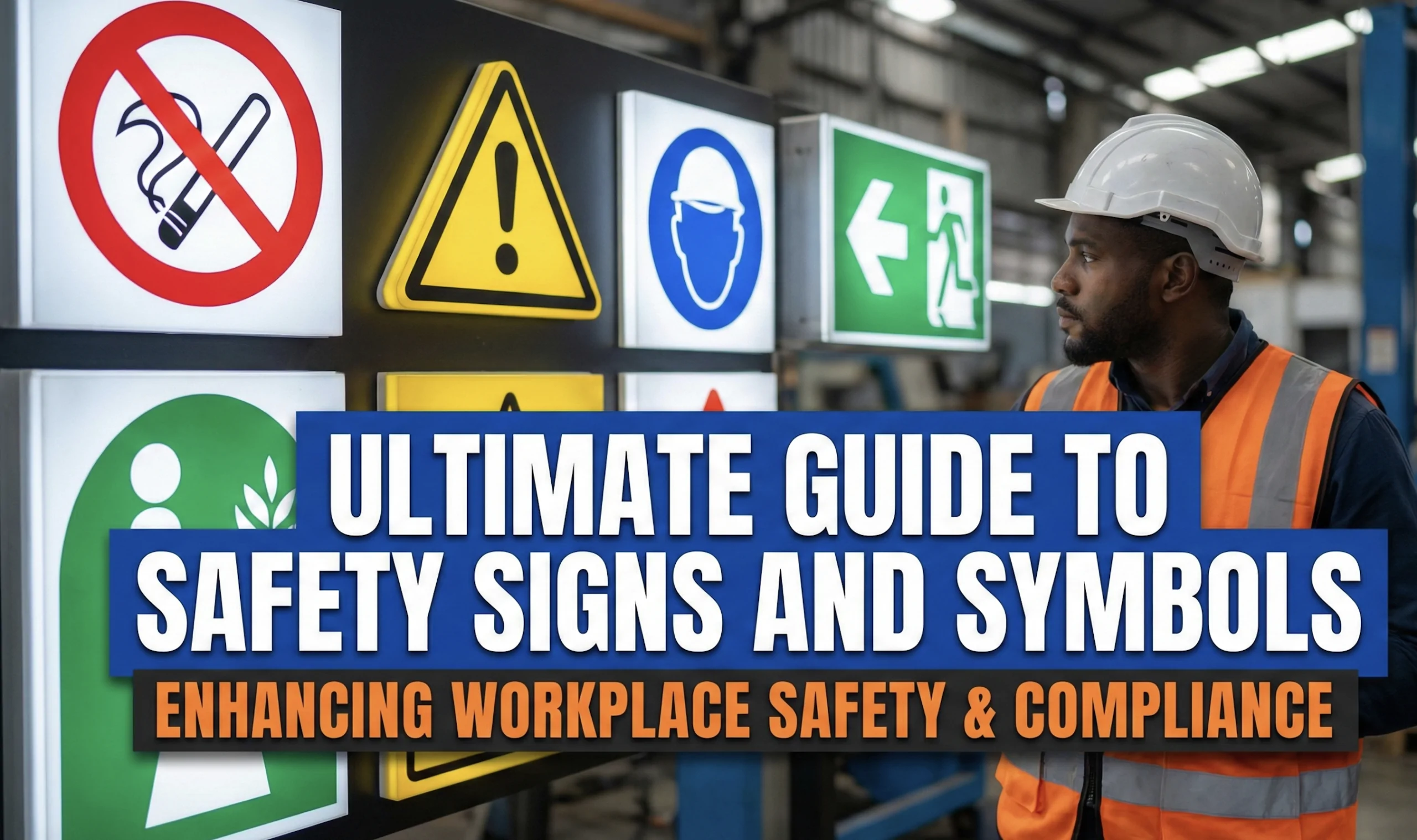
Safety Sign and Symbols
In any high-risk environment – from a bustling construction site to a clinical laboratory – communication is the first line of defense. But when seconds count or language barriers exist, words aren’t always enough. This is where safety signs and symbols come in.
Universal, standardized, and immediately recognizable, these visual cues are silent guardians that prevent accidents before they happen. In this guide, we will break down the categories, colors, and meanings of the most common safety signs to help you stay compliant and, most importantly, keep your team safe.
Five Main Categories of Safety Signage
To maintain order and clarity, safety signs are categorized into five distinct groups, each defined by a specific color and shape according to international standards such as ISO 7010, HSE, or OSHA.
Prohibition Signs (“Do Not” Signs)
- Appearance: Red circle with a diagonal crossbar over a black symbol.
- Meaning: These indicate actions that are strictly forbidden to prevent danger.
- Common Examples: No Smoking, No Entry, Do Not Touch.
Mandatory Signs (“Must Do” Signs)
- Appearance: Solid blue circle with a white symbol.
- Meaning: These tell you that a specific action is required to stay safe.
- Common Examples: Wear Eye Protection, Hard Hat Area, Wash Your Hands.
Warning Signs (“Be Aware” Signs)
- Appearance: Yellow triangle with a black border and symbol.
- Meaning: These alert you to potential hazards or dangers in the vicinity.
- Common Examples: High Voltage, Slippery Surface, Flammable Material.
Safe Condition Signs (“Follow Me” Signs)
- Appearance: Green rectangle or square with a white symbol.
- Meaning: These point you toward safety, equipment, or exit routes during an emergency.
- Common Examples: Emergency Exit, First Aid Kit, Assembly Point.
Fire Safety Signs (“Equipment” Signs)
- Appearance: Red rectangle or square with a white symbol.
- Meaning: Used specifically to identify the location of fire-fighting equipment.
- Common Examples: Fire Extinguisher, Fire Hose Reel, Fire Alarm Call Point.
Specialized Industry Symbols
Beyond general facility signs, certain industries require specialized icons.
Laboratory and Chemical Safety (GHS Pictograms)
In a lab, symbols like the Skull and Crossbones (Acute Toxicity) or the Exploding Bomb (Unstable Explosives) are critical. Other key lab symbols include:
- Biohazard: Indicates infectious agents or biological waste.
- Oxidizing: A flame over a circle, indicating chemicals that can cause other materials to burn.
- Corrosive: A hand or surface being etched by a liquid.
Electrical Safety
Electrical hazards are often invisible. Signs featuring a lightning bolt signify high voltage or risk of electric shock. These are often paired with “Danger” headers to emphasize the life-threatening nature of the hazard.
Why Are Safety Signs Important?
According to industry experts, safety signage serves four critical functions:
- Accident Prevention: By identifying hazards like wet floors or moving machinery, signs drastically reduce the frequency of “struck-by” and “slip-and-fall” incidents.
- Emergency Response: In the heat of a crisis, people often panic. Clear, photoluminescent (glow-in-the-dark) signs provide a calm, visual roadmap to safety.
- Legal Compliance: Failing to display proper signage isn’t just dangerous – it’s expensive. Regulatory agencies can issue heavy fines for missing or non-compliant signs.
- Universal Communication: In diverse workplaces, symbols bypass language barriers, ensuring every worker understands the risks regardless of their native tongue.
Best Practices for Implementing Safety Signs
- Placement: Place signs at eye level and in the immediate vicinity of the hazard. Ensure they are not obstructed by doors or equipment.
- Simplicity: Use minimal text. The symbol should convey the message at a glance.
- Maintenance: A faded or dirty sign is ineffective. Regularly inspect signage for visibility and replace any that are damaged or illegible.
- Signage Fatigue: Do not over-saturate a small area with signs. If a wall is covered in too many symbols, workers may stop noticing them. Only use signs where there is a significant risk that cannot be controlled by other means.
CONTACT US
- Message Us on Facebook: https://www.facebook.com/rbsublimationsignage
- Call/Text: +639460480491