
World Athletics Track and Field Discipline Guide

Discus Throw: Rules, World Records, Equipment & Field Mechanics

An authoritative technical guide covering official World Athletics equipment dimensions, the 2.50 meter concrete throwing circle, ground sector geometry, kinetic chain rotational biomechanics, the historic 74.35 meter world record, and athletic uniform manufacturing for school and provincial delegations in Tagum City.

Discus thrower in athletic stance holding a regulation discus inside the throwing circle
Official World Athletics discus throw event: athletes generate rotational velocity across a recessed 2.50 meter circle enclosed by a heavy duty protective safety cage.

Sport Heritage

Ancient Greek Origins to Modern Olympic Competition

The discus throw is one of humanity's oldest organized athletic disciplines, demonstrating an extraordinary synthesis of rotational physics, explosive muscular power, and refined kinetic timing.

Classical Antiquity & The Pentathlon

Documented in Homer's Iliad and celebrated in 8th century BC Greek literature, discus throwing was incorporated into the Ancient Olympic Games in 708 BC as the pivotal fourth discipline of the classical pentathlon. Ancient competitors threw circular slabs carved from bronze, stone, or iron from a raised pedestal called the balbis.

The iconic fifth century BC bronze sculpture Discobolus by Myron captured the coiled tension and aesthetic balance of the ancient thrower, establishing a universal symbol of athletic harmony that endures across international sports iconography.

Modern Olympic Rebirth & Standardization

The modern discus throw was revived during the inaugural 1896 Olympic Games in Athens, Greece for male athletes. Women's discus competition joined the official Olympic program at the 1928 Amsterdam Olympic Games, making it the very first women's track and field event contested in Olympic history.

Early twentieth century competitors threw with a restricted linear rock step until throwers revolutionized the event by adopting a full 1.5 revolution rotational spin across the circle, dramatically accelerating rim speed and transforming discus into an aerodynamic science governed globally by World Athletics.

Technical Parameters

World Athletics Discus Specifications by Age & Division

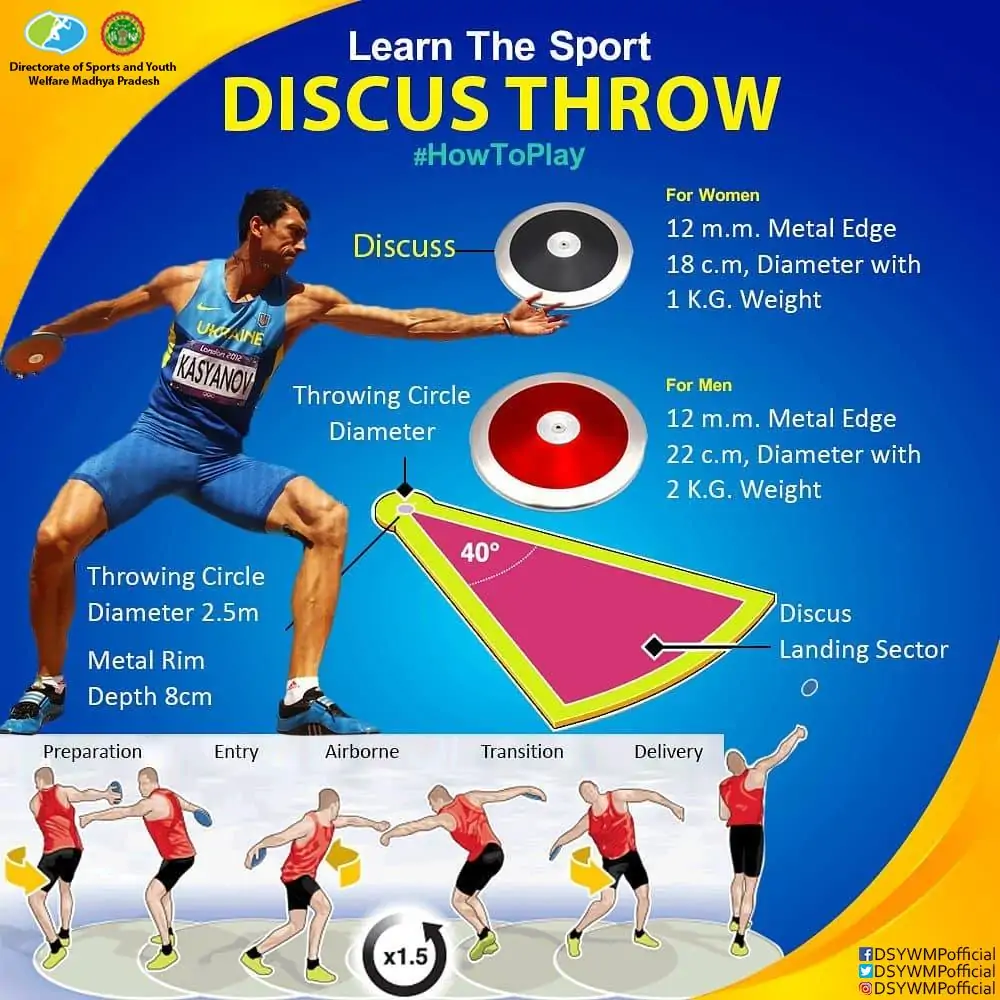
Official World Athletics competition rules mandate rigorous tolerances for implement weight, outer diameter, center thickness, and rim edge geometry to ensure fair competition worldwide.

Competition CategoryImplement WeightOuter DiameterCenter ThicknessRim Edge Radius
Senior Men & Under 232.000 kg to 2.025 kg219 mm to 221 mm44 mm to 46 mm6.0 mm (smooth circular metal)
Under 20 Men (Junior)1.750 kg to 1.775 kg210 mm to 212 mm41 mm to 43 mm6.0 mm
Under 18 Boys (Youth)1.500 kg to 1.525 kg200 mm to 202 mm38 mm to 40 mm6.0 mm
Senior & Under 20 Women1.000 kg to 1.025 kg180 mm to 182 mm37 mm to 39 mm6.0 mm
Under 18 & Under 16 Girls1.000 kg to 1.025 kg180 mm to 182 mm37 mm to 39 mm6.0 mm
Elementary School (DepEd Philippines)750 grams to 1.000 kg165 mm to 180 mm32 mm to 37 mm6.0 mm

Rim Weight Percentage & Gyroscopic Spin

A competition discus consists of a solid wooden, plastic, or composite fiberglass body encased in a smooth steel or brass rim. Elite throwers select high rim weight discs, where 75% to 85% of the total implement mass is concentrated in the outer rim.

Higher rim mass creates substantial rotational inertia (gyroscopic stability), preventing the discus from wobbling or turning over in turbulent crosswinds and maintaining an optimal angle of attack over long flights.

Center Weighted Training Implements

Beginner throwers, youth learners, and school competitors typically utilize center weighted rubber or wood composite discuses (50% to 65% rim weight). These implements are more forgiving during imperfect finger releases, allowing developing throwers to build technical muscle memory without severe flight stalling.

Facility Architecture

The 2.50 Meter Circle & Protective Cage Engineering

The discus throwing circle provides the standardized launch platform, engineered to strict friction and elevation standards to protect athletes from slips while providing maximum rotational traction.

2.500 Meter Throwing Ring

The interior of the circle measures exactly 2.500 meters (plus or minus 5 millimeters) in diameter. The rim is fabricated from 6 millimeter thick galvanized steel or iron, coated in weather resistant white paint, with the top edge flush with the surrounding ground.

The throwing surface within the ring is recessed 20 millimeters (plus or minus 6 millimeters) below the top of the metal rim, crafted from non slip brushed concrete or certified synthetic polyurethane composite.

750 Millimeter Boundary Lines

Two white lines, 50 millimeters wide and at least 750 millimeters long, extend perpendicularly from the outer edge of the metal rim on both sides. These lines demarcate the front and rear halves of the circle.

To avoid a foul, the athlete must exit the circle completely from the rear half, strictly behind these painted boundary markings, and only after the implement has made initial contact with the landing ground.

Protective U Shaped Safety Cage

Because an errant two kilogram discus traveling at 25 meters per second (90 km/h) presents severe risk to field officials and spectators, modern facilities enclose the circle within a heavy duty safety cage.

The cage stands at least 4.0 meters tall (often 7.0 meters in Olympic facilities) with movable front screening panels (gates) adjusted for left handed and right handed throwers, capable of halting implements without dangerous rebounds.

Field Marking Geometry

Ground Sector Marking: The 34.92 Degree Sector & 0.60 Chord Formula

Laying out the discus landing field requires precise trigonometry. Under World Athletics Technical Rule 34, the throwing sector forms an interior angle of exactly 34.92 degrees radiating from the theoretical center point of the 2.50 meter circle.

The Ground Marking Chord Ratio (0.60 Multiplier)

For groundskeepers, coaches, and sports officials marking an athletic field, measuring the exact 34.92 degree angle is simplified by the geometric chord formula: Chord Distance = 2 × Radius × sin(17.46°) ≈ 0.60 × Radius. At any given distance from the circle center along the boundary lines, the cross field distance between the inner edges of the two sector lines equals exactly 60 percent of that distance.

Distance from Circle Center (Radius)Cross Sector Chord Width (Between Inner Edges)Target Competition Level
20.00 Meters12.00 Meters (20 × 0.60)Elementary School & Para Athletes
30.00 Meters18.00 Meters (30 × 0.60)Junior High School Division Qualifiers
40.00 Meters24.00 Meters (40 × 0.60)Senior High School Provincial Meets
50.00 Meters30.00 Meters (50 × 0.60)Collegiate & Regional Athletic Associations
60.00 Meters36.00 Meters (60 × 0.60)National Championships & SEA Games
70.00 Meters42.00 Meters (70 × 0.60)Olympic Games & World Championships

Step by Step Field Layout Procedure

1. Drive a central marking peg into the exact geometric center point of the 2.50 meter circle.

2. Extend a tape measure directly through the midpoint of the cage opening down the center axis of the field to 70 meters.

3. At the 20 meter mark, measure 6.00 meters perpendicular to the left and 6.00 meters to the right, establishing an exact 12.00 meter cross chord.

4. Repeat at 50 meters with 15.00 meters on each side (30.00 meter chord total) to establish line alignment.

5. Paint boundary lines 50 millimeters wide in bright white or chalk. The discus must land completely within the inner edges of these lines.

Landing Surface Requirements

The landing sector must consist of natural grass, compacted turf, or soft cinder. Concrete, asphalt, and hard stones are prohibited, as the landing medium must clearly record the initial point of impact of the discus rim without damaging the implement or causing erratic bounces.

Movement Science

Kinetic Chain Rotational Biomechanics: 7 Key Throwing Phases

Throwing a discus over 70 meters requires an athlete to convert linear and angular momentum through a sequential kinetic chain, starting from ground reaction forces at the feet and culminating in a whip like finger release.

1

The Finger Pad Grip & Centrifugal Retention

The discus rests upon the distal phalanges (the fleshy pads of the first finger joints). The fingers spread naturally across the rim, with the index finger aligned along the intended release arc. The thumb lies flat against the upper plate for balance without gripping the outer edge. During preliminary swings and rotation, the implement is held securely against the palm purely by centrifugal force, never by finger clamping.

2

Starting Stance & Preliminary Windups

The athlete begins at the rear of the 2.50 meter circle with the back facing the landing field. Feet stand shoulder width or slightly wider, knees flexed, and the center of mass positioned low. The thrower executes one or two relaxed, wide pendulum swings to establish rhythm, widen the throwing arc, and maximize the stretch shortening cycle of the chest and shoulder musculature.

3

The Entry & Wide Right Leg Sweep

Weight shifts over the ball of the left foot as it pivots toward the center of the ring. The right leg sweeps wide around the outside perimeter. Sweeping the right leg wide increases the athlete's moment of inertia and builds substantial angular velocity. The upper body remains relaxed and passive, ensuring the throwing arm trails as far behind the pelvis as possible.

4

Non Support Flight & Active Center Touchdown

The left foot drives off the concrete, launching the thrower into a brief non support (airborne) flight phase across the center of the ring. The right foot touches down actively near the center of the circle on the ball of the foot, turned roughly 90 to 120 degrees relative to the throwing direction, continuing its rapid rotational pivot.

5

Power Position & Heel to Toe Alignment

The left foot plants rapidly near the front rim in a stable heel to toe alignment with the center right foot. Both feet are now in contact with the ground (double support phase). The pelvis is rotated forward, while the chest, shoulders, and trailing throwing arm are twisted backward, generating immense elastic torsional energy across the abdominal obliques and latissimus dorsi.

6

The Left Side Block & Aerodynamic Release

The right leg drives aggressively upward and forward, violently rotating the hips open toward the sector. The left leg and left arm lock into a rigid block, halting forward rotation on the left side. This abrupt deceleration transfers all stored rotational and kinetic energy directly into the throwing arm like a cracking whip. The discus peels off the index finger with clockwise spin (for right handers) at a 34 to 38 degree launch angle. Because the discus functions as an airfoil, throwing into a gentle headwind generates aerodynamic lift, adding extra distance.

7

The Reverse & Dynamic Center of Mass Recovery

Following release, the right leg hops forward to replace the left foot near the front rim. The athlete drops their hips, flexes the knees, and absorbs forward linear momentum. This recovery maneuver prevents the thrower from touching the top of the metal rim or stepping onto the ground outside the circle, ensuring a legal throw.

Historic Milestones

World Records & Historic Achievements in Modern Discus

From European throwing powerhouses to Philippine Para athletic champions, the discus record books reflect decades of technical evolution and historic physical feats.

Men World Record

Mykolas Alekna (Lithuania)

74.35 Meters

On April 14, 2024 at the Oklahoma Throws Series in Ramona, Oklahoma, Mykolas Alekna shattered the longest standing men's track and field world record in history (Jürgen Schult's 74.08 meter mark from 1986). His father, Virgilijus Alekna, was a two time Olympic champion, creating an unprecedented throwing dynasty.

Men Olympic Record

Rojé Stona (Jamaica)

70.00 Meters

At the 2024 Paris Olympic Games, Rojé Stona set an Olympic record of exactly 70.00 meters to capture the gold medal, breaking the previous Olympic record of 69.89 meters set by Virgilijus Alekna at the 2004 Athens Games.

Women World Record

Gabriele Reinsch (East Germany)

76.80 Meters

Set on July 9, 1988 in Neubrandenburg, Gabriele Reinsch's 76.80 meter throw remains the longest women's discus throw officially recognized by World Athletics, demonstrating the peak flight distances achievable with a one kilogram implement.

Modern Olympic Champion

Valarie Allman (USA)

71.46 Meters (PB)

Valarie Allman dominated the modern women's division by capturing back to back Olympic gold medals at Tokyo 2020 (68.98 m) and Paris 2024 (69.50 m), combining a background in competitive dance with elite throwing mechanics.

Philippine Para Champion

Jeanette Aceveda (Philippines)

20.01 Meters (PB)

A decorated Asian Para Games silver medalist and multi title ASEAN Para Games champion in the F11 classification for visually impaired athletes, Jeanette Aceveda represents the pinnacle of Filipino resilience and throwing dedication on the global stage.

Officiating Standards

World Athletics Competition Rules & Common Technical Fouls

Understanding officiating criteria prevents athletes from scratching legal throws during high stakes school, division, regional, and national championships.

Criteria for a Legal Competition Throw

1. The athlete must initiate the trial from a stationary position inside the circle.

2. The thrower must remain entirely within the inner circumference during the rotation and release.

3. The discus must make its initial ground contact completely inside the inner boundary edges of the 34.92 degree landing sector.

4. The thrower must remain inside the ring until the implement has made contact with the turf.

5. The athlete must exit calmly through the rear half of the circle, behind the 750 mm white dividing lines, under full balance and control.

Frequent Throwing Fouls (Red Flag)

Rim or Ground Touching: Touching the top edge of the iron rim, stepping onto the metal ring, or touching the ground outside the circle during the trial results in an immediate foul.

Sector Line Foul: If the discus strikes directly upon or outside the white 50 mm sector boundary line, the attempt is declared invalid.

Premature Circle Exit: Stepping out of the circle before the discus hits the ground results in a scratch.

Front Half Exit: Walking out through the front half of the circle toward the sector, even after a legal throw, disqualifies the trial.

Time Expiration: Failing to initiate the attempt within 60 seconds of the official calling the athlete's name.

Local Sports Infrastructure

Athletics in Tagum City & Davao del Norte Sports Complex

Tagum City serves as the premier athletics capital of Davao Region, boasting state of the art sporting complexes, dedicated throwing rings, and competitive school athletic training programs.

Davao Del Norte Sports Complex

Located in Barangay Mankilam, Tagum City, this Olympic grade facility features an eight lane all weather rubberized track, concrete throwing circles, and regulation protective cages. DNSTC has hosted the Palarong Pambansa, DAVRAA Meets, Batang Pinoy National Finals, and regional championships.

Tagum City School Delegations

Student throwers from Tagum City athletics programs train rigorously at local institutions including Tagum City National High School (TCNHS), University of Mindanao (UM) Tagum College, St. Mary's College of Tagum, Letran de Davao, and Davao del Norte State College.

Complementary Field Disciplines

Athletes developing explosive throwing capacity frequently compete across multiple field disciplines, including javelin throw, shot put, and hammer throw during provincial meets and regional athletic association qualifiers.

Team Apparel & Manufacturing

Custom Athletic Uniforms & Delegation Apparel in Tagum City

RB Advertising (PHSHIRT) manufactures specialized track and field singlets, throwing team shirts, moisture wicking compression gear, and athletic delegation uniforms tailored for Philippine sporting meets.

Field Discipline Kit

Track and Field Singlets & Shorts

Aerodynamic, ultra lightweight sublimated singlets and running shorts engineered for optimal shoulder mobility, rapid sweat evaporation, and vibrant school delegation colors.

BIR Invoiced Delegations
Breathable Performance

Quick Dry Sublimation Shirts

Durable bird's eye polyester and moisture wicking dry fit t shirts for throwers, coaches, and sports officials training under high heat in Mindanao and across the Philippines.

Custom Sizes & Numbers
Teamwear & Delegations

Sublimation Team Jerseys

Full color dye sublimation printing that never fades, cracks, or peels. Perfect for DepEd division delegations, DAVRAA qualifiers, PRISAA meets, and collegiate athletic programs.

Fast Turnaround

Complete Event Fabrication for Athletic Meets

In addition to team jerseys and gym uniforms, RB Advertising produces event tarpaulins, stage backdrops, podium medals, acrylic plaques, and tournament banner signages for meet coordinators and sports organizers in Tagum City and Davao Region.

FAQ

Frequently Asked Questions About the Discus Throw

Clear answers to common questions about circle sizes, implement weights, world records, and athletic field markings.

What is the official diameter of a discus throwing circle?

The official inner diameter of a World Athletics discus throwing circle is 2.500 meters (plus or minus 5 millimeters), which equals approximately 8 feet 2.5 inches. The circle is recessed 20 millimeters below a 6 millimeter thick white painted steel rim.

How heavy is an official competition discus?

For senior men, the regulation discus weighs 2.000 kilograms with an outer diameter of 219 to 221 millimeters. For senior women, the discus weighs 1.000 kilogram with an outer diameter of 180 to 182 millimeters. Junior divisions throw 1.75 kg (U20 men) and 1.50 kg (U18 boys).

What is the landing sector angle for discus throw?

The landing sector angle is exactly 34.92 degrees radiating from the center of the 2.50 meter circle. A convenient field marking rule is that the chord width across the sector lines equals distance multiplied by 0.60 (for example, 12 meters wide at a 20 meter distance, and 30 meters wide at 50 meters).

Who holds the men's and women's world records in discus throw?

The men's world record is held by Mykolas Alekna of Lithuania, who threw 74.35 meters on April 14, 2024 in Ramona, Oklahoma. The women's world record is held by Gabriele Reinsch of East Germany, who threw 76.80 meters on July 9, 1988.

Why must throwers exit from the back half of the circle?

World Athletics rules require athletes to exit under control from behind the 750 millimeter white extension lines on the circle sides after the implement lands. Exiting through the front half signifies a forward loss of balance and results in an automatic foul.

Where can schools order custom track and field uniforms in Tagum City?

RB Advertising (PHSHIRT), located at the Naungayan Building on Aala Road in Barangay Mankilam, Tagum City, manufactures custom sublimated track and field singlets, athletic shorts, delegation warmups, and sports banners with official BIR invoices.

Connect With Us

Order Custom Athletic Uniforms & Team Kits in Tagum City

Reach out to our production team for quotations on sublimated track and field uniforms, school delegation kits, tournament banners, and athletic apparel. We provide fast digital mockups and official receipts.