
Duterte's House: Davao City Visitor Guide, History, and Current Status
A verified traveler guide to the Davao properties associated with former Philippine President Rodrigo Duterte: his iconic personal home in Doña Luisa Subdivision Phase 1 (Matina Aplaya) and the ancestral family residence on Taal Street in Central Park Subdivision (Bangkal). Discover the true architectural reality, visiting rules, recent developments, and neighborhood directions.
From Gated Neighborhood to National Landmark
Understanding why two private residences in southern Davao City became focal points of national curiosity, political pilgrimages, and tourist itineraries.
During the presidency of Rodrigo Roa Duterte from 2016 to 2022, Davao City transformed into the de facto second capital of the Philippines. Unlike previous heads of state who resided full-time in the historic quarters of Malacañang Palace in Manila, Duterte frequently flew back to his home city every weekend, publicly declaring his aversion to palace living and his loyalty to his Davao bed.
This routine cemented his personal residence in Doña Luisa Subdivision Phase 1 and his ancestral home in Central Park Subdivision, Bangkal, into essential stops for tour vans, backpackers, political supporters, and curious travelers exploring Davao City.
Visiting today offers a distinct experience. Neither property functions as a traditional commercial museum with ticket booths or guided interior tours. Instead, travelers experience a quiet residential landmark in the suburban heart of Talomo District, where visitors stop at the perimeter gate, pose alongside a life-sized standee, inspect message tarpaulins signed by citizens from across the archipelago, and observe the neighborhood where Davao's longtime mayor lived for decades.
"Our van driver didn't even need instructions: all the tour drivers in Davao know exactly where it is. As soon as you arrive, you see a life-sized cutout of Duterte standing outside by the gate, welcoming visitors."
Syra May, Philippine travel writer documenting her Davao City tour stop
The Two Davao Properties: Doña Luisa vs Taal Street Ancestral House
Travelers often confuse the two Duterte residences in Davao City. Both sit in the Talomo administrative district, but they serve distinct personal histories and community roles.
Doña Luisa Subdivision Phase 1 Residence
This is the famous residence where Rodrigo Duterte lived with common-law partner Cielito "Honeylet" Avanceña and their daughter Veronica "Kitty" Duterte. It is the green-painted house with the iron perimeter gate that became the visual backdrop of his 2016 presidential campaign and subsequent presidential terms.
- Home of the Viral "Kulambo": The master bedroom where photographs of Duterte sleeping under a mosquito net gained national traction in 2016.
- Rappler 2015 Tour: Featured in a detailed media walkthrough with reporter Pia Ranada, displaying his personal book collection, living room, and modest kitchen.
- Sentimental Value: First property bought with his own earned income, as emphasized by his family during the 2025 for-sale debate.
- Primary Tourist Stop: Where most Davao City tour vans stop for guests to photograph the exterior and sign message boards.
Central Park Ancestral House
The historic ancestral home associated with Elizabeth Zimmerman, former wife of Rodrigo Duterte and mother of Vice President Sara Duterte, Representative Paolo "Pulong" Duterte, and Mayor Sebastian "Baste" Duterte. This property holds deep roots in Davao's grassroots community gatherings.
- Pahalipay sa Taal Tradition: The venue of the massive annual Christmas food pack and gift distribution, drawing thousands of residents every December.
- Walk-In Tour Status: Historically offered informal walk-in perimeter visits, but interior tours were temporarily paused in March 2026 by Elizabeth Zimmerman.
- Gate Standee: Caretaker Mila maintains a life-sized standee at the front gate so visitors during the Araw ng Dabaw festival can capture souvenir photos.
- Long-Term Plans: While family members discussed converting it into a heritage museum in 2016, it remains a family-administered private property.
Key Events: From the 2025 For-Sale Sign to Current 2026 Access
Major news events have centered on both properties over the past two years. Here is the verified factual record based on national press reports and family statements.
The Doña Luisa "For Sale" Sign and Sibling Opposition
Duterte supporters were alarmed in late June 2025 when a prominent "For Sale" sign was mounted outside the Doña Luisa residence. In a radio interview with DZRH on June 28, 2025, common-law partner Honeylet Avanceña confirmed she had posted the notice, citing severe emotional distress and security anxieties. However, Davao City 1st District Representative Paolo "Pulong" Duterte clarified that the former president expressly refused to sell the house, emphasizing its emotional significance as the first home he acquired with his own funds. The Duterte siblings opposed the sale, and the sign was taken down immediately.
House Quadcomm and Investigative Records
The Doña Luisa residence was repeatedly cited during House of Representatives Quad Committee hearings and legal depositions. Former police colonel Royina Garma testified that Duterte summoned her to the Doña Luisa residence at 5:00 AM in May 2016 prior to his inauguration to outline anti-narcotics enforcement strategies. Anthropologist Antonio Montalván II in VERA Files and former Davao Death Squad members also referenced early morning meetings inside the property, spotlighting the house as an epicenter of executive decision-making.
Ancestral House Interior Visits Temporarily Suspended
During the 89th Araw ng Dabaw celebrations in late March 2026, reports circulated that the ancestral home in Central Park Subdivision, Bangkal, was shuttering permanently. Longtime caretaker Mila promptly clarified to Manila Bulletin, GMA Super Radyo Davao, and SunStar Davao that the property is not permanently closed. Interior walk-in tours were paused under orders from Elizabeth Zimmerman to preserve privacy and order during festival crowds. Outdoor perimeter photography with the life-sized standee remains accessible to all visitors.
Architectural Reality: Dispelling the Luxury Mansion Myth
Early internet articles mistakenly claimed the property boasted private movie theaters, olympic pools, and floor-to-ceiling glass atriums. The authentic reality is grounded in practical suburban Philippine design.
| Feature Category | Internet Myths & False Claims | Verified Physical Reality |
|---|---|---|
| Overall Structure | Sprawling multi-wing mansion with modern luxury glass pavilion | Modest two-story suburban residential home with painted concrete ground floor and wooden upper level |
| Grounds & Pool | Olympic swimming pool with landscaped fountain grounds | Compact paved driveway and perimeter garden strip enclosed by green-painted iron grille fencing |
| Interior Amenities | Private cinema, commercial gym, and luxury billiard salon | Standard living room with local hardwood furniture, family portrait displays, and a functional home kitchen |
| Master Bedroom | Presidential penthouse suite with imported furnishings | Unassuming bedroom featuring an ordinary mattress, reading lamp, and his iconic mosquito net (kulambo) |
| Security Infrastructure | Heavy military outpost with high surveillance towers | Subdivision checkpoint at the entrance gate and discrete Presidential Security Group (PSG) guard personnel |
The Political Power of the Kulambo: In May 2016, photos of Duterte asleep in his Davao bedroom under a green nylon mosquito net (*kulambo*) went viral across Philippine social media. His daughter Veronica "Kitty" Duterte later noted: "If we had millions in the bank, we would have lived in a mansion." While political critics like former Senator Antonio Trillanes pointed to undeclared properties in upscale subdivisions like Woodridge and Royal Pines, the modest facade of the Doña Luisa home remained Duterte's most potent visual symbol of ordinary, unpretentious provincial living.
Photo Showcase: The Davao Landmark in Focus
Photographs documenting the residence exterior, gate banners, and community gatherings outside the Duterte home.
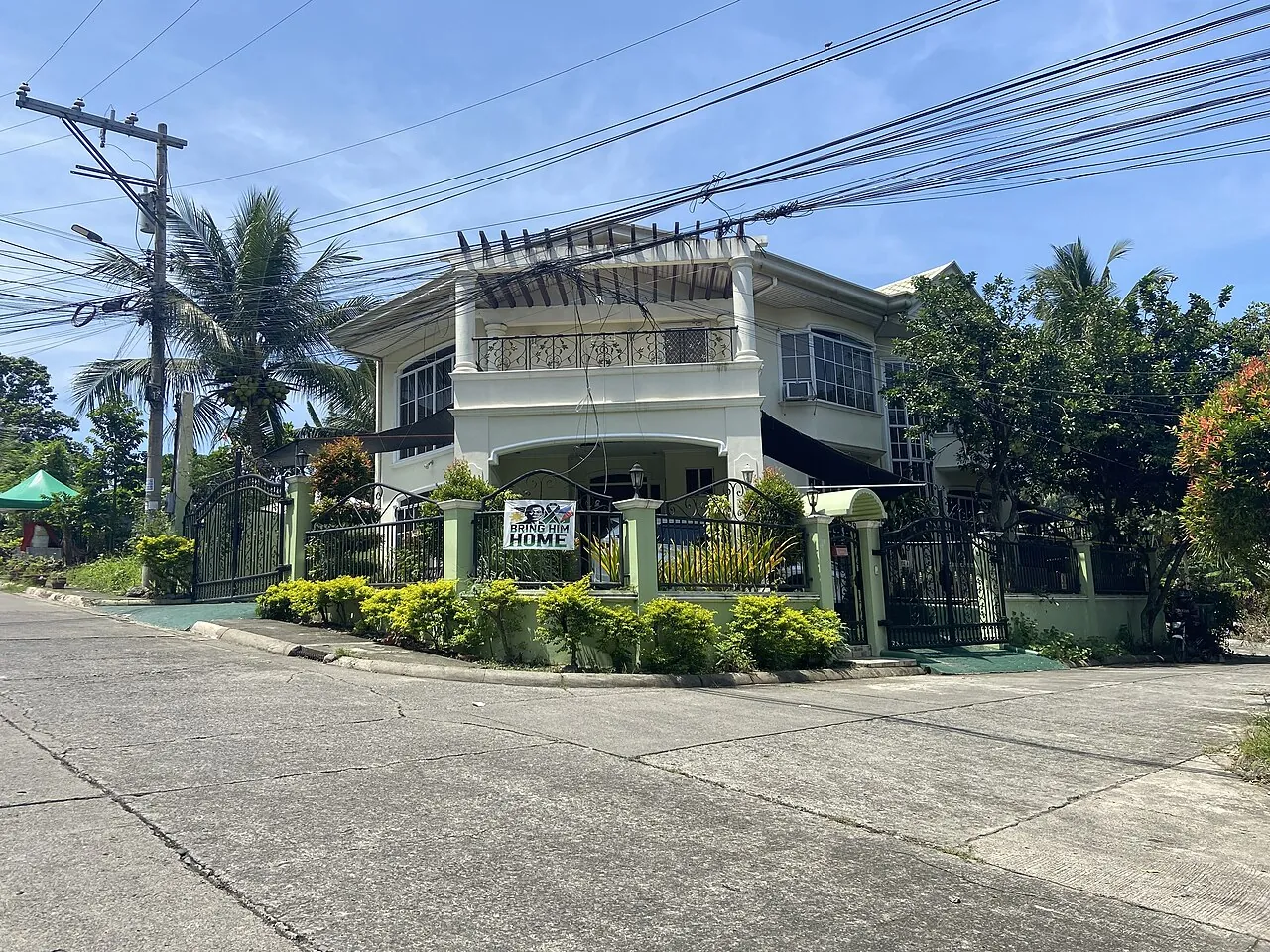
Main Residence Facade
View of the two-story Davao residence showcasing its painted upper story, sliding windows, and gated perimeter in Doña Luisa Subdivision.
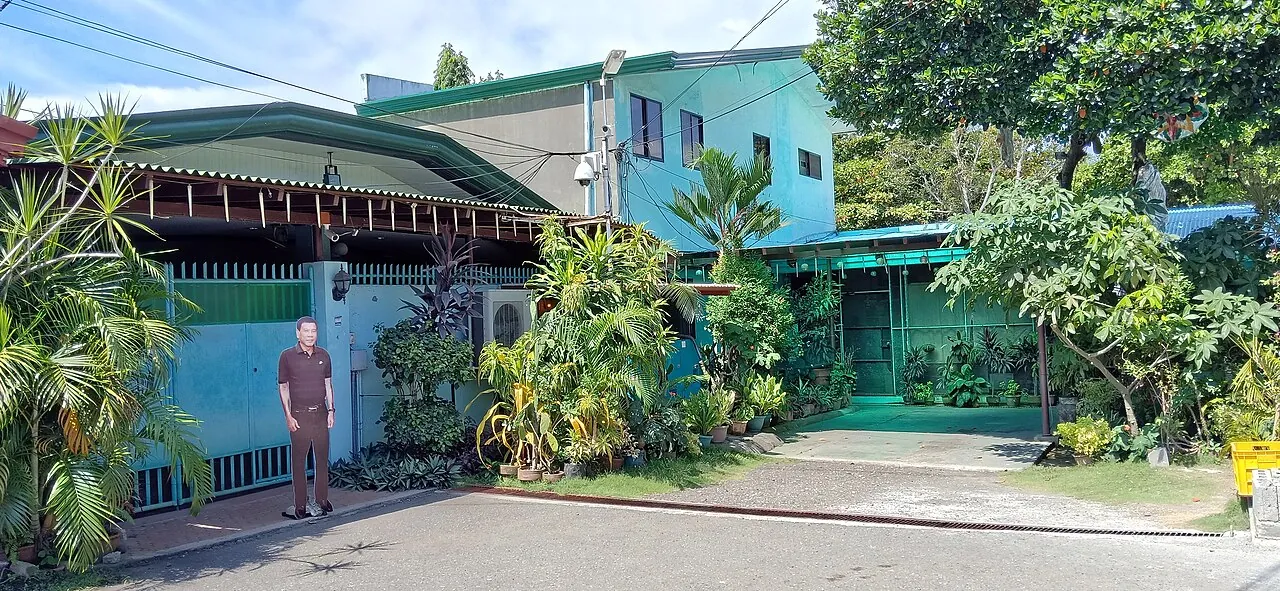
Street-Level Residence View
Exterior perspective of the Duterte residence street frontage and perimeter wall, as viewed by arriving tourists and neighborhood visitors.
Community Messages & Standee
Exterior gates featuring supporter tarpaulins, commemorative notes, and the life-sized cutout placed for visiting tourists.
Davao Homes vs Malacañang, Bahay Pangarap, and the Laperal Mansion
Rodrigo Duterte's choice of residences throughout his six-year presidency broke sharply with historical Philippine executive traditions.
Malacañang Palace and Bahay Pangarap (Manila)
Upon taking office in June 2016, Duterte famously declared he would not sleep in Malacañang Palace, claiming the historic halls were "haunted by ghosts of past leaders." Instead, he stayed across the river at Bahay Pangarap (later renamed Bahay Pagbabago), a more modest residence within Malacañang Park. Even then, he frequently boarded commercial flights back to Davao City on Thursday or Friday evenings to spend weekends in his own bed in Doña Luisa Subdivision.
The Rodrigo R. Duterte Presidential Suite (Laperal Mansion)
In February 2024, the newly restored Laperal Mansion in Manila unveiled dedicated presidential guest rooms honouring past Philippine presidents. The Rodrigo R. Duterte suite, designed by Chat Fores Design Studio, was crafted around his "no-frills, function-over-form" philosophy. Featuring masculine deep browns, burgundies, natural abaca wallpaper, leather trim, and brass accents, the space pays homage to his Davao heritage and austere aesthetic taste.
Guidelines for a Respectful Visit: Do's and Don'ts
Because both properties are situated within quiet residential subdivisions, visitors and tour vans must observe neighborhood etiquette and security rules.
Photograph at the Gate
Pose with the life-sized Duterte standee and view the public message tarpaulins from the street side without blocking vehicular traffic.
Sign the Message Boards
Visitors are welcome to write brief messages of goodwill or greetings on designated supporter tarpaulins stationed by the perimeter fence.
Coordinate with Guards
Inform the subdivision guardhouse security personnel courteously upon entry that your vehicle is making a brief sightseeing stop.
No Unauthorized Entry
Do not climb gates, open latches, or enter private lawns. Interior access is strictly private and unauthorized entry is prohibited.
Do Not Block Neighbors
Never park across neighbor driveways or idle tour bus engines loudly in front of adjoining residential homes on Sapphire or Taal Streets.
Observe Quiet Hours
Maintain calm voices and avoid noisy amplified speakers. Restrict visits to regular daytime hours between 8:30 AM and 5:00 PM.
How to Get to Duterte's House in Davao City
Practical navigation steps whether you are hiring a taxi, riding a city tour van, or traveling from Francisco Bangoy International Airport.
Private City Tour Van
Nearly all licensed Davao City tour operators include a 15-minute photo stop at Duterte's house in Doña Luisa Subdivision, usually combined with Jack's Ridge, Shrine Hills, and the Philippine Eagle Center. Simply ask your driver: they know the subdivision gates intimately.
Taxi or Ride-Hailing
From downtown Davao (Poblacion) or major hotels, hail a metered taxi or book a ride to "Doña Luisa Subdivision Phase 1, Matina Aplaya" or "Central Park Subdivision, Bangkal." Fares typically range from ₱160.00 to ₱240.00 (about $2.80 to $4.20 / €2.60 to €3.90 / £2.25 to £3.40).
From Davao Airport (DVO)
From Francisco Bangoy International Airport, take a taxi south along the Carlos P. Garcia Highway (Davao City Diversion Road) or through McArthur Highway toward Matina and Bangkal. Travel time is approximately 45 to 60 minutes depending on peak afternoon traffic.
Nearby Attractions to Pair with Your Visit
Maximize your journey into southern Davao City by adding these acclaimed cultural, culinary, and historic landmarks located within 15 to 25 minutes of Matina and Talomo.
Jack's Ridge Resort & Shrine
Perched on Shrine Hills in Matina, offering panoramic views of Davao City and Davao Gulf, historic World War II gun emplacements, and traditional Mindanao dining.
Shrine of the Holy Infant Jesus of Prague
A tranquil open-air Catholic pilgrimage site set amidst green forest trails on Shrine Hills, popular for quiet prayer and panoramic city vistas.
Times Beach & Coastal Boulevard
A historic coastal stretch in Matina Aplaya directly fronting Davao Gulf, featuring open sea breezes, local seaside snack stalls, and the scenic coastal road.
Davao City People's Park
A 4-hectare urban park in central Poblacion famous for its Durian dome, walking tracks, dancing fountains, and monumental indigenous sculptures by Kublai Millan.
Roxas Night Market
Davao City's premier evening food bazaar featuring charcoal-grilled seafood, chicken inasal, fresh durian fruit, and local souvenir apparel stalls.
Davao Crocodile Park & Zoo
A premier wildlife conservation facility along the Riverfront Corporate City in Ma-a, showcasing thousands of Philippine crocodiles, birds, and exotic reptiles.
Frequently Asked Questions
Everything you need to know before visiting the Duterte residences in Davao City.
Can tourists enter inside Duterte's house?
No, interior walk-in tours are not permitted. Both properties are private residences. In March 2026, caretaker Mila confirmed that interior access at the Bangkal ancestral home was temporarily halted by directive of Elizabeth Zimmerman to protect household privacy. However, visitors are welcome to take photos from the street side, stand alongside the life-sized cutout of Duterte at the gate, and read the supporter tarpaulins.
Where is the main Duterte house located in Davao City?
His primary personal residence is located on Sapphire Street inside Doña Luisa Subdivision Phase 1, in Barangay Matina Aplaya (near Times Beach Road), Talomo District, Davao City. The ancestral family home is situated on Taal Street in Central Park Subdivision, Bangkal, Barangay Talomo Proper.
Is there an admission or entrance fee to see the house?
No. Viewing the house exterior from the street and taking photos at the gate is completely free. There are no tickets, admission fees, or donation charges.
Why was there a "For Sale" sign outside the house in 2025?
In late June 2025, common-law partner Honeylet Avanceña placed a "For Sale" notice outside the Doña Luisa home, explaining on radio station DZRH that emotional stress and security concerns prompted the decision. However, Representative Paolo "Pulong" Duterte announced that his father refused to part with the property, as it was the first house he bought with his own money. The sign was promptly taken down following sibling opposition.
What is "Pahalipay sa Taal" and when does it take place?
"Pahalipay sa Taal" is a decades-old annual Christmas tradition held outside the Duterte ancestral residence on Taal Street in Central Park Subdivision, Bangkal. Every December 24 and 25, thousands of Davao residents, children, and indigenous Lumad families line up to receive holiday food packs, groceries, and gift allowances from the Duterte family.
How do I visit Duterte's House as part of a Davao City tour?
Most licensed city tour vans in Davao City include the house as a standard 10 to 15-minute photo stop. If you are hiring a private taxi or ride-hailing car, simply state "Doña Luisa Subdivision Phase 1, Matina Aplaya." Drivers will take you directly to the gate.
Organizing a Davao City Tour, Government Delegation, or Event?
RB Advertising manufactures custom sublimation polo shirts, tour group t-shirts, dry-fit event singlets, and corporate uniforms across the Davao Region and Mindanao. Reach our sales desk directly through any of our official channels: