
Omnibus Sworn Statement: Format, Requirements, and How to Complete It
An Omnibus Sworn Statement, or OSS, is one sworn sheet that carries several declarations under a single oath. Instead of filing a stack of separate affidavits, a bidder, supplier, or job applicant affirms identity, legal standing, and compliance on one notarized instrument. This guide covers both documents that share the name: the procurement form for government bidders, now governed by Republic Act No. 12009, and the DepEd application form for teacher applicants, which no longer needs a notary since 2024. It carries the current declarations, the steps to complete the form, the fee range, the mistakes that sink a bid, and the penalties for a false statement.
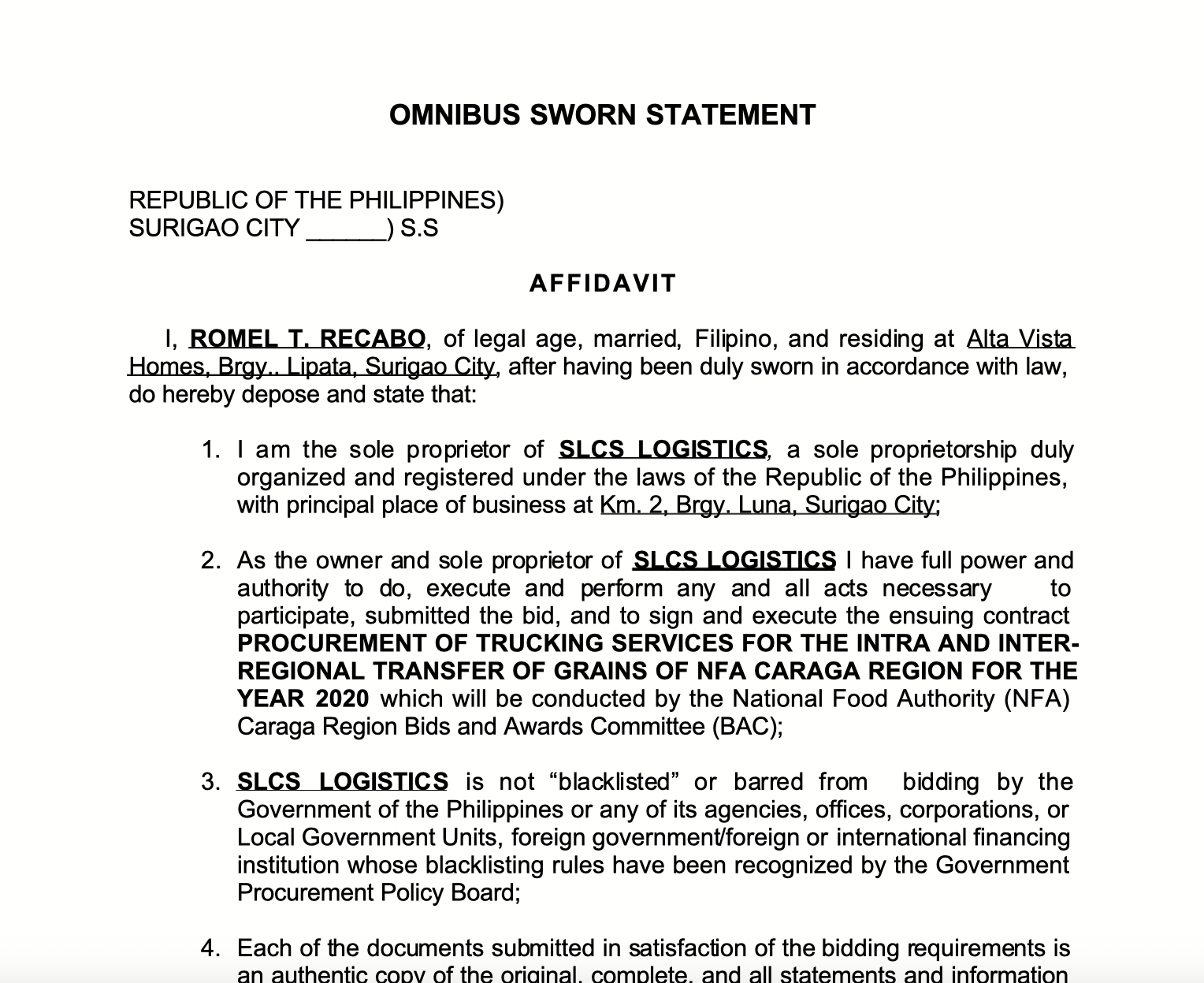
Republic of the Philippines
) S.S.
OMNIBUS SWORN STATEMENT
- Current bid form
- GPPB, July and October 2025
- Governing law
- RA 12009, IRR February 2025
- Bids
- Notarized
- DepEd applicants
- Sworn, not notarized
Which Omnibus Sworn Statement Do You Need
Search results mix two unrelated forms. One is a supplier document for government bids. The other is a job applicant document for the Department of Education. They share a name and a structure, but the rules, the templates, and the notarization requirement are different. Start by picking your track.
Government Procurement Bidder
Filed with a bid or proposal to a national agency, local government unit, state university, government corporation, or any procuring entity. The form is the standard GPPB Omnibus Sworn Statement, now issued under Republic Act No. 12009, the New Government Procurement Act, with its Implementing Rules and Regulations approved in February 2025.
Filed through PhilGEPS and the bidding documents. Notarization is required, signed before a commissioned notary public.
DepEd Teacher Applicant
Filed with a teaching application to the Department of Education. It is Item 20(j) of the application checklist under DepEd Order No. 007, s. 2023, on the prescribed Annex C form, and it bundles the checklist itself, a Certification of Authenticity and Veracity, and a Data Privacy Consent under Republic Act No. 10173.
Since DepEd Order No. 021, s. 2024, it no longer has to be notarized. It still has to be sworn, before any public officer authorized to administer an oath.
Filing for something else, such as a scholarship, a permit, or an accreditation, or a visa application. Those requests usually ask for a specific sworn statement drafted for that purpose. Ask the requesting office for its own template, and print that, rather than adapting a procurement form.
What Changed Since 2024
Most online copies of this form, and most guide articles, still cite Republic Act No. 9184. That law has been replaced. Here is the sequence that matters when you download a template today.
- 2003
Republic Act No. 9184
The Government Procurement Reform Act set up the modern bidding system and the sworn declarations that later became the consolidated OSS.
- 2013
GPPB standard OSS form
The Government Procurement Policy Board issued one standard form to replace the separate affidavits for non blacklisting, document authenticity, and related certifications. Versions of this form still circulate widely online.
- 13 August 2024
Republic Act No. 12009 takes effect
The New Government Procurement Act revised RA 9184 and introduced new principles, including efficiency, proportionality, sustainability, and procurement professionalization.
- 10 February 2025
RA 12009 IRR approved
GPPB Resolution No. 02-2025 approved the Implementing Rules and Regulations. The IRR now carries the OSS requirement and points to the standard form.
- July and October 2025
Current GPPB OSS forms
The GPPB published the updated Omnibus Sworn Statement form for bids, and a version for negotiated procurement and small value proposals dated 10 October 2025.
- 23 December 2024
DepEd drops notarization
DepEd Order No. 021, s. 2024 removed the notary requirement for the application OSS to spare applicants the cost. The form is still sworn before an authorized public officer.
What the Current Bid Form Declares
Under RA 12009 and its IRR, the Omnibus Sworn Statement is part of the bid requirements, now listed in the Philippine Bidding Documents as a related form and required by the Instructions to Bidders. The current form affirms the following, in substance. Always download the exact form named in your bidding documents, since the procuring entity may add declarations.
Capacity and Authority
You state whether you sign as a sole proprietor, as the authorized representative of a partnership, corporation, cooperative, or joint venture, or as an individual consultant in consulting services. You then declare your full power and authority to submit the bid and sign the contract, supported by the proper document.
Not Blacklisted
You declare that the bidder is not blacklisted or barred by the Philippine Government, any of its agencies, offices, corporations, or local government units, or by a foreign government or financing institution whose blacklisting rules the GPPB recognizes.
The current form widens this: the bar also covers blacklisting by relation, membership, association, affiliation, or controlling interest with another blacklisted person or entity.
Authentic and Complete Documents
You declare that every document submitted in satisfaction of the bidding requirements is an authentic copy of the original, is complete, and that all statements and information in them are true and correct.
Permission to Verify
You authorize the Head of the Procuring Entity, or a duly authorized representative, to verify all documents you submitted. This is the legal basis for the cross checking and audit that follows.
No Relationship, Disclosed Ownership
You declare that the owner, the officers and members, or the officers, directors, and controlling stockholders, as applicable, are not related to the Head of the Procuring Entity, the Bids and Awards Committee, the Technical Working Group, the BAC Secretariat, the head of the Project Management Office or the end user or implementing unit, the procurement agent, and the project consultants, by consanguinity or affinity up to the third civil degree.
The current form adds a consequence clause: failure to faithfully disclose this relationship, or submission of beneficial ownership information with false entries, is subject to blacklisting under Section 100 of the RA 12009 IRR, without prejudice to criminal and civil liabilities.
Labor, Conduct, and Estafa
You declare that the bidder complies with existing labor laws and standards, and that it understands its responsibilities as a bidder, including examining all bidding documents and securing any supplemental bid bulletins.
You also declare that the bidder did not give or pay, directly or indirectly, any commission, amount, fee, or any consideration to any government person or representative in relation to the project. The form adds that if an advance payment was made and the bidder fails to perform, that can constitute swindling or estafa under Article 315 of the Revised Penal Code.
What to Attach
Proof of authority for representatives: a duly notarized Special Power of Attorney, a Board or Partnership Resolution, or a Secretary's Certificate, whichever applies to your organization.
Where It Goes
Submitted with the bid or proposal, and uploaded through PhilGEPS where the procuring entity requires electronic submission.
How Long It Lasts
There is no fixed expiry in law. Procuring entities usually want the statement dated within the bid validity period, or within the last three to six months. Check your bidding documents.
Every new procurement uses a single OSS that covers all declarations. Do not submit the older separate affidavits alongside it unless the procuring entity specifically asks for them.
The DepEd Application Form, and the 2024 Change
If you are applying for a teaching or non teaching position in the Department of Education, your Omnibus Sworn Statement is not the procurement form. It is the bottom half of the department's Annex C form, and one recent amendment changed who has to notarize it.
Where It Sits
DepEd Order No. 007, s. 2023 lists it at Item 20(j) of the application checklist, as the Checklist of Requirements and Omnibus Sworn Statement on the Certification of Authenticity and Veracity of the documents submitted, plus a Data Privacy Consent Form under Republic Act No. 10173, using Annex C.
That is why it is called omnibus: the one sheet is the checklist, the authenticity certification, and the data privacy consent together.
What It Certifies
- That all information in the application is true and correct, to your personal knowledge and belief.
- That the documents you submitted are original or certified true copies.
- That you consent to DepEd collecting and processing your personal information for recruitment, selection, and placement, and for compliance with Civil Service Commission rules.
No Longer Notarized
DepEd Order No. 021, s. 2024 amended the earlier order so that the application OSS no longer has to be notarized, to relieve applicants of unnecessary cost. The wording is specific: it must be sworn before any public officer authorized to administer an oath under Book I, Chapter 10, Section 41 of Executive Order No. 292, as amended by Republic Act No. 6733 and further amended by Republic Act No. 10755.
Read that carefully. The document is still sworn. What changed is that a notary public is no longer the only route, and the notarial fee is no longer an unavoidable cost.
Who Can Administer the Oath
The officers with general authority under Section 41 of Executive Order No. 292 include the President and Vice President, members and secretaries of both Houses of Congress, department secretaries, members of the judiciary, clerks of courts, provincial governors and lieutenant governors, city and municipal mayors, bureau and regional directors, registrars of deeds, all other constitutional officers, and notaries public.
Availability, not authority, is usually the constraint. Many applicants still choose a notary simply because it is faster.
Divisions differ in how they implement this. Some calls for applications still print the word notarized, either from an older template or as a local preference. Follow the wording in your own schools division memorandum, and if it conflicts with DepEd Order No. 021, s. 2024, ask the Human Resource Management Officer rather than assuming.
Six Steps to a Clean Form
The sequence below suits both tracks. The main difference is step 5: bidders sign before a notary public, while DepEd applicants sign before any authorized public officer.
Get the Right Template
Download the form from the Government Procurement Policy Board for bids, or your own schools division copy of Annex C for a DepEd application. Never start from a random blog copy, since the version and the header fields matter.
Gather Your Papers
Prepare a valid identification card issued by the government, with your photo and signature. For representatives, prepare the proof of authority: a notarized Special Power of Attorney, a Board or Partnership Resolution, or a Secretary's Certificate.
Fill the Header
Write the city or municipality where the statement will be sworn. Add your full legal name, civil status, nationality, and complete address, plus the bidder or applicant details the form asks for.
Pick One Capacity
Choose the statement that matches your legal structure, and delete the others. A sole proprietor picks the sole proprietorship option. A partnership, corporation, cooperative, or joint venture picks the representative option and attaches the proof of authority.
Sign and Swear
Do not sign in advance. Sign the statement in person before the notary public, or, for DepEd, before the authorized public officer. The officer administers the oath and completes the jurat or subscription section.
Check and Copy
Retype blank fields, avoid erasures after signing, and keep a photocopy of the completed sheet. The copy is the cleanest record of exactly what you submitted, and when.
Where to Get It Sworn, and What It Costs
For a bid, the form goes before a commissioned notary public under the 2004 Rules on Notarial Practice. For a DepEd application, any authorized public officer will do. Here is where to go and what to expect.
Where to Go
- Notary public offices. Private lawyers commissioned as notaries can swear the document at their law offices, and most cities and municipalities have several.
- City or municipal hall. Some local government units have a notary on duty, or can refer you to one nearby.
- Courthouse. Clerks of court and some court personnel provide notarization for certain documents.
- Online notarization. Under the Revised Rules on Notarial Practice, certain documents may be notarized through video conferencing, depending on the commissioning court. Check with your notary.
What to Bring, What It Costs
Bring a valid identification card issued by the government, with your photo and signature. The notary must personally know you, or verify your identity through competent evidence of identity as defined in the 2004 Rules on Notarial Practice.
Notarization in the Philippines typically runs from ₱100.00 (about $1.60 / €1.40 / £1.20) to ₱300.00 (about $4.80 / €4.20 / £3.60), depending on the notary and the location. Some charge extra for the oath or for multiple copies, and conversions here are approximate. Always ask for the official receipt.
For a DepEd application since DepEd Order No. 021, s. 2024, you may not need to pay a notary at all, since the form only has to be sworn before an authorized public officer.
The document itself is free. Download the current template from the GPPB or your schools division, and pay only for printing and, where required, the oath.
What Gets a Statement Rejected
Most rejections trace back to a handful of avoidable errors. Check your draft against this list before you sign.
The Wrong Capacity
Applicants often tick the corporation or partnership option when they are actually a sole proprietor, or the reverse. Verify your business registration type before filling the form.
Signed in Advance
The signature must be made in the physical or virtual presence of the officer who administers the oath. A form signed ahead of time will be rejected.
Blank Fields
Leave nothing empty. If a field does not apply, write N/A or Not Applicable, rather than leaving it blank.
An Outdated Template
Republic Act No. 12009 replaced RA 9184, and the current GPPB forms are dated 2025. A template that still cites RA 9184, or that asks for the old separate affidavits, is out of date.
Missing Proof of Authority
If you sign for a partnership, corporation, cooperative, or joint venture, attach the proper authorization: a notarized Special Power of Attorney, a Board or Partnership Resolution, or a Secretary's Certificate.
Handwritten and Altered
Type the document for clarity. Some agencies reject handwritten forms, and any alteration or erasure after signing invites doubt.
Why a False Statement Is Serious
An Omnibus Sworn Statement is a legally binding document. Making a false statement under oath is a criminal offense, and procurement adds its own administrative penalties on top.
Perjury
Under Article 183 of the Revised Penal Code, as amended by Republic Act No. 11594, a person who knowingly makes an untruthful statement in an affidavit upon a material matter may be charged with perjury.
The penalty is prision mayor in its minimum to medium period, or imprisonment of six years and one day to ten years.
For Public Officers
If the offender is a public officer or employee, the penalty is imposed in its maximum period, plus a fine not exceeding one million pesos and perpetual absolute disqualification from holding any appointive or elective government position.
Blacklisting and Bid Sanctions
Under procurement rules, a false statement can lead to disqualification, forfeiture of the bid security, and blacklisting under Section 100 of the RA 12009 IRR. Blacklisting bars the entity and its affiliates from all government procurement.
The three also stack. A single false declaration can expose you to criminal liability, an administrative ban, and the loss of the bid security at the same time.
The Current Bid Form, Condensed
Below is a condensed reference of the Omnibus Sworn Statement used in government bidding under Republic Act No. 12009. It follows the current GPPB form. The authoritative wording is the downloadable form issued by the Government Procurement Policy Board, so use this page to prepare, and use the GPPB file, or your bidding documents, to file.
Show the condensed form
Republic of the Philippines
City or Municipality of ______________ ) S.S.
OMNIBUS SWORN STATEMENT
I, [Name of Affiant], of legal age, [Civil Status], [Nationality], and with residence at [Address of Affiant], after having been duly sworn in accordance with law, do hereby depose and state that:
- Select one and delete the others. If a sole proprietorship: I am the sole proprietor or authorized representative of [Name of Bidder] with office address at [Address of Bidder]. If a partnership, corporation, cooperative, or joint venture: I am the duly authorized and designated representative of [Name of Bidder] with office address at [Address of Bidder]. If an individual consultant not registered under a sole proprietorship, in consulting services: I am the individual consultant or authorized representative of [Name of Bidder] with office address at [Address of Bidder].
- Select one and delete the others. As the owner and sole proprietor, or authorized representative of [Name of Bidder], I have full power and authority to do, execute, and perform any and all acts necessary to participate, submit the bid, and to sign and execute the ensuing contract for [Project Title] of the [Name of the Procuring Entity]. For a partnership, corporation, cooperative, or joint venture, I am granted full power and authority to do the same, as supported by the attached duly notarized Special Power of Attorney, Board or Partnership Resolution, or Secretary's Certificate, whichever is applicable.
- [Name of Bidder] is not blacklisted or barred from bidding by the Government of the Philippines, or any of its agencies, offices, corporations, or local government units, or by a foreign government or foreign or international financing institution whose blacklisting rules have been recognized by the Government Procurement Policy Board, by itself or by relation, membership, association, affiliation, or controlling interest with another blacklisted person or entity.
- Each of the documents submitted in satisfaction of the bidding requirements is an authentic copy of the original, is complete, and all statements and information provided in them are true and correct.
- [Name of Bidder] is authorizing the Head of the Procuring Entity, or a duly authorized representative, to verify all the documents submitted.
- Select one and delete the others. The owner or sole proprietor, the officers and members, or the officers, directors, and controlling stockholders, as applicable, are not related to the Head of the Procuring Entity, members of the Bids and Awards Committee, the Technical Working Group, the BAC Secretariat, the head of the Project Management Office or the end user or implementing unit, the procurement agent, and the project consultants, by consanguinity or affinity up to the third civil degree. It is understood that failure to faithfully disclose this relationship, or submission of beneficial ownership information containing false entries, is subject to blacklisting under Section 100 of the Implementing Rules and Regulations of Republic Act No. 12009, without prejudice to criminal and civil liabilities under applicable laws.
- [Name of Bidder] complies with existing labor laws and standards.
- [Name of Bidder] is aware of and has undertaken the responsibilities as a Bidder under the Philippine Bidding Documents, which includes:
- a) Carefully examining all of the Bidding Documents;
- b) Acknowledging all conditions, local or otherwise, affecting the implementation of the Contract;
- c) Making an estimate of the facilities available and needed for the contract to be bid, if any; and
- d) Inquiring or securing Supplemental Bid Bulletin(s) issued for the [Project Title].
- [Name of Bidder] did not give or pay, directly or indirectly, any commission, amount, fee, or any form of consideration, pecuniary or otherwise, to any person or official, personnel, or representative of the government in relation to any procurement project or activity.
- In case advance payment was made or given, failure to perform or deliver any of the obligations and undertakings in the contract shall be sufficient grounds to constitute criminal liability for swindling, or estafa, or the commission of fraud with unfaithfulness or abuse of confidence, through misappropriating or converting any payment received by a person or entity under an obligation involving the duty to deliver certain goods or services, to the prejudice of the public and the government of the Philippines, pursuant to Article 315 of the Revised Penal Code.
IN WITNESS WHEREOF, I have hereunto set my hand this ____ day of ____________, 20____ at ____________________, Philippines.
[Name of Affiant] · [Bidder's Representative or Authorized Signatory] · [Signatory's Legal Capacity] · Affiant
JURAT. SUBSCRIBED AND SWORN to before me this ____ day of ____________ at ____________________, Philippines. Affiant is personally known to me, and was identified through competent evidence of identity as defined in the 2004 Rules on Notarial Practice (A.M. No. 02-8-13-SC).
WITNESS MY HAND AND SEAL on the date and at the place first above written.
Doc. No. ______ · Page No. ______ · Book No. ______ · Series of ______
Questions We Hear Most
Straight answers on the form, the cost, the notarization rule, and validity.
What is an Omnibus Sworn Statement
Is the Omnibus Sworn Statement still required under RA 12009
Does the DepEd Omnibus Sworn Statement still have to be notarized
How much does an Omnibus Sworn Statement cost
How long is an Omnibus Sworn Statement valid
Can I prepare an Omnibus Sworn Statement without a lawyer
Can an Omnibus Sworn Statement be electronic
What happens if there is a mistake on the form
Print Your Omnibus Sworn Statement
Send us your completed form, or the template you were given, and we print clean, sharp copies for bidding, application, or notarization. We handle single copies, bulk bids, and last minute deadlines from Tagum City, with delivery across Mindanao and nationwide.
Branches: Naungayan Building, Aala Road, Barangay Mankilam and Sobrecary Street in front of the Velox Gas Station, Tagum City. Open Mon to Sat, 8:30 AM to 5:00 PM.