
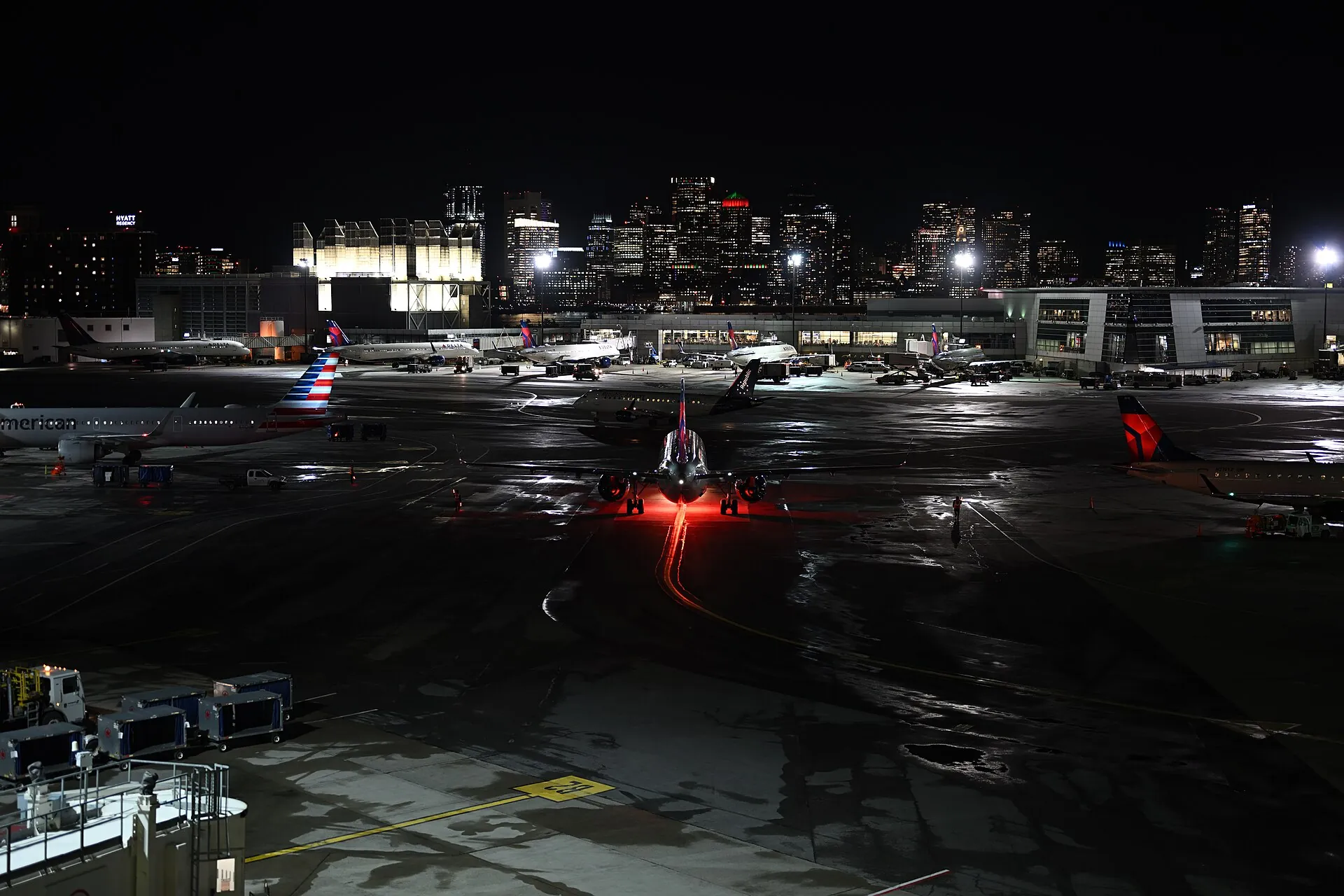
BOS / KBOS East Boston, Massachusetts, United States
Boston Logan International Airport and the Philippines: Travel, Investment and Manufacturing
New England's largest airport sits four kilometres across Boston Harbor from downtown, carried 43.2 million passengers in 2025, and has no nonstop to Manila. This page sets out the crossings that work, the thirty day visa free entry that waits for a US passport, the incentives open to a Massachusetts investor, and what a Philippine factory can make for a New England brand.
The field in four soundings
- Passengers, 2025
- 43,236,013
- Runways
- 6
- Passenger terminals
- 4
- Distance to Manila
- 13,600 km
No scheduled nonstop between Boston and any Philippine airport. Every itinerary connects once, at minimum.
Six runways on filled harbor land, and the shortest one is 779 metres
Logan opened on 8 September 1923 at Jeffries Point, and the airfield grew into Boston Harbor on landfill taken from Governors, Noddle's and Apple islands through the 1940s and 1950s. The field now covers 2,384 acres, sits 19 feet above the water, and runs six asphalt strips in the crossed pattern that lets it handle a north Atlantic schedule in almost any wind.
- Operator
- Massachusetts Port Authority (Massport)
- Location
- East Boston and Winthrop, 4 km east of downtown across the harbor
- Site
- 2,384 acres (965 hectares), 19 ft above sea level
- Runways
- 6 asphalt, longest 15R/33L at 3,073 m, shortest 15L/33R at 779 m
- Terminals
- 4 passenger buildings, A, B, C and E, with 107 gate positions
- Traffic, 2025
- 43,236,013 passengers, 407,116 movements, 246,375 tonnes of cargo
- Airline roles
- Delta hub, JetBlue focus city, Cape Air operating base
- Newest runway
- 14/32, opened 23 November 2006, the first major addition in more than 40 years
Runway lengths and the crossed layout are drawn to relative scale. The two 4/22 strips and the 15R/33L strip carry most long haul departures.
Four terminals, 107 gates, and one building where every international arrival clears customs
Terminal E is the international building, and almost every arrival from Asia clears United States Customs there. Terminals B, C and E are joined behind security, and the A to B connector approved in 2024 closes the last gap. Allow time for the walk: Logan is compact, but the piers are long.
Delta, and the first green terminal in the country
Eleven gates in the main building and ten in the satellite, linked by a tunnel under the apron. Terminal A was the first airport terminal in the United States to earn LEED certification. Delta and its codeshare partner WestJet use it.
21 gatesAmerican, United, Southwest and Alaska
Forty one gates in two piers, joined behind security since a 160 million dollar renovation finished in 2014. Air Canada and Boutique Air also operate here. This is the domestic workhorse of the airport.
41 gatesJetBlue's operating base
Twenty seven gates, renovated in 1987, 2002 and 2005. JetBlue is the largest carrier at Logan and runs its Boston base from here. Aer Lingus, Cape Air and TAP Air Portugal departures also use Terminal C.
27 gatesThe Volpe International Terminal
Eighteen common use gates, so no airline owns a stand. Every international arrival without preclearance clears customs here, and the federal inspection station can process more than 2,000 passengers an hour. Arrivals from Manila connect through this building.
18 gatesA subway station, a free Silver Line, and five Logan Express lots
Logan is closer to its city centre than almost any large American airport, and it is the only one with a rapid transit station that opened in the same decade as the terminal. The trade off is harbor tunnels: the ride is short, but a crash or a snow event can double it.
- Blue Line, Airport station Opened in 1952, the first rapid transit connection at a United States airport. A free Massport shuttle links the station to all terminals. About 10 minutes to Aquarium and 15 to State Street. Best in snow
- Silver Line SL1 Free from every terminal to South Station and the Seaport, about 20 to 25 minutes in its own busway and tunnel. The default for anyone staying downtown or near the convention centre. Free, no ticket
- Logan Express Five park and ride routes from Back Bay, Braintree, Framingham, Peabody and Woburn. The service carried a record 2.6 million passengers in 2024, and the Back Bay stop was reordered to cut 30 percent from the trip. Suburban park and ride
- Car, taxi and rideshare Sumner and Callahan tunnels put downtown 10 to 20 minutes away outside peak hours. Allow 45 minutes in the morning rush, and more in snow. Pickups sit in the designated ride app lots, not at the curb. 10 to 20 minutes off peak
What that means for a Manila connection
Almost every Boston to Manila itinerary leaves Logan in the afternoon or evening and connects in Asia or the Gulf. That makes the domestic connection the risk, not the long haul. If you are flying in from Vermont, New Hampshire, Maine or the Cape the same day, book a connection through Boston with at least three hours of buffer, and check the overnight snow forecast for December through March.
On the return, you will clear immigration and customs at Terminal E. If your onward flight is from Terminal B or C, the walk is indoors through the connector, but you must exit the international arrivals hall and reclear security. Two hours is comfortable, ninety minutes is tight, and a checked bag makes it tighter.
Where to stay the night before
The airport hotels at Jeffries Point and the neighboring waterfront are the practical choice for a 6 AM departure. Downtown Boston is 15 minutes away by tunnel, and the Back Bay Logan Express stop makes a late arrival or an early start workable from a city hotel.
There is no nonstop, so the hub you pick is the trip
Boston and Manila sit 13,600 kilometres apart, and no airline flies the pair nonstop. Philippine Airlines serves the east coast from New York, so a Boston traveller either connects in Asia or the Gulf, or takes a short hop to JFK first. The fastest reliable itineraries run through Hong Kong, Tokyo or Seoul, and the cheapest often run through the Gulf.
Boston to Hong Kong is about 15 hours 40 minutes, then Hong Kong to Manila is about 2 hours 15 minutes. The airline advertises roughly 18 hours 30 minutes door to door, which makes this the fastest single connection.
18 h 30 m totalAbout 13 hours 50 minutes to Narita, then 4 hours 45 minutes to Manila. The connection is easy and the Tokyo transfer is well signed, but the second leg lands late in the evening.
19 h 30 m totalAbout 14 hours 40 minutes to Incheon, then 4 hours 15 minutes to Manila. Incheon is the smoothest Asian transfer for a first time visitor, with a single terminal and clear signage.
20 h totalAbout 12 hours 30 minutes to Doha, then 9 hours to Manila. The Gulf routing adds distance but often undercuts the Asian hubs on fare, and the Manila arrival is in the morning.
22 h totalAbout 9 hours 30 minutes to Istanbul, then 11 hours to Manila. The first leg is the shortest of any option, but the total is the longest, and the transfer airport is the busiest in Europe by destinations.
21 h totalAbout 12 hours to Dubai, then 8 hours 45 minutes to Manila. The Dubai connection runs through the night in one direction, which suits travellers who sleep on the long leg.
21 h totalClock change and arrival: Manila runs 13 hours ahead of Boston in winter and 12 hours ahead in summer. A morning departure from Logan lands in Manila the following evening. Terminal warning: Ninoy Aquino has four terminals that are not connected airside, and airlines move between them. Confirm the terminal on your ticket, and allow three hours between a domestic and an international connection.
Thirty days without a visa, and a dry window that runs from December to May
The United States is the Philippines' largest source market, and the entry rules are the simplest in Southeast Asia for a US passport. The weather is the harder planning problem: the country sits on the typhoon belt, and the difference between a January trip and an August trip is the difference between a beach holiday and a flight rebooking.
Bar length is relative rainfall and storm risk, not a forecast. December to May is the planning window; late August to October is when trips get rewritten.
Three island groups, one short hop each
Entry on a US passport
- 30 days visa free under Executive Order 408, for tourism and short business visits.
- Passport valid at least six months beyond the stay, and a return or onward ticket.
- eTravel registration inside 72 hours before arrival, at etravel.gov.ph. It is free.
- One extension of 29 days at a Bureau of Immigration office, then monthly extensions up to 36 months.
- Former Filipino citizens and their immediate family can use the Balikbayan privilege for one year.
- Business visitors who need to work locally should check the 9a visa and the Special Work Permit before travel.
A realistic Boston itinerary
Seven days: three nights in Manila and Intramuros, then a flight to Cebu or Bohol for four nights. Ten days: add Boracay or Siargao. Two weeks: Manila, Banaue or Vigan, then Cebu, Bohol and one beach. Domestic flights are cheap and frequent, but they leave from different Manila terminals, so build the transfer into the day.
Bring a physical SIM or buy one at the airport, carry cash for tricycle and ferry fares, and book the first and last nights in Manila rather than cutting it fine for the international flight.
A 20 percent corporate rate, and full foreign equity in export manufacturing
The Philippines changed its investment rules in 2024 and 2025, and the headline is simple: a registered export manufacturer can own the whole enterprise, take a holiday from income tax, and then pay a reduced rate on gross income. For a Boston company with a life science, electronics or marine technology product, the question is not whether the door is open, but which agency to walk through.
20 percent for a registered enterprise, down from the previous 25 percent standard rate for most activity.
Four to seven years, depending on location and sector, for a project registered with the Board of Investments or PEZA.
A 5 percent tax on gross income in place of all national taxes, after the holiday, for an export enterprise.
100 percent ownership in export manufacturing outside the Foreign Investment Negative List.
200,000 US dollars for a domestic market enterprise, halved to 100,000 with advanced technology or 50 or more direct employees.
VAT zero rating on local purchases and duty free capital equipment for registered export projects. The SIRV and SVEG visas give resident status to an investor or an employer.
Registration runs through the Board of Investments, PEZA or the investment promotion agency that matches the sector and location. The Department of Trade and Industry publishes the current negative list and the CREATE MORE implementing rules.
The New England lane
- Massachusetts goods exports to the Philippines
- about $185 M
- United States goods exports to the Philippines, 2025
- $9.2 B
- Philippine goods exports to the United States, 2025
- $17.8 B
- Two way goods trade, 2025
- $27.0 B
- Goods and services, 2025
- $40.9 B
Massachusetts figure is the latest annual Census export value. National figures are 2025. Services are included in the last line only.
Sectors that fit a Boston balance sheet
Life sciences and medical devices: the Boston cluster already sources components and clinical trial services across Asia, and the Philippines has a growing medical device and contract research base.
Electronics and semiconductors: assembly and test, not wafer fabrication, with a supplier base that already serves the automotive and consumer markets.
Aerospace and marine: parts machining and MRO for the region's aviation and shipbuilding supply chains, with English language technical staff.
Digital and shared services: finance, health records and software support, in a market with a large English speaking graduate pool.
This is general information, not investment, legal, tax or accounting advice. Confirm the current rules with the Board of Investments, PEZA and Philippine counsel before committing capital.
Electronics pays the bills, but apparel is the lane a New England brand can open this quarter
Philippine electronics exports reached 49.64 billion US dollars in 2025, 58.81 percent of everything the country sold abroad. That is the industrial headline. The practical entry point for a Boston buyer is smaller and faster: technical apparel, uniforms, team kit and promotional product, where the minimums are low, the samples are quick, and the factory is already set up for American sizing and labelling.
| Sector | What it makes | Fit for Boston |
|---|---|---|
| Semiconductors and electronics | Assembly, test and packaging for automotive, industrial and consumer devices | Supply chain diversification for hardware and robotics firms |
| Aerospace parts | Machined components, harnesses and MRO support | New England aviation and defense suppliers |
| Medical devices | Consumables, housings and contract assembly | Life science and hospital supply companies |
| Automotive electronics | Wiring, sensors and battery pack assembly | Electric vehicle and fleet operators |
| Technical apparel | Performance knit, outerwear, uniforms and team kit | Outdoor, running, rowing and collegiate brands |
| Furniture and home goods | Case goods, seating and contract furniture | Hospitality and university fit out |
Why a Boston brand fits the apparel lane
New England has an outdoor and performance apparel cluster, a dense university and hospital system that buys uniforms by the thousand, and four major league teams plus a college sports market that consumes team kit every season. Those buyers need small runs, accurate sizing, fast samples and labelling that meets United States care and fibre rules. That is the work a Philippine factory does well, and it is the work behind this page.
The time zone helps more than it sounds. Manila is 13 hours ahead of Boston in winter, so a specification sent at the end of a Boston afternoon lands on a Philippine desk at the start of the next working day, and the answer is waiting when Boston opens again.
Production at a glance
- Minimum per design
- 50 pieces
- Sampling
- Paid sample, then fit correction
- Production lead time
- 3 to 6 weeks after approval
- Air freight, Manila to Boston
- 3 to 5 days
- Sea freight, Manila to Boston
- 30 to 40 days
- Labels and packaging
- Woven labels, care labels, hangtags, polybags, carton marks
Prices are quoted ex works in Philippine pesos. Freight, duty and local delivery are separate, and the header currency switcher converts to US dollars, euros and pounds at the live rate.
What the factory handles
- OEM and ODM production from a tech pack or a reference sample.
- Buyer supplied fabric, or fabric sourced and tested locally.
- Embroidery, screen print, sublimation and heat transfer.
- Pre shipment inspection and a photo report before the carton is sealed.
- Multi site delivery, with serialised cartons for a university or hospital rollout.
Manufacturing workwear covers the uniform programme in more detail, and the manufacturing FAQ answers the commercial questions.
Air through Logan, sea through Conley, and a duty stack with no preference to claim
Boston is a two mode port. Logan moves about 246,000 tonnes of cargo a year, mostly belly freight on passenger aircraft plus a small freighter presence. Conley Terminal in South Boston handled 245,000 TEUs in 2025 and now takes the MSC round the world service, which gives New England an all water option from Asia. What neither mode changes is the tariff: there is no free trade agreement between the United States and the Philippines, and the preferential scheme for developing countries has not been renewed.
Most favoured nation duty on the exact line. Cotton knit shirts sit at 16.5 percent, woven cotton shirts at 19.7 percent, synthetic knit tops at 32.5 percent.
In force from 24 July 2026 on the affected apparel lines, on top of the base rate.
Assessed on the customs value, with a minimum and a maximum per entry. Air shipments do not pay the harbor maintenance fee.
Worked example: 10,000 dollars of cotton knit shirts
Customs value 10,000 dollars. Duty at 16.5 percent is 1,650 dollars. The Section 301 action at 12.5 percent is 1,250 dollars. The merchandise processing fee is 34.64 dollars. Total landed before freight and broker fees is 12,934.64 dollars, or 29.3 percent of the customs value. The same shipment in synthetic knit tops, at 32.5 percent, lands at 4,534.64 dollars of duty and fee, or 45.3 percent.
The sea option
Conley Terminal is the only container terminal in New England. It handled 245,000 TEUs and more than 1.7 million metric tons in 2025, welcomed ships over 16,000 TEUs for the first time, and added the MSC Dragon round the world service. For apparel, an all water booking takes 30 to 40 days door to door, and a west coast discharge with rail to Boston is usually 22 to 30 days.
Sea is the right choice for a seasonal programme booked months ahead. Air is the right choice for a sample, a replenishment, or a launch that cannot wait.
What changed in 2026
- The 19 percent reciprocal rate is gone. The Supreme Court held in February 2026 that the emergency powers statute did not authorise tariffs, and collections stopped.
- The de minimis exemption is suspended. Parcels of 800 dollars or less have paid duty since 29 August 2025, so a sample shipment is no longer free.
- There is no preference to claim. No bilateral free trade agreement is in force, and the generalised system of preferences has not been renewed.
- The effective rate is measurable. The average effective American tariff on Philippine knitted apparel was 31.8 percent in August 2026, and 30.2 percent on woven apparel.
None of this is advice on a specific entry. Classification depends on the garment, the fibre and the construction, and the treatment of a shipment is decided at the port by Customs and Border Protection. Take a written ruling from a licensed broker before you commit to a price.
What travellers and buyers ask about Boston Logan
01Is there a nonstop flight from Boston to Manila?
No. No airline operates a scheduled nonstop between Boston Logan and any Philippine airport. Every itinerary connects at least once, most often through Hong Kong, Tokyo Narita, Seoul Incheon, Doha, Istanbul or Dubai. Philippine Airlines serves the east coast from New York, so a Boston traveller can also take a short domestic hop to JFK and board the nonstop there.
02How long does the trip take?
About 18 hours 30 minutes through Hong Kong with Cathay Pacific, which is the fastest single connection. Tokyo and Seoul run about 19 to 20 hours in total. The Gulf hubs add distance and land around 21 to 22 hours, but often price lower. Manila is 13 hours ahead of Boston in winter and 12 in summer, and a morning departure lands the following evening.
03Do US citizens need a visa for the Philippines?
No, for a stay of up to 30 days. US passports enter visa free under Executive Order 408 with a passport valid six months beyond the stay, a return or onward ticket, and eTravel registration inside 72 hours of arrival. A first extension of 29 days is filed at a Bureau of Immigration office, and further monthly extensions run to 36 months. Former Filipino citizens and their immediate family can use the Balikbayan privilege for one year.
04How do I get from Logan to downtown Boston?
The Blue Line is the default in bad weather: the Airport station is linked to the terminals by a free shuttle and downtown is about 10 to 15 minutes away. The Silver Line SL1 is free from the terminals to South Station and the Seaport. Logan Express runs from Back Bay, Braintree, Framingham, Peabody and Woburn. A taxi or rideshare is 10 to 20 minutes off peak and up to 45 in the morning rush, because both harbor tunnels carry the traffic.
05What duty will a Philippine garment shipment pay?
Start with the most favoured nation rate for the exact line, which runs from 16.5 percent on cotton knit shirts to 32.5 percent on synthetic knit tops and 19.7 percent on woven cotton shirts. Add the Section 301 action of 12.5 percent in force since 24 July 2026, plus the merchandise processing fee of 0.3464 percent. A 10,000 dollar cotton knit shipment lands at about 29.3 percent of customs value. No free trade agreement or preference applies, so confirm the line with a broker first.
06What can a Philippine factory make for a Boston brand?
Sectors with real depth include semiconductors and electronics assembly, aerospace parts, medical devices, automotive electronics and technical apparel. Apparel is the fastest entry: 50 pieces per design, a paid sample, then 3 to 6 weeks of production after approval. The factory handles OEM and ODM work, buyer supplied fabric, embroidery and print, the full labelling pack, and a pre shipment inspection report.
07What incentives are open to a Massachusetts company?
Under CREATE MORE, a registered enterprise pays 20 percent corporate income tax, or takes an income tax holiday of four to seven years and then a 5 percent special corporate income tax in place of national taxes for export activity. Export manufacturing is open to 100 percent foreign equity, with a 200,000 dollar minimum paid in capital for a domestic market enterprise, halved with advanced technology or 50 or more employees. Registration runs through the Board of Investments or PEZA, and the SIRV and SVEG visas cover resident status.
08When is the best time to visit the Philippines from Boston?
December to May. December to February is dry and cooler, March to May is hot and dry and the best beach window, and June to November brings the southwest monsoon and the typhoon season, with the highest risk from late August to October. Boston adds a second risk in winter: a nor'easter can ground the first leg, so book a buffer day before the international departure and check the forecast.
Flying in, or sourcing from Manila?
Send your travel dates, your routing question or your apparel specification and our team in Tagum City will reply. Business hours: Mon to Sat, 8:30 AM to 5:00 PM (PHT).
Passenger, movement and cargo figures for 2025 come from Massport airport statistics and the Massport 2025 Year in Review. Runway dimensions, gate counts, terminal opening dates and the 2,384 acre site come from the Federal Aviation Administration airport diagram and Massport facility data. Airline roles and the 107 gate total come from the airport operator and the current terminal map. Blue Line, Silver Line and Logan Express detail comes from the MBTA and Massport ground transportation pages. Crossing times are calculated from the published airline schedules and the airport coordinates, and should be confirmed before ticketing. Visa rules come from Executive Order 408, the Department of Foreign Affairs and the Bureau of Immigration. Source market figures come from the Department of Tourism dashboard. Investment terms come from Republic Act 12066, the CREATE MORE implementing rules and the Board of Investments. Electronics export values come from SEIPI. Trade values come from the United States Census Bureau, the United States Trade Representative and the Bureau of Economic Analysis. Tariff detail comes from the Harmonized Tariff Schedule, the Section 301 notice of July 2026, the Supreme Court decision of 20 February 2026 and the effective rate series compiled from Customs data. Port figures come from Massport and the Conley Terminal 2025 review. The photograph is by 4300streetcar, CC BY 4.0, via Wikimedia Commons. Schedules, visa rules, tariff lines and terminal assignments change, so confirm with the airline, the airport operator, the customs broker and the Philippine Embassy before you commit.