
IATA: BTS | ICAO: LZIB | Ružinov, Bratislava, Slovakia

M. R. Štefánik Airport (BTS): Bratislava Air Cargo and Slovak Customs Guide

M. R. Štefánik Airport is the main international airport of Slovakia and the air gateway to the Slovak capital. It sits about 9 km northeast of the city centre, on the edge of the Ružinov district and the neighbouring villages of Vrakuňa and Ivanka pri Dunaji. For an apparel buyer it is the natural place for a time sensitive garment order to touch down in Slovakia, whether the shipment arrives on a bellyhold flight or is trucked in from Vienna, about 49 km west. This guide covers the terminal and the runways, the cargo operation, Slovak customs and EU duty relief, and how an order travels from the Philippines to Bratislava.

  • BTS / LZIBIATA and ICAO airport codes
  • 9 kmTo Bratislava city centre
  • 2.44MPassengers in 2025
  • 18,929 tCargo in 2025, up 70 percent
  • H24Operational hours, two runways
Gateway Overview

Why apparel flies into Bratislava

Slovakia has no coastline, so every import finishes its journey overland or in the air, and M. R. Štefánik Airport is the country's main international air gateway. It opened in 1951 as Bratislava Ivanka Airport and was renamed after General Milan Rastislav Štefánik once Slovakia became independent in 1993. Štefánik was a Slovak general, astronomer and politician, a co founder of Czechoslovakia, who died in a plane crash near Bratislava in 1919. The airport is owned and run by Letisko M. R. Štefánika, a state owned company under the Slovak Ministry of Transport.

2,438,215Passengers in 2025, up 25 percent on 2024
18,929 tCargo in 2025, up 70 percent on 2024
3,190 mMain runway 13/31, the longest at the airport
6 millionCatchment population across four countries
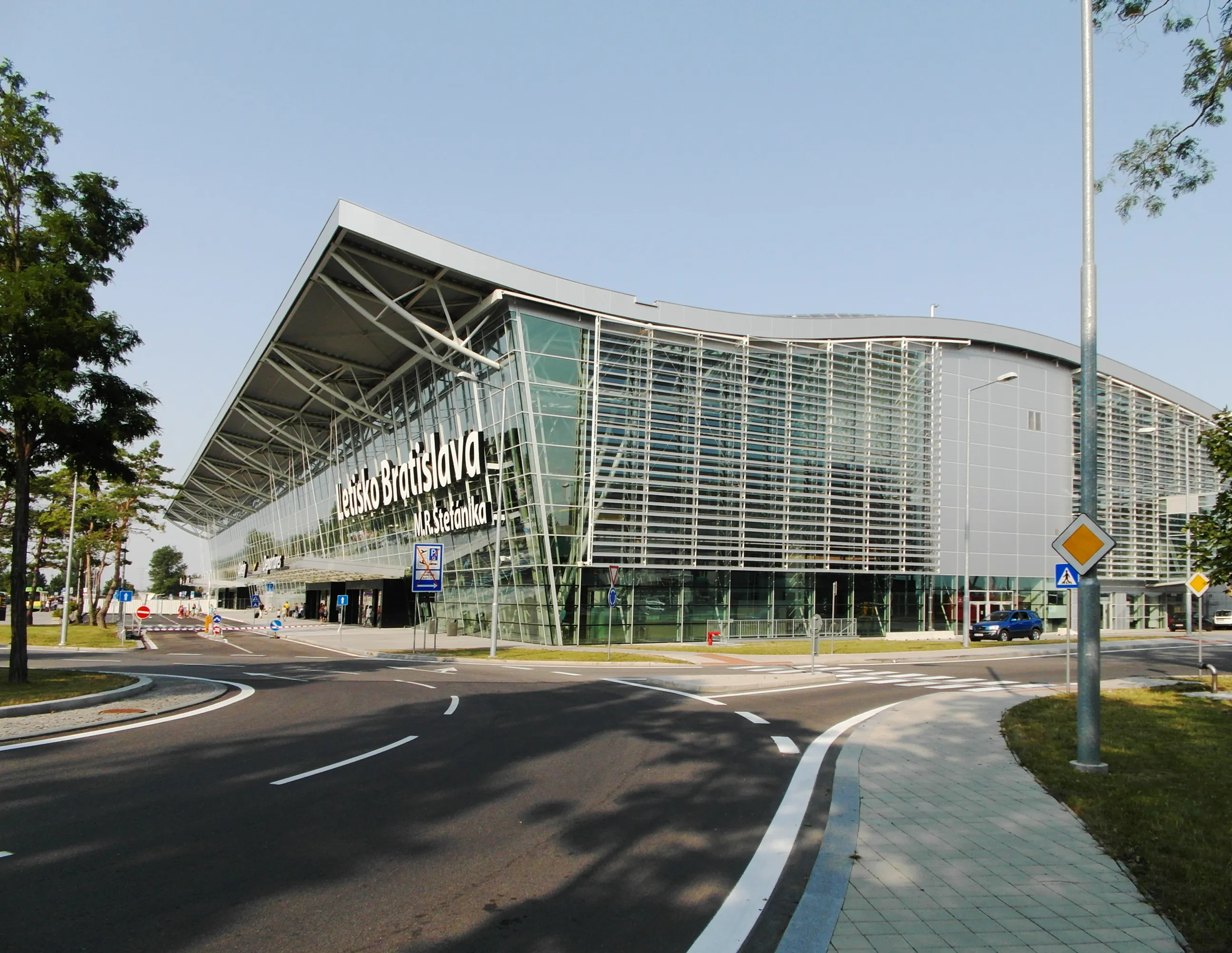
Terminal building at M. R. Štefánik Airport in Bratislava, Slovakia
The passenger terminal at M. R. Štefánik Airport, which opened in July 2012. Photo: Andrej Neuherz, CC BY-SA 3.0, via Wikimedia Commons.

Passenger, movement and cargo figures are the airport's own published 2025 results, used here as a planning reference rather than a live schedule.

Terminal and Airside

One terminal, two perpendicular runways

Bratislava runs a single passenger building that handles both arrivals and departures, plus a separate General Aviation Terminal for private, business and VIP flights, emergency flights and crew. The runway pair is set at right angles, which keeps the airport usable through most wind conditions and lets it accept almost every aircraft type in service today.

Completed July 2012

The passenger terminal

The current terminal opened in July 2012 and holds 29 check in desks, one of them set aside for oversized baggage. Inside the departures area there are 13 gates, split into eight in the Schengen zone and five in the non Schengen zone. The building is sized for more than 5 million passengers a year, well above the 2.44 million the airport handled in 2025.

A separate General Aviation Terminal handles private, business and VIP passengers, emergency flights and aircrew. A new control tower was added in the 1990s, and the offices of the Slovak Civil Aviation Authority sit on the airport property.

Two runways

Runways and aircraft capability

Runway 13/31 is the longest at 3,190 m by 45 m and is equipped for a category IIIA approach and landing, which allows operations in low visibility. Runway 04/22 is 2,900 m by 60 m at category I. Both are concrete and were fully reconstructed in the 1980s.

The airfield is rated category 4E, and it can land almost every aircraft in service except the largest types such as the Airbus A380 and the Boeing 747-8. Rescue and fire cover can be raised to category 7 or 8 on request.

Airport codes
IATA BTS, ICAO LZIB
Slovak name
Letisko M. R. Štefánika, Bratislava
Operator
Letisko M. R. Štefánika, Airport Bratislava, a state owned company under the Ministry of Transport
Location
About 9 km northeast of Bratislava city centre, across Ružinov, Vrakuňa and Ivanka pri Dunaji
Elevation and position
133 m above sea level, at 48.1700 North and 17.2128 East
Runways
04/22 at 2,900 m by 60 m, category I; 13/31 at 3,190 m by 45 m, category IIIA
Operating hours
24 hours a day, with a catchment of about 6 million people across Slovakia, Austria, Hungary and Czechia
Air Cargo

How cargo is handled at Bratislava

Air cargo at M. R. Štefánik Airport runs through the airport's own Cargo Handling Department, which serves the Slovak market from a facility watched around the clock by monitoring, electronic security and on site staff, with an automated fire suppression system. Cargo is escorted to the aircraft by security personnel. The department office is open Monday to Friday from 8:00 to 20:00, and closed on weekends and public holidays, so cut off and collection times should be confirmed with the forwarder before a shipment is booked.

Largest cargo carrier

European Air Transport Leipzig

The biggest cargo operator at the airport is European Air Transport Leipzig, which flies freight services for DHL. The sharp rise in 2025 cargo, up 70 percent to 18,929 tonnes, was driven mainly by the deployment of larger aircraft by that carrier, together with more one off charter freighter flights.

Road feeder reality

Most air freight arrives by road

Bratislava is a short drive from Vienna, about 49 km west, so a large share of air freight reaches the airport or the region by bonded road feeder from a bigger hub. For a garment order this often means the flight lands at Vienna, Frankfurt or another major gateway and the final leg into Slovakia is a truck, cleared under the EU Union Customs Code.

What flies where

A point to point and bellyhold airport

Bratislava is not a widebody freighter hub for long haul services from Asia. Garments typically fly from the Philippines to a major hub such as Vienna, Frankfurt, Istanbul, Doha or Dubai, then reach Bratislava on a short connecting flight or a road feeder. The airport's scheduled network is mostly European, led by Ryanair, Wizz Air, Smartwings and Pegasus.

Airline, handler and capacity details are planning references drawn from airport and airline publications, not a live schedule. Confirm uplift, cut off time and transit for the actual order before the shipment is committed.

The Route

From the Philippines to Bratislava by air

Air freight suits urgent season launches, pre production samples and time sensitive restocks. Garments leave Philippine international airports and reach Bratislava by way of a European, Middle East or Gulf hub, then a short flight or a road feeder into Slovakia.

  1. Philippine origin airports

    Cargo departs Ninoy Aquino International Airport in Manila, or Clark, Mactan Cebu or Davao, depending on the factory location and the carrier.

  2. Hub connection

    A widebody freighter or a bellyhold service connects through a major hub such as Vienna, Frankfurt, Istanbul, Doha or Dubai, subject to carrier space and schedule.

  3. Arrival in the region

    The shipment lands at the hub airport, then reaches M. R. Štefánik Airport on a short connecting flight or a bonded road feeder. Vienna is about 49 km west of Bratislava, roughly a one hour drive.

  4. Slovak customs clearance

    The Colný úrad Bratislava clears the entry under the EU Union Customs Code, with a Registered Exporter statement on the invoice where zero duty preference is claimed.

  5. Onward delivery

    Road and rail carry the goods to the buyer's city across Slovakia, and into the wider Visegrad market of Czechia, Hungary and Poland.

Air transit is typically 2 to 4 days airport to airport, while custom production normally takes 3 to 6 weeks after sample, artwork and payment approval, and that time is separate from the flight. For routing on a specific order, contact the air transport desk or the road feeder desk.

Where Bratislava connects

Bratislava is a point to point and bellyhold airport, and its road feeder links tie it to the bigger European hubs. Country coverage is a planning reference and changes with the schedule.

  • Austria
  • Germany
  • Czechia
  • Hungary
  • Poland
  • United Kingdom
  • Turkiye
  • United Arab Emirates
  • Qatar
Export base in Mindanao. Garment orders for Slovakia are packed and dispatched from the Davao region. Containers move through the Davao International Container Terminal (DICT), a modern deepwater gateway in Panabo City, and through the PEZA proclaimed Hijo Special Economic Zone (HSEZ) in Tagum City, with its cold chain and export handling infrastructure, before the air or sea leg to Europe.

Transit times, cut off times and uplift are subject to carrier space, hub connection times and customs. Confirm the booking details with the export desk before the order is committed.

Customs and Compliance

Slovak customs and the EU GSP+ advantage

Slovakia applies the common European Union customs code. On arrival the customs office of the Slovak Financial Administration clears the entry, and eligible Philippine garments can enter at a preferential zero rate when the correct origin statement travels with the shipment. Without valid origin evidence the standard most favoured nation rate of around 12 percent applies instead.

Authority
The Financial Administration of the Slovak Republic, Finančná správa, through the Colný úrad Bratislava, the Customs Office Bratislava.
Customs duty
Philippine apparel can enter at 0 percent under the European Union Generalized Scheme of Preferences Plus, against a standard most favoured nation rate of around 12 percent.
Preferences
A valid Registered Exporter (REX) statement on origin, declared on the invoice, typically as Document Code U161. Rules of origin apply to the finished garment.
Import VAT
Slovakia applies a standard 23 percent value added tax, assessed on the CIF customs value. Registered business importers account for it through their periodic return.
Classification
The commodity code under HS chapters 61 and 62 drives the rate. See the finished apparel HS 61 and 62 reference.
Transit
Goods move under the EU Union Customs Code and T1 bonded transit until the Slovak declaration is lodged. An EORI number with the SK prefix is required.

Documents normally requested

  • Commercial invoice with the REX statement on origin where a preference is claimed
  • Packing list with carton and size breakdown
  • Air waybill or road feeder consignment note
  • Certificate of origin
  • EORI number with the SK prefix for the importer
  • Product safety and chemical compliance evidence under REACH
  • Fibre composition and care labelling evidence for the EU market

These notes are planning prompts, not a binding tariff ruling. Confirm the exact product scope, commodity code and duty with a licensed customs broker before production labels and packaging are approved. Rules change, and the responsible importer holds the final classification.

Frequently Asked Questions

Flying apparel into Bratislava

What are the airport codes for Bratislava airport?

The IATA code is BTS and the ICAO code is LZIB. M. R. Štefánik Airport serves Bratislava, the capital of Slovakia, and is the main international airport in the country.

Where is M. R. Štefánik Airport located?

It sits about 9 km northeast of Bratislava city centre, across the Ružinov district and the neighbouring villages of Vrakuňa and Ivanka pri Dunaji. It has direct access from the D1 motorway, and Vienna International Airport is about 49 km west, roughly a one hour drive away.

How long does air freight take from the Philippines to Bratislava?

The airport to airport flight time is typically 2 to 4 days, depending on the hub connection and carrier space. Custom production normally takes 3 to 6 weeks after sample, artwork and payment approval, and that time is separate from the flight. Add customs clearance and inland delivery on arrival.

Does Bratislava airport handle freighter aircraft?

Yes. The airport runs its own Cargo Handling Department and the largest cargo operator is European Air Transport Leipzig, which flies for DHL. Widebody freighters from Asia usually discharge at a bigger hub such as Vienna or Frankfurt, and the final leg into Bratislava is a short flight or a bonded road feeder.

What duty and VAT apply to apparel imported into Slovakia?

Apparel made in the Philippines can enter Slovakia at a 0 percent preferential rate under the European Union Generalized Scheme of Preferences Plus, instead of the standard most favoured nation rate of around 12 percent, when the shipment carries a valid Registered Exporter (REX) statement on origin. Slovakia applies a standard 23 percent import VAT, assessed on the CIF customs value. The exact rate depends on the commodity code, which the importer's customs broker confirms at the time of clearance.

Which runway does Bratislava use, and what can it land?

The airport has two perpendicular concrete runways. Runway 13/31 is 3,190 m long and 45 m wide with a category IIIA approach, and runway 04/22 is 2,900 m long and 60 m wide at category I. The airfield is rated category 4E and can land almost every aircraft in service except the largest types such as the Airbus A380 and the Boeing 747-8.

Can PHShirt arrange labels and packaging for an air shipment to Slovakia?

Yes. OEM and ODM orders can include buyer approved size labels, care labels, brand labels, hangtags, folding, polybags and carton marks, subject to the current labelling, fibre composition and product safety rules of the European Union. Air freight and road feeder are arranged with the forwarder for the agreed Incoterm.

Air Freight Operations Desk

Plan an air shipment to Bratislava

Send your garment type, quantity, sizes, decoration method, target delivery date and destination city in Slovakia. The export desk will respond with routing options and a freight indication for air cargo into M. R. Štefánik Airport.