
MAD / LEMD · Barajas, Madrid, Spain
Adolfo Suárez Madrid Barajas Airport and the Philippines
The largest airport in Spain and the main gateway to the Iberian peninsula. This page covers the four runways, the Terminal 4 roof, the carriers that fly here, the fastest routing to Manila, the 30 days Spanish passport holders can stay visa free, and the trade and manufacturing case that connects Madrid to Philippine production.
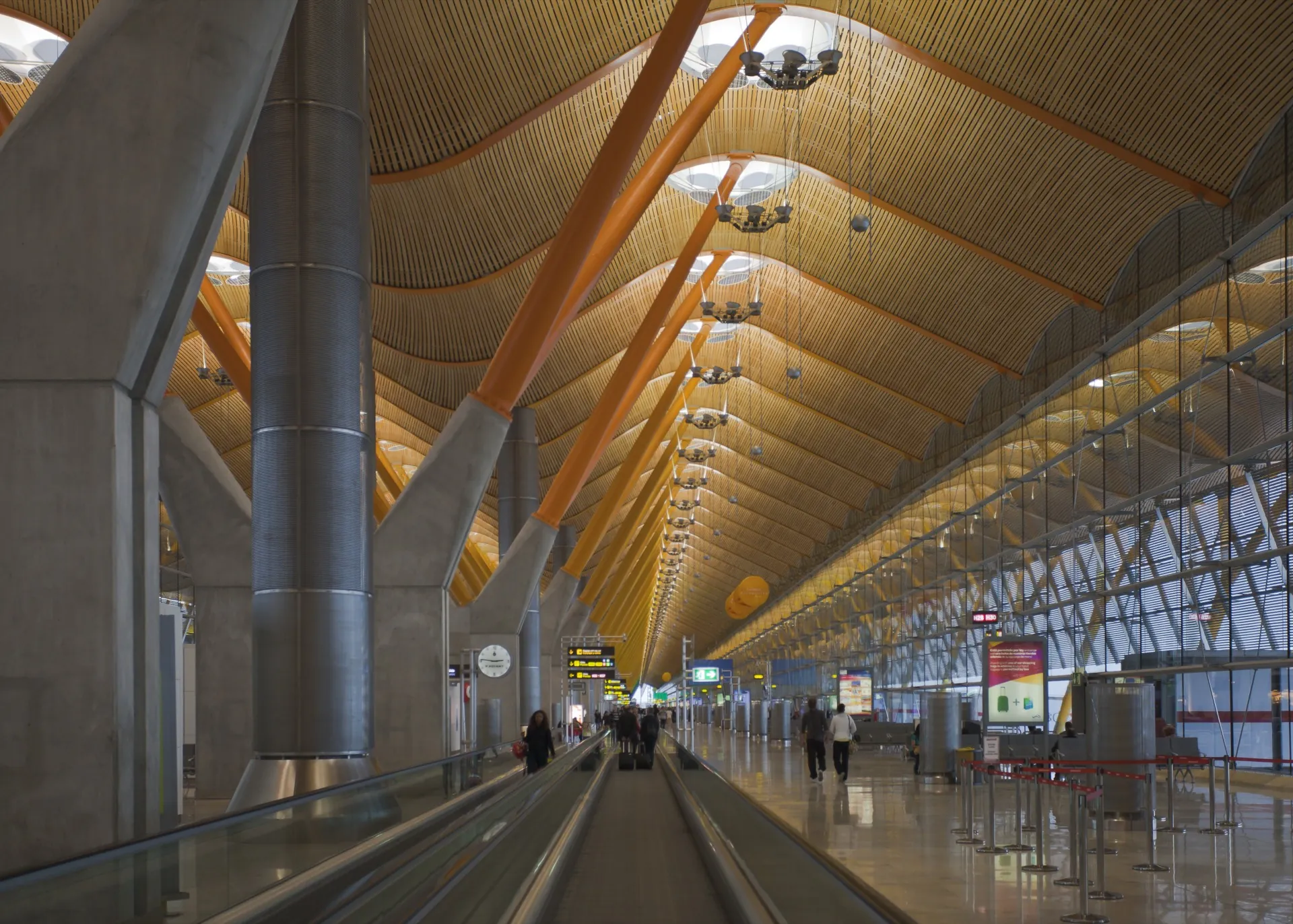
Terminal 4 at Madrid Barajas. Photo by Diego Delso, CC BY-SA 3.0, via Wikimedia Commons.
The airport as it stands
Four runways on a plateau 609 metres above the sea
Madrid Barajas opened on 30 April 1931 on farmland beside the village of Barajas. The field has grown to 3,050 hectares and four runways, and it remains the busiest airport in Spain by passengers, cargo and movements.
The site sits at 609 metres, which is high for a major European hub, and the air is dry for most of the year. The two north to south runways, 18L/36R and 18R/36L, are parallel and 1.8 kilometres apart. The two northwest to southeast runways, 14L/32R and 14R/32L, are 2.5 kilometres apart. The layout allows independent operations and a peak rate of about 120 movements an hour, one take off or landing every 30 seconds.
Runway 18R/36L is the longest at 4,350 metres and takes the heaviest long haul departures. Runway 14R/32L is 3,988 metres. The other two measure 3,500 metres. Several thresholds are displaced, including 1,050 metres on 32L and 985 metres on 18R, so the landing distance is shorter than the physical strip.
Aena's expansion case rests on the four runways being sufficient for the traffic it forecasts to 2031. The money goes into terminals, access and the apron rather than new asphalt. In 2025 the airport handled 68,179,054 passengers, 840,331 tonnes of cargo and 430,616 movements, all records. It ranks fifth in Europe and fifteenth in the world by passengers.
Why the cargo figure matters. Madrid handled 61 percent of all air cargo in the Aena Spanish network in 2025, more than Barcelona, Zaragoza and Vitoria combined. For a Philippine exporter the relevant fact is not the total but the Latin American and European belly capacity that comes with it.
Runway lengths, longest first
Terminals
Terminal 4 turned twenty, and the roof still sets the tone
Terminal 4 opened on 5 February 2006 with its satellite, T4S, and two new runways. Richard Rogers, Antonio Lamela and Luis Vidal designed 760,000 square metres of terminal, with a bamboo ceiling carried on steel trees and a colour gradient that runs the length of the building. It won the Stirling Prize in 2006, the only Spanish building to do so.
T4 holds check in, security, the Schengen and domestic gates, and the metro and train station. T4S is airside only and takes most non Schengen long haul. An underground automated train links the two buildings across 2.1 kilometres and runs around the clock. There is no walkway, and access to T4S is always through T4.
The older T1, T2 and T3 buildings sit about two kilometres away and operate as one complex. Passengers can walk between them airside. A free shuttle bus connects the complex with T4 every few minutes, 24 hours a day, and Metro line 8 has stations at both the T1 to T3 complex and T4.
Terminal assignments move with alliances and seasons, so the boarding pass decides. The table is the working pattern in late 2026.
DORA 2027 to 2031
Aena plans €4.49 billion of investment at Madrid, with €2.96 billion spent in the 2027 to 2031 window. The current practical ceiling is about 70 million passengers.
- T4 extended by 500 metres, with more check in, security and boarding positions
- T4S south dock extended 36 metres for three contact stands
- T1, T2 and T3 combined behind a new processing building
- Metro line 5 reaches the airport around 2027
- Ground prepared for high speed rail access
- Forecast of 73.3 million passengers by 2031
| Terminal | Main users | Gates | Access |
|---|---|---|---|
| T1 | SkyTeam, Star Alliance, Ryanair, easyJet and most non aligned long haul | A, B, C | Metro station at T2, free shuttle to T4 |
| T2 | Schengen carriers including Air France, KLM, Lufthansa, Swiss and TAP | D | Metro station on floor 1 |
| T3 | Overflow for the T1 and T2 group | D, E | Walk to T2 for metro |
| T4 | Iberia group, Air Europa, oneworld, Schengen and domestic | H, J, K | Metro and Cercanías station |
| T4S | Non Schengen long haul of the T4 carriers | M, R, S, U | Airside train from T4 only |
Airlines and routes
Iberia's hub, 447 routes, and the Asian nonstops that matter
Madrid runs 447 routes, 377 international and 70 domestic. Iberia carried 27 percent of passengers in 2025, Air Europa 17 percent and Ryanair 11 percent. Iberia, Iberia Express, Air Europa, Plus Ultra, World2Fly and Wamos Air all base aircraft here, which is why Madrid has more seats to Latin America than any other European hub.
The Asian nonstops from Madrid
Madrid has direct flights to Beijing with Air China, Shanghai with China Eastern, Hong Kong with Cathay Pacific and Seoul with Korean Air. Cathay moved Madrid to a daily service on 25 October 2026, and Korean Air runs four weekly rotations to Incheon. Singapore Airlines also runs five weekly Madrid to Singapore flights that stop in Barcelona, which keeps the Changi network reachable on one ticket. Tokyo, Bangkok and Kuala Lumpur require a connection.
For a Philippine trip the Asian nonstop is only useful if the second leg is short and the ticket is protected. Hong Kong and Seoul both have several daily flights to Manila, Clark and Cebu. Beijing and Shanghai work for business travel but add visa and transit complexity for a holiday.
Latin America is the real Madrid advantage. Iberia and Air Europa connect Madrid to more than 20 Latin American cities. A Spanish exporter can put a Philippine sourcing team in Manila and a regional sales office in Madrid without a third hub, and a Philippine exporter can reach Europe and Latin America through one European stop.
The connection
11,653 kilometres, no nonstop, and a 17 hour best case
No airline flies nonstop between Madrid and Manila. The great circle distance is 11,653 kilometres. The fastest published one stop routing is about 17 hours 10 minutes through Hong Kong. Most itineraries run 18 to 24 hours, and cheap fares with long layovers reach 25 to 30 hours.
| Hub | Carrier from Madrid | Typical total | Note |
|---|---|---|---|
| Hong Kong | Cathay Pacific, daily | 17 to 20 hours | CX298 leaves Madrid at 22:30 and reaches Hong Kong at 18:15 the next day |
| Doha | Qatar Airways | 18 to 21 hours | Best connection to Philippine Airlines through the codeshare |
| Dubai | Emirates | 19 to 21 hours | Several daily Dubai to Manila departures |
| Abu Dhabi | Etihad Airways | 18 to 22 hours | Good fares, longer layovers on some dates |
| Istanbul | Turkish Airlines | 20 to 23 hours | Strong network to Cebu and Clark |
| Beijing, Shanghai, Guangzhou | Air China, China Eastern, China Southern | 19 to 25 hours | Transit visa rules apply to some routings |
| Seoul | Korean Air, four weekly | 18 to 21 hours | Useful for Incheon to Clark or Cebu |
| Singapore | Singapore Airlines, five weekly via Barcelona | 22 to 26 hours | Two stops, but one ticket and a strong Manila network |
Time difference. Manila is six hours ahead of Madrid in the European winter and seven hours ahead in summer. A morning departure from Madrid lands in Manila the following day, and a late evening departure can land in the afternoon of the next day.
Arrival airports. Ninoy Aquino International in Manila has four terminals. Terminal 1 takes most foreign carriers, Terminal 2 is Philippine Airlines, Terminal 3 is Cebu Pacific and most international low cost flying, and Terminal 4 handles domestic turboprops. Clark, Cebu and Davao are the other international gateways, and all three have direct links to the Gulf, Hong Kong, Seoul or Singapore.
Philippine Airlines does not fly to Europe. It reaches Europe through its Qatar Airways codeshare, so the Doha routing can be sold as one ticket with a single baggage rule and a protected connection. Do not assume a European carrier will check baggage through to a separate Philippine Airlines ticket.
Tourism
Thirty days visa free, and three island groups to spend them on
Spanish passport holders enter the Philippines visa free for 30 days under Executive Order 408. The passport must be valid for six months beyond the stay, and you need a return or onward ticket. Register on eTravel within 72 hours of arrival. Extensions are handled by the Bureau of Immigration.
The Philippines recorded 5.94 million foreign visitors in 2025, with tourism accounting for about 9 percent of GDP. The country has 7,641 islands, and the practical split for a first trip is three groups.
Luzon
- Manila and Intramuros, the walled city begun in 1571
- Vigan, a UNESCO World Heritage town of Spanish colonial streets
- Banaue and Batad rice terraces, a UNESCO site of more than 2,000 years
- Baguio, Sagada and the Cordillera mountains
- Taal, Corregidor and the beaches of Zambales
Visayas
- Cebu, Bohol and the Chocolate Hills
- Boracay and the Aklan coast
- Iloilo, Bacolod and Negros
- Siquijor and Dumaguete
- Kalibo and Antique for quieter beaches
Mindanao
- Davao, Samal and Mount Apo
- Siargao and the Caraga coast
- Camiguin and its volcanoes
- Bukidnon and Lake Sebu
- Zamboanga and the Chavacano speaking peninsula
A shared history that Madrid readers notice
Spain and the Philippines share 333 years of history. Spanish surnames, the Catholic calendar and thousands of loanwords remain, and Chavacano, a Spanish based creole, is still spoken in Zamboanga and Cavite. Intramuros, San Agustin Church and Vigan are the clearest places to see it. Spanish returned to the public school curriculum as an optional subject in 2012, and the Instituto Cervantes has a branch in Manila.
That history is not a museum piece. It is the reason a Spanish traveller finds the food, the street names and the church calendar familiar, and the reason a Spanish company can build trust faster than a competitor starting from zero.
When to go
The dry season runs December to May and is the best window for beaches and mountain roads. June to November brings rain and typhoons, with the peak in August and September. Temperatures stay between 26 and 32 degrees Celsius on the coast all year, and the highlands around Baguio are 8 to 10 degrees cooler.
For a two week trip, fly into Manila, spend two days in Intramuros and the old city, then choose one island group rather than three. Internal flights are frequent and cheap, but the ferries and roads add hours that a short itinerary cannot absorb.
Investment
A 20 percent corporate rate and full foreign equity in export manufacturing
The CREATE MORE Act, Republic Act 12066, took effect in 2024. It cut the standard corporate income tax to 20 percent for domestic corporations, added deductions for power and logistics, and kept the 4 to 7 year income tax holiday. Export manufacturing can be 100 percent foreign owned.
The standard rate for domestic corporations, down from 25 percent.
Based on location and industry tier under the investment priorities plan.
On gross income for export enterprises, in place of the standard rate.
Allowed in export manufacturing and in most sectors opened by the 2022 reforms.
Halved to $100,000 for advanced technology or 50 or more direct employees.
BOI, PEZA, SBMA and CDC administer the incentives, with DTI as the policy ministry.
The Spanish angle
The EU is the fourth largest trading partner of the Philippines, with €17.6 billion of two way goods trade in 2025. Spain exported $960 million to the Philippines in 2024 and imported $508 million. The 11th Philippines Spain Forum met in Madrid in March 2025 around port cooperation, water management, language and the EU trade agreement.
Spanish firms already work in infrastructure, water, rail signalling, renewables, tourism and port operations. The Spanish Chamber of Commerce now describes the Philippines as a base for Southeast Asia rather than a single market, which is the right frame for a manufacturer looking at the 680 million people in ASEAN.
Links: Board of Investments, PEZA and the Department of Trade and Industry.
This page is not investment, legal, tax or incentive advice. Confirm the current rules with the Board of Investments, PEZA or your counsel before committing capital.
What a Madrid head office actually gets. English is an official language, the legal system is civil law with a familiar corporate form, and the time difference allows a same day call with Manila before the end of the Madrid morning. The harder parts are power costs, permitting timelines and the need for a local partner on land and labour, so budget for a six to twelve month setup rather than a quick registration.
Manufacturing
What Madrid buys, and what Luzon can make
Philippine merchandise exports reached $84.48 billion in 2025. Electronics and semiconductors were $49.64 billion, or 58.81 percent of the total. The sectors below are the ones a Spanish buyer or investor is most likely to use.
| Sector | What it covers | Where | Why Madrid |
|---|---|---|---|
| Electronics and semiconductors | Assembly, test, printed circuit boards, power supplies | Laguna, Cavite, Batangas, Clark | EU electronics demand and Spanish EMS partners |
| Aerospace | Maintenance, parts and composites | Clark, Subic, Laguna | Iberia maintenance and the Airbus supply chain |
| Automotive and parts | Wiring harnesses, interiors, castings | Laguna, Batangas, Cebu | Spanish tier one suppliers and Latin American plants |
| Agribusiness | Coconut, pineapple, banana, tuna | Mindanao, Bicol, Panay | Spain is a large coconut oil buyer |
| Apparel and uniforms | Workwear, corporate wear, sport and school kit | Metro Manila, Cavite, Cebu, Tagum | Short runs from 20 pieces and four currency pricing |
Contract apparel, priced for a Spanish buyer
Indicative ex works prices for the order bands below, in the four currencies used across this site. Embroidery, printing, labels and freight are quoted separately.
Corporate polo shirts and office uniforms
Pique or jersey, embroidery, woven collar
Minimum 20 pieces, 12 to 18 working days after artwork approval.
Rash guards and athletic kit
Four way stretch, sublimation, flatlock seams
Minimum 20 pieces, 15 to 22 working days for a first run.
Heavy duty workwear and jackets
Twill or canvas, reinforced seams, reflective trim
Minimum 50 pieces, 20 to 30 working days depending on fabric.
Corporate jackets and blazers
Structured lining, embroidered crest, tailored fit
Minimum 50 pieces, 25 to 35 working days after fitting.
Trade
Coconut oil west, spirits and pork east, and a tariff window that closes in 2027
Two way goods trade between Spain and the Philippines was about $1.47 billion in 2024. The lane is small next to Germany or the Netherlands, but it is balanced enough to support regular container and air freight rather than one off shipments.
Philippines to Spain, 2024
$508M- Electronics$169M
- Coconut oil$103M
- Processed fish$55.9M
- Electric heaters$49.9M
Spain to Philippines, 2024
$960M- Hard liquor$207M
- Pig meat$122M
- Edible offal$121M
The tariff window
Philippine goods enter the EU duty free under GSP+ on 6,274 tariff lines, including apparel, until the scheme ends in 2027. The Philippines has been classified as upper middle income, and graduation follows three consecutive years at that level. The EU and the Philippines reached substantial agreement on a free trade deal on 22 September 2026, covering more than 94 percent of tariff lines and 97 percent of trade, with signature expected in 2027.
If the gap is not closed, most finished apparel would face the 12 percent most favoured nation rate. That is the single number a Spanish buyer should keep in view when setting a landed cost for 2027 and 2028. Detail sits on the EU Philippines FTA status page.
Freight and paperwork
Air cargo from Manila to Madrid moves through the Gulf or Hong Kong and takes two to four days door to door. Sea freight from Manila to Valencia or Barcelona runs about 30 to 38 days through Suez, and a full container is the normal unit for apparel above 5,000 pieces.
GSP+ claims need a registered exporter statement, and the REX number is the document the EU customs system checks. The registered exporter REX system page explains the registration, and the HS 61 and 62 classification page covers the tariff lines.
Questions
What travellers and buyers ask about Madrid Barajas
What is the airport code and where is it?
The IATA code is MAD and the ICAO code is LEMD. The airport sits at Barajas, 12 kilometres northeast of the centre of Madrid, at an elevation of 609 metres. It covers 3,050 hectares and has four runways.
Is there a nonstop flight from Madrid to Manila?
No. The fastest one stop routing is about 17 hours 10 minutes through Hong Kong, and most itineraries run 18 to 24 hours. Doha, Dubai, Abu Dhabi, Istanbul, Beijing, Shanghai, Guangzhou and Seoul are the other one stop hubs. The distance is 11,653 kilometres.
Do Spanish passport holders need a visa for the Philippines?
No, for stays up to 30 days under Executive Order 408. You need a passport valid for six months beyond the stay, a return or onward ticket, and an eTravel registration within 72 hours of arrival. Extensions are handled by the Bureau of Immigration.
Which terminal does my flight use?
Iberia, Air Europa and most oneworld long haul use T4 and T4S. SkyTeam, Star Alliance and most other carriers use T1, T2 or T3. T4S is airside only and reached by an underground train from T4. Assignments change by season, so check the boarding pass.
How do I get from the airport to central Madrid?
Metro line 8 runs to Nuevos Ministerios in about 25 minutes for €4.50 to €5.00 including the €3 airport supplement. Cercanías C1 runs from T4 to Atocha and Chamartín for €1.70 to €2.60. The airport express bus 203 runs 24 hours for €5. A taxi inside the ring road is a fixed €33. The airport is 12 kilometres from the centre.
What incentives does the Philippines offer a Spanish manufacturer?
Under CREATE MORE, a 20 percent corporate income tax, a 4 to 7 year income tax holiday, a 5 percent special corporate income tax on gross income for export enterprises, and 100 percent foreign equity in export manufacturing. BOI, PEZA, SBMA and CDC administer the incentives. Minimum paid in capital is $200,000, or $100,000 for advanced technology or 50 or more direct employees.
What duty applies to Philippine garments entering Spain?
Zero duty under GSP+ on eligible lines, while the scheme runs to 2027. If GSP+ ends before the EU Philippines free trade agreement takes effect, most finished apparel would face the 12 percent most favoured nation rate. A registered exporter statement is needed for the preference.
Is Madrid a practical base for a Philippine sourcing office?
Yes. Madrid has a direct one stop link to Manila, a daily Cathay service to Hong Kong and four weekly Korean Air flights to Seoul. The time difference is six hours in winter and seven in summer, which leaves a working overlap in the Madrid morning. English is an official language in the Philippines, and the Spanish business community there is small but active.
Planning a trip or a production run from Madrid?
Send your travel dates, flight routing or apparel specification and our team in Tagum City will reply. Business hours: Mon to Sat, 8:30 AM to 5:00 PM (PHT).
Passenger, cargo and movement figures for 2025 come from Aena statistics published on 13 January 2026. Airport profile, route count, terminal split and the T4 twentieth anniversary come from Aena. The DORA 2027 to 2031 investment and the 90 million capacity come from Aena on 30 July 2026. Runway lengths, displaced thresholds and elevation come from the Spanish AIP and the LEMD aeronautical data. Airline schedules come from Cathay Pacific, Korean Air, Qatar Airways, Emirates and Singapore Airlines in late 2026. Trade figures are 2024 merchandise flows reported by the Observatory of Economic Complexity. Aid for trade, GSP+ and the free trade agreement come from the European Commission, including the substantial agreement statement of 22 September 2026. Visitor arrivals and tourism share come from the Philippine Department of Tourism for 2025. Visa detail is from Executive Order 408 and the Philippine Department of Foreign Affairs. Investment detail is from the CREATE MORE Act, Republic Act 12066. The hero photograph is by Diego Delso, CC BY-SA 3.0, via Wikimedia Commons. Schedules, fares, visa rules and construction dates change, so confirm with the airline, the airport operator and the Philippine consulate before you commit.