
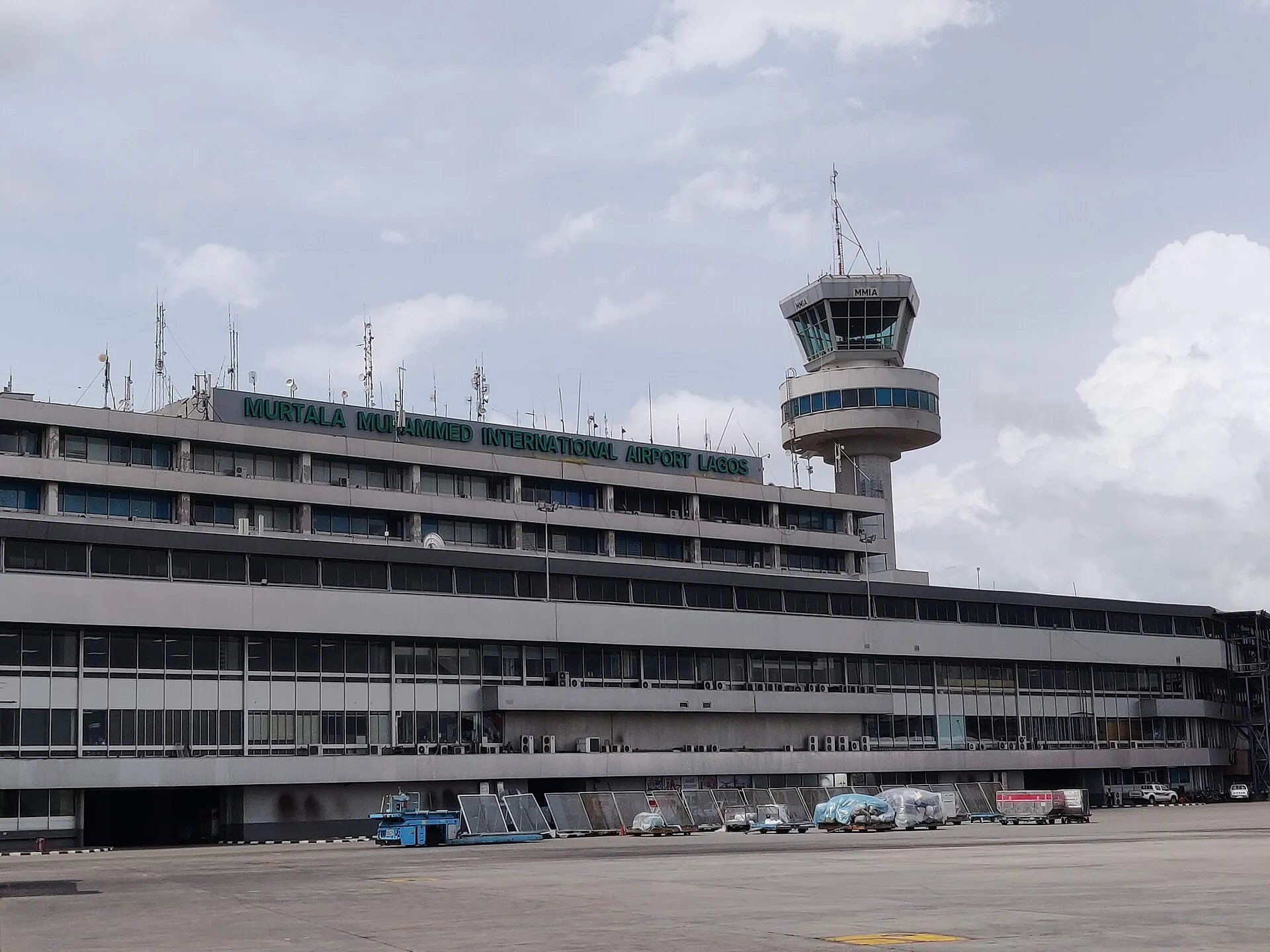
Murtala Muhammed International Airport and the Philippines
The busiest international gateway in Nigeria, on the mainland at Ikeja in Lagos State. This page covers the runways, the Terminal 1 rebuild and the temporary departure hall, the carriers, the one stop routing to Manila, the visa a Nigerian passport needs, and the trade and manufacturing case that connects Lagos to Philippine production.
The international terminal and control tower. Photo by Sm105, CC BY-SA 4.0, via Wikimedia Commons.
Two parallel runways on the Lagos mainland
Murtala Muhammed International Airport sits at Ikeja, about 20 kilometres north of Lagos Island. The field was built during the Second World War, renamed in 1976 for the head of state assassinated that year, and given its international terminal on 15 March 1979.
The international and domestic terminals stand about a kilometre apart and share the same runway pair. The longer strip, 18R/36L, runs 3,900 metres and takes the long haul departures to Europe, the Gulf and the Americas. The shorter strip, 18L/36R, runs 2,743 metres and carries most domestic and regional narrowbody traffic. The reference elevation is 41 metres, low and hot, which is why payload planning matters on the longest sectors.
The airport is operated by the Federal Airports Authority of Nigeria and is the base for Air Peace, Arik Air, Aero Contractors, Ibom Air, Azman Air, ValueJet and Rano Air. That domestic depth is the part a visitor notices first: the apron is busy from early morning with 737s and regional jets moving between Lagos, Abuja, Port Harcourt, Kano and Enugu.
Nigeria's airports handled 17.94 million passengers in 2025, 13.09 million of them on domestic routes, according to FAAN. International traffic at Lagos grew 6.5 percent to 4.3 million passengers in 2024. The national total and the Lagos international figure measure different things, and the international one is the number that matters to a traveller arriving from abroad.
Why the runway length matters. The 3,900 metre strip is what allows nonstop widebody service to London, Paris, Amsterdam, Istanbul, Dubai, Doha, Addis Ababa and Atlanta. A shorter field would push some of those routes into a technical stop, and a technical stop is where fresh produce, samples and urgent freight lose their advantage.
Terminal 1 is closed for a 22 month rebuild
The 1979 international building closed in March 2026 for a full rebuild approved at ₦712.26 billion. Departures run through a temporary hall and arrivals continue at Terminal 2, which opened in 2022 with capacity for 14 million passengers a year.
Terminal 2 was built with a China Exim Bank loan and commissioned by President Muhammadu Buhari on 22 March 2022. Airlines were ordered to move across by October 2023, which freed Terminal 1 for the rebuild. When both buildings are open the pair is expected to handle about 17.6 million passengers a year.
For a traveller the practical advice is simple. Confirm the terminal with the airline on the day, arrive three hours before an international departure, and allow extra time for road traffic on the Airport Road approach. The temporary departure hall works, but it is a temporary hall, and the walk from the curb to the gate is longer than the building suggests.
What the rebuild changes. New mechanical, electrical and plumbing systems, a reinforced facade, separated arriving and departing flows in the terminal fingers, and a reworked commercial layout. The point is not cosmetic. The old building was handling peak loads far above its design, and the constraint showed up as queues at immigration and baggage rather than in the air.
Europe, the Gulf, and a domestic network that fills the apron
Lagos carries the European and Gulf long haul that connects Nigeria to the world, alongside one of the largest domestic airline clusters in Africa. The list below is the working pattern in late 2026 and it changes with seasons and aircraft availability.
Europe
- British AirwaysLondon Heathrow
- Virgin AtlanticLondon Heathrow
- Air FranceParis Charles de Gaulle
- KLMAmsterdam
- LufthansaFrankfurt and Malabo
- NeosMilan Malpensa
- Royal Air MarocCasablanca
Gulf and Middle East
- EmiratesDubai
- Qatar AirwaysDoha
- Turkish AirlinesIstanbul
- Etihad AirwaysAbu Dhabi, from 18 March 2027
- Middle East AirlinesBeirut and Abidjan
Africa
- Ethiopian AirlinesAddis Ababa
- Kenya AirwaysNairobi
- South African AirwaysJohannesburg
- RwandAirKigali
- Air Côte d'IvoireAbidjan, Johannesburg, Libreville
- ASKY AirlinesLomé and onward
- Africa World AirlinesAccra
- Air Tanzania, Uganda Airlines, TAAGDar es Salaam, Entebbe, Luanda
Americas and domestic
- Delta Air LinesAtlanta, seasonal New York JFK
- United AirlinesWashington Dulles
- Air PeaceLargest domestic carrier
- Arik Air, Aero ContractorsDomestic and regional
- Ibom Air, United NigeriaDomestic and Accra
- ValueJet, Green Africa, Max Air, Azman AirDomestic
Freighters and belly capacity
Cargo moves on dedicated freighters and in the belly of the passenger long haul. The dedicated operators include Air France Cargo, Cargolux, DHL Aviation, Emirates SkyCargo, Ethiopian Airlines Cargo, Lufthansa Cargo, Qatar Airways Cargo, Saudia Cargo and Turkish Cargo. The two ground handlers, SAHCO and NAHCO, run the breakdown and sorting.
For a Philippine exporter the useful capacity is the Gulf and Ethiopian belly network, because both connect to Asian hubs without crossing Europe. A shipment routed Manila to Dubai to Lagos, or Manila to Addis Ababa to Lagos, stays on one airline group and one baggage rule for the whole journey.
Lagos is not a cargo airport first. It is a passenger airport with a serious cargo operation attached. That matters when you compare it with Lekki Deep Sea Port, which is the modern container gateway, or with Apapa and Tin Can Island, which still carry most of the traditional container volume. Air is for samples, launches and urgent restock, not for a full season.
12,757 kilometres, no nonstop, and three clean one stop hubs
No airline flies nonstop between Lagos and Manila. The great circle distance is 12,757 kilometres. Doha, Dubai and Istanbul are the one stop hubs that keep the whole journey on a single ticket, and Addis Ababa works as a two stop routing through Hong Kong.
Time difference. Manila is seven hours ahead of Lagos all year. Neither country changes clocks. A 09:00 departure from Lagos reaches Manila the following afternoon, and a late evening departure can land in the morning two calendar days later once the connection is counted.
Arrival airports. Ninoy Aquino International in Manila has four terminals. Terminal 1 takes most foreign carriers, Terminal 2 is Philippine Airlines, Terminal 3 is Cebu Pacific and most international low cost flying, and Terminal 4 handles domestic turboprops. Clark, Cebu and Davao are the other international gateways, and all three connect to the Gulf, Hong Kong, Seoul or Singapore.
Buy one ticket. A protected connection matters more than a short layover. If the first leg is late, a single ticket puts the airline under an obligation to rebook you. Two separate tickets leave you with a missed flight and a new fare, which is the most common way a Lagos to Manila trip turns into a two day journey.
A visa is required, and the e-Visa is the shortest route
Nigeria is not on the Philippine 30 day visa free list. A Nigerian passport needs a visa before travel. The Philippine Embassy in Abuja is one of the posts piloting the e-Visa, and the 9(a) temporary visitor visa is the normal route for tourism or business.
What a Nigerian applicant prepares
- Apply at evisa.gov.ph or through the Philippine Embassy in Abuja. Use the post that has jurisdiction over your place of residence.
- Prepare a passport valid for six months beyond departure, a confirmed return or onward ticket, proof of financial capacity, hotel booking or proof of lodging, and an itinerary.
- Pay the fee and wait for the e-Visa by email. Carry the approval with the passport, not on the phone alone.
- Register on eTravel inside 72 hours of arrival, and keep the confirmation ready at the airport.
An e-Visa cannot be converted to another visa type and cannot be extended. If the trip may run past the visa period, apply for the appropriate visa before departure rather than relying on an extension at the Bureau of Immigration.
What feels familiar, and what does not
English is an official language in both countries, so the paperwork, the signage and the negotiation all happen in the same language. Both are tropical, both have a long coastline, and both run on a service culture that visitors from Lagos recognise quickly.
The differences are the ones that make the trip worth taking. The Philippines is an archipelago of 7,641 islands with a Spanish colonial layer, an American influenced school system and a food culture built on vinegar, soy, coconut and grilled fish rather than pepper and palm oil. The pace outside Manila is slower, and island hopping is a normal weekend rather than a special expedition.
The honest part. The visa takes time, the flight takes a full day, and Manila traffic is as bad as Lagos traffic on its worst day. The reward is a country where a Nigerian visitor can move in English, pay in pesos or dollars, and reach a beach, a mountain and a Spanish walled city inside a single two week trip.
LuzonNorth
- Manila and Intramuros, the walled city begun in 1571
- Vigan, a UNESCO World Heritage town of colonial streets
- Banaue and Batad rice terraces
- Baguio, Sagada and the Cordillera mountains
- Taal, Corregidor and the Zambales coast
VisayasCentre
- Cebu, Bohol and the Chocolate Hills
- Boracay and the Aklan coast
- Iloilo, Bacolod and Negros
- Siquijor and Dumaguete
- Kalibo and Antique for quieter beaches
MindanaoSouth
- Davao, Samal and Mount Apo
- Siargao and the Caraga coast
- Camiguin and its volcanoes
- Bukidnon and Lake Sebu
- Zamboanga and the Chavacano speaking peninsula
When to go
The dry season runs December to May and is the best window for beaches and mountain roads. June to November brings rain and typhoons, with the peak in August and September. Temperatures stay between 26 and 32 degrees Celsius on the coast all year, and the highlands around Baguio are 8 to 10 degrees cooler.
For a first trip, fly into Manila, spend two days in Intramuros and the old city, then choose one island group rather than three. Internal flights are frequent and cheap, but ferries and roads add hours that a short itinerary cannot absorb. The Philippines recorded 5.94 million foreign visitors in 2025, with tourism accounting for about 9 percent of gross domestic product.
A 20 percent corporate rate and full foreign equity in export manufacturing
The CREATE MORE Act, Republic Act 12066, took effect in 2024. It cut the standard corporate income tax to 20 percent for domestic corporations, added deductions for power and logistics, and kept the 4 to 7 year income tax holiday. Export manufacturing can be 100 percent foreign owned.
The standard rate for domestic corporations, down from 25 percent.
Based on location and industry tier under the investment priorities plan.
On gross income for export enterprises, in place of the standard rate.
Allowed in export manufacturing and in most sectors opened by the 2022 reforms.
Halved to $100,000 for advanced technology or 50 or more direct employees.
BOI, PEZA, SBMA and CDC administer the incentives, with DTI as the policy ministry.
The Lagos angle
Nigeria and the Philippines are both English speaking republics with young populations, large domestic markets and a diaspora that sends money home. Nigeria has about 230 million people and the Philippines about 114 million. For a Lagos investor, the Philippine market is smaller but the export platform is larger: the country sits inside ASEAN, has preferential access to Japan, Australia and the European Union on many lines, and ships to the United States at scale.
The time difference is the practical advantage. Lagos at 08:00 is Manila at 15:00, so a Lagos morning call reaches a Manila afternoon, and a decision taken in Lagos on Monday can be acted on in Manila the same working day. That is a shorter loop than Lagos to London or Lagos to New York.
Links: Board of Investments, PEZA and the Department of Trade and Industry.
This page is not investment, legal, tax or incentive advice. Confirm the current rules with the Board of Investments, PEZA or your counsel before committing capital.
What a Lagos head office actually gets. English is an official language, the corporate form is familiar, and the incentives are written into statute rather than negotiated case by case. The harder parts are power costs, permitting timelines and the need for a local partner on land and labour, so budget for a six to twelve month setup rather than a quick registration.
What Lagos buys, and what Philippine factories can make
Philippine merchandise exports reached $84.48 billion in 2025. Electronics and semiconductors were $49.64 billion, or 58.81 percent of the total. The sectors below are the ones a Nigerian buyer or investor is most likely to use.
Apparel and uniforms
Corporate wear, oil and gas workwear, school and hospitality uniforms, church and choir robes, blank shirts for Lagos labels
Metro Manila, Cavite, Cebu, Tagum English specs, low minimums, OEM and ODMElectronics and semiconductors
Assembly, test, printed circuit boards, power supplies, wire harnesses
Laguna, Cavite, Batangas, Clark 58.81 percent of Philippine exportsCoconut and agribusiness
Coconut oil, desiccated coconut, processed fruit, marine products
Mindanao, Bicol, Panay The Philippines is the world's largest coconut exporterPackaging and printing
Corrugated cartons, labels, retail packaging, point of sale print
Metro Manila, Cebu Supports the apparel and food lanesContract apparel, priced for a Nigerian buyer
Indicative ex works prices for the order bands below, in the four currencies used across this site. Embroidery, printing, labels and freight are quoted separately.
Corporate polo shirts and office uniforms
Pique or jersey, embroidery, woven collar
Minimum 20 pieces, 12 to 18 working days after artwork approval.
Rash guards and athletic kit
Four way stretch, sublimation, flatlock seams
Minimum 20 pieces, 15 to 22 working days for a first run.
Heavy duty workwear and jackets
Twill or canvas, reinforced seams, reflective trim
Minimum 50 pieces, 20 to 30 working days depending on fabric.
Corporate jackets and blazers
Structured lining, embroidered crest, tailored fit
Minimum 50 pieces, 25 to 35 working days after fitting.
Oil one way, manufactured goods the other, and a 35 percent tariff wall
Two way goods trade was about $214 million in 2025. Nigeria sent $207.04 million, almost all of it mineral fuels. The Philippines sent $7.02 million, led by machinery, cosmetics and knit apparel. The lane is small, lopsided, and open to a manufacturer who can absorb the duty.
Nigeria to the Philippines, 2025
$207.04M- Mineral fuels and oils$204.62M
- Food industry residues and fodder$2.42M
- Glass and glassware$4.20K
Almost 99 percent of the value is mineral fuels. This is an energy trade with a small manufactured goods tail, not a two way consumer goods corridor.
Philippines to Nigeria, 2025
$7.02M- Machinery and boilers$1.51M
- Essential oils, perfumes, cosmetics$1.44M
- Soaps, waxes, lubricants$819.92K
- Plastics$665.74K
- Knit apparel$638.35K
- Cereal, flour and starch preparations$439.68K
What the Nigerian customs bill adds up to
Nigeria applies the ECOWAS Common External Tariff. Finished garments sit in the 20 percent or 35 percent band depending on the exact HS line, and the duty is only the first line of the bill. The order below is the order the charges stack.
- Import duty at the ECOWAS CET rate, 20 percent or 35 percent on finished apparel, charged on the CIF value.
- 7 percent surcharge on the duty itself, not on the goods value.
- 1 percent CISS on the FOB value, the Comprehensive Import Supervision Scheme levy.
- 0.5 percent ETLS on the CIF value, the ECOWAS Trade Liberalisation Scheme levy.
- 7.5 percent VAT on the CIF value plus duty plus surcharge plus levies.
At the 20 percent band the stack comes to roughly 32 percent of the CIF value. At the 35 percent band it is materially higher. Confirm the exact HS line and rate with a licensed customs broker or the Nigeria Customs Service before you price a landed cost.
Documents and the trade agreement gap
A commercial invoice, packing list, bill of lading or air waybill, certificate of origin, Form M registration and a SONCAP certificate are the core set. SONCAP testing is handled by accredited agencies such as Bureau Veritas, Intertek or SGS before departure, and the certificate is checked at clearance. PAAR is the pre arrival assessment that releases the container.
Nigeria is a member of the African Continental Free Trade Area. The Philippines is not, so there is no preferential rate on this lane and no cumulation between the two. That is the structural reason a Philippine garment pays the full tariff while a garment made inside an ECOWAS member can move at a lower rate. The AfCFTA overview explains the rules and the Nigeria import page covers the port and document sequence in detail.
For freight, sea to Lekki, Apapa or Onne runs 28 to 48 days, and air to Lagos runs 3 to 5 days airport to airport. A first order usually flies so the buyer can inspect the make before committing a container.
What travellers and buyers ask about Lagos
What is the airport code and where is it?
The IATA code is LOS and the ICAO code is DNMM. The airport sits at Ikeja in Lagos State, about 20 kilometres north of Lagos Island, at an elevation of 41 metres. It has two parallel runways and one international terminal, with a separate domestic terminal about a kilometre away.
Is Terminal 1 open?
No. Terminal 1 closed in March 2026 for a 22 month rebuild approved at ₦712.26 billion. Departures run through a temporary hall and arrivals continue at Terminal 2. Confirm the terminal with the airline on the day and arrive three hours before an international departure.
Is there a nonstop flight from Lagos to Manila?
No. The great circle distance is 12,757 kilometres. Doha, Dubai and Istanbul are the clean one stop hubs, with total journey times of 18 to 24 hours. Addis Ababa, Nairobi and Johannesburg work as two stop routings. Buy the whole journey on one ticket so the connection is protected.
Do Nigerian passport holders need a visa for the Philippines?
Yes. Nigeria is not on the 30 day visa free list under Executive Order 408. Apply for a 9(a) temporary visitor visa through the Philippine Embassy in Abuja or the e-Visa portal at evisa.gov.ph, which the Abuja post is piloting. Bring a passport valid for six months beyond departure, a return or onward ticket, proof of financial capacity, lodging and an itinerary, then register on eTravel inside 72 hours of arrival.
How long does air cargo take from Manila to Lagos?
Three to five days airport to airport on the Gulf or Ethiopian belly network, plus clearance. Sea freight to Lekki, Apapa or Onne runs 28 to 48 days. A first apparel order usually flies so the buyer can inspect the make before committing a container.
What duty applies to Philippine garments entering Nigeria?
Finished garments sit in the 20 percent or 35 percent ECOWAS CET band depending on the exact HS line. On top of the duty come a 7 percent surcharge on the duty, a 1 percent CISS levy on the FOB value, a 0.5 percent ETLS levy on the CIF value, and 7.5 percent VAT on the combined value. At the 20 percent band the stack is roughly 32 percent of CIF. There is no Philippines Nigeria free trade agreement, so no preferential rate applies.
Is Lagos a practical base for a Philippine sourcing office?
Yes. English is the working language, the airport has one stop links to Manila through Doha, Dubai and Istanbul, and the time difference leaves a Lagos morning overlap with the Manila afternoon. The harder parts are road traffic, power reliability and the cost of setting up a local entity, so budget for local counsel and a serviced office before committing to a lease.
What incentives does the Philippines offer a Nigerian manufacturer?
Under CREATE MORE, a 20 percent corporate income tax, a 4 to 7 year income tax holiday, a 5 percent special corporate income tax on gross income for export enterprises, and 100 percent foreign equity in export manufacturing. BOI, PEZA, SBMA and CDC administer the incentives. Minimum paid in capital is $200,000, or $100,000 for advanced technology or 50 or more direct employees.
Planning a trip or a production run from Lagos?
Send your travel dates, flight routing or apparel specification and our team in Tagum City will reply. Business hours: Mon to Sat, 8:30 AM to 5:00 PM (PHT).
Passenger figures for 2025 come from the Federal Airports Authority of Nigeria and the Lagos international figure for 2024 from the same source. Airport history, runway lengths and elevation come from the FAAN airport profile and the Nigerian aeronautical data. Terminal 1 status, the temporary departure hall and the 3,840 passenger hourly capacity come from the FAAN rehabilitation and expansion FAQ. The ₦712.26 billion approval and the 22 month programme come from the Federal Executive Council announcement of July 2025. Terminal 2 capacity and the March 2022 commissioning come from FAAN and the China Exim Bank project record. Airline and cargo schedules come from the carriers and the airport in late 2026. Trade values are 2025 merchandise flows from UN Comtrade, reported through Trading Economics. Duty bands and the levy stack come from the ECOWAS Common External Tariff, the Nigeria Customs Service and the Nigeria Tax Act 2025, which kept VAT at 7.5 percent from 1 January 2026. SONCAP and Form M detail comes from the Standards Organisation of Nigeria and the Nigeria Single Window. Visa detail comes from Executive Order 408, the Department of Foreign Affairs and the eVisaPH policy page. Visitor arrivals and tourism share come from the Philippine Department of Tourism for 2025. Investment detail comes from the CREATE MORE Act, Republic Act 12066. The hero photograph is by Sm105, CC BY-SA 4.0, via Wikimedia Commons. Schedules, fares, visa rules, tariff lines and construction dates change, so confirm with the airline, the airport operator, the Nigeria Customs Service and the Philippine Embassy before you commit.