
Digos City: Complete Barangay Guide, Tourism, and Regional Atlas
Digos City serves as the vibrant capital of Davao del Sur, positioned between the scenic western shores of the Davao Gulf and the rolling foothills of Mount Apo. Celebrated as the Mango Capital of the Philippines for its sweet carabao variety and recognized as the Gateway to the South, Digos unites 26 distinct barangays across 287.10 square kilometers, connecting Metropolitan Davao with central and southern Mindanao.
About Digos City: Origin, Growth, and Gateway Heritage
From an ancestral Austronesian settlement along the Digos River to a bustling modern component city, Digos has grown into the administrative and economic anchor of Davao del Sur.
In ancient times, the fertile plains of Digos served as a natural meeting ground along the Digos River for indigenous Austronesians dwelling at the foot of Mount Apo. The river provided rich fishing and clean bathing as it flowed into the calm waters of the Davao Gulf. During the Spanish era, conquistador Lopez Jaena Pacheco inquired about the area's name from barefoot local inhabitants. Thinking he was asking where they were bound, the natives replied "Padigus", which translates in the local dialect to "to take a bath". Over centuries of trade and settlement, the term evolved into the name Digos.
During the nineteenth century, Digos lay within the sphere of the Sultanate of Maguindanao under Datu Bago, who led regional resistance against Spanish colonization. Later recognized as part of the agricultural food bowl of the Padada Valley, the area attracted industrious migrant families from the Visayas and Ilocos regions. Prior to World War II, entrepreneur N.E. Crumb established an expansive 10.24-square-kilometer abaca plantation, laying early foundations for commercial agriculture.
Digos gained regular municipality status on July 1, 1949, through Executive Order No. 236 signed by President Elpidio Quirino, inaugurated with Benito Rabor as its first municipal mayor. Following the division of Davao Province under Republic Act No. 4867 on May 8, 1967, Digos was designated the provincial capital of Davao del Sur. Cityhood was realized through Republic Act No. 8798 authored by Congressman Douglas Cagas and signed by President Joseph Estrada, ratified overwhelmingly by residents on September 8, 2000.
Quick City Profile
- Official Status Component City, 2nd Income Class
- Provincial Role Capital of Davao del Sur
- Metropolitan Area Metropolitan Davao (Metro Davao)
- Total Population 188,376 (2020 PSA Census)
- Population Density 656 residents per km²
- Total Barangays 26 (9 Poblacion, 17 Outlying)
- Land Area 287.10 km² (13.27% of province)
- Major River Digos River
- Coastal Waterbody Davao Gulf
Geography: The Gate City of the South
Situated at the pivotal junction of the Pan-Philippine Highway (AH26) and the Davao-Cotabato Road, Digos acts as the southern transit gateway of Mindanao.
Strategic Boundaries
Digos is bounded on the south by the municipality of Hagonoy, on the north and northwest by Bansalan along Siranagan and Miral Creek, on the northeast by Santa Cruz, and on the east by the calm waters of the Davao Gulf. Its central road junction provides direct overland transit north to Davao City (60 kilometers), south to General Santos City (73 kilometers), and west across the mountains to Kidapawan and Cotabato City.
Elevation & Terrain
The city terrain transitions from coastal shores and gently rolling agricultural lowlands along the Davao Gulf to dramatic upland terrain in the north-northeast. In highland barangays such as Kapatagan, elevations climb above 1,100 meters above sea level, offering cool temperatures and serving as the primary climbing gateway to Mount Apo (2,954 meters), the highest summit in the Philippines.
Climate & Rainfall
Digos falls under a Type IV climate according to the Corona classification, characterized by evenly distributed rainfall throughout all twelve months without pronounced wet or dry extremes. Sheltered by the Mount Apo mountain range from major typhoons, the climate provides an ideal environment for fruit orchards, vegetable farming, and year-round ecotourism.
Complete Directory of the 26 Barangays of Digos City
Official Philippine Statistics Authority (PSA) 2020 Census figures, population percentages, classification, and key community landmarks across all 26 barangays.
| Barangay Name | Classification | Population (2020) | Share of City | Key Features & Landmarks |
|---|---|---|---|---|
| Tres de Mayo | Urban Core | 19,978 | 10.61% | Most populous barangay in Digos City; thriving commercial and residential area along the national highway. |
| Aplaya | Coastal | 19,234 | 10.21% | Major coastal barangay; home to Aplaya Beach Resort, seaside dining, fishermen cooperatives, and coastal schools. |
| Zone 3 (Poblacion) | Urban Core | 18,068 | 9.59% | Central downtown retail district; shopping arcades, commercial banks, professional offices, and civic commerce. |
| San Miguel (Odaca) | Urban Core | 17,312 | 9.19% | High-density residential and suburban center; technical vocational institutions and family subdivisions. |
| Zone 1 (Poblacion) | Urban Core | 16,942 | 8.99% | Historic center; hosts Rizal Park, historic town thoroughfares, traditional trade establishments, and civic hubs. |
| Kapatagan (Rizal) | Highland | 15,070 | 8.00% | Premier highland ecotourism capital at the base of Mount Apo; home to Camp Sabros, Kublai Art Garden, and vegetable farms. |
| Cogon | Urban Core | 9,650 | 5.12% | Northern highway entrance corridor; location of Kusina Kabacan, transport checkpoints, and commercial expansion. |
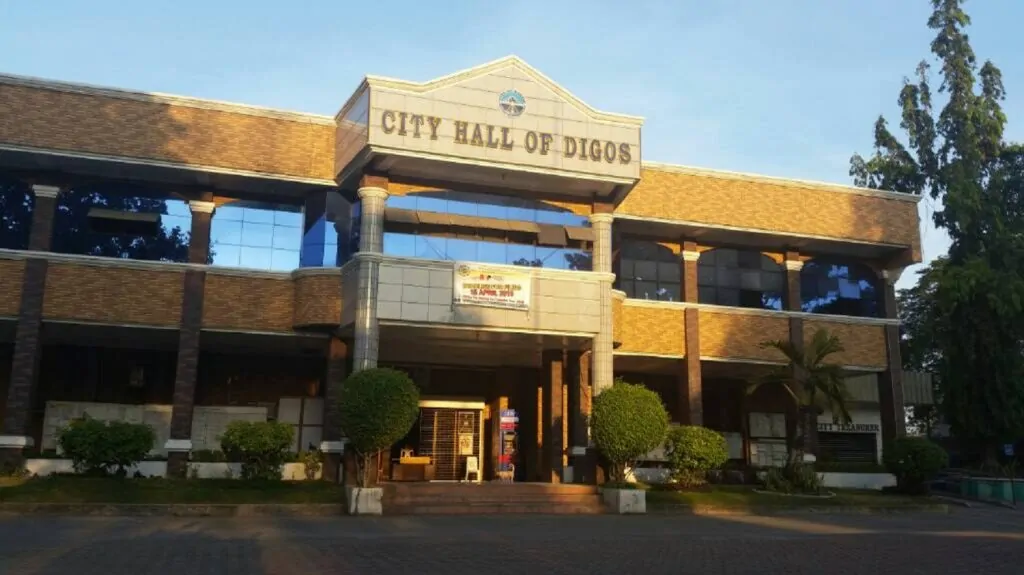
| Zone 2 (Poblacion) | Urban Core | 7,565 | 4.02% | Administrative seat of municipal authority; hosts Digos City Hall along Jose Abad Santos Street and central offices. |
| San Jose (Balutakay) | Agricultural | 7,009 | 3.72% | Productive agricultural and coastal plain; fruit orchards, banana plantations, and farming settlements. |
| Matti | Urban Core | 6,460 | 3.43% | Provincial government center; home to the Davao del Sur Provincial Capitol, Davao del Sur Sports Complex, and Provincial Hospital. |
| Kiagot | Agricultural | 6,182 | 3.28% | Rolling terrain with expanding residential communities, agroforestry, and family farms. |
| Sinawilan | Agricultural | 5,820 | 3.09% | Inland farming heartland; extensive sugarcane plantations, rice fields, and corn production. |
| Dawis | Coastal | 5,814 | 3.09% | Scenic coastal recreation area; famous for Dawis Beach, black sand shorelines, sunset views, and fishing communities. |
| Goma | Agricultural | 4,358 | 2.31% | Inland agricultural barangay with rubber groves, banana farms, and peaceful rural communities. |
| Ruparan | Agricultural | 4,278 | 2.27% | Coconut and cacao farming district; site of Ruparan National High School and family orchards. |
| Igpit | Agricultural | 3,713 | 1.97% | Foothill barangay with fertile soil, mango orchards, and Igpit National High School. |
| San Agustin | Agricultural | 3,530 | 1.87% | Inland farming sector; diversified crop production including cacao, corn, and coconuts. |
| Colorado | Agricultural | 3,301 | 1.75% | Rolling countryside; high-yield carabao mango production and homestead farms. |
| Tiguman | Agricultural | 3,095 | 1.64% | Valley settlement surrounded by gentle hills; coconut groves, sugarcane, and livestock farming. |
| Binaton | Highland | 2,645 | 1.40% | Mountain foothill community; pristine freshwater springs, abaca groves, and agroforestry plots. |
| Dulangan | Agricultural | 1,900 | 1.01% | Tranquil interior barangay; smallholder farming and lush natural flora along mountain creeks. |
| San Roque | Agricultural | 1,659 | 0.88% | Traditional farming community; corn farming, poultry raising, and rural livelihoods. |
| Soong | Highland | 1,602 | 0.85% | Elevated upland area; fresh mountain air, forest cover, and Soong National High School. |
| Balabag | Agricultural | 1,434 | 0.76% | Rural community bordering mountain ranges; small agricultural plots and community schools. |
| Mahayahay | Highland | 1,105 | 0.59% | Highland boundary barangay; breezy mountain trails, highland vegetables, and coffee cultivation. |
| Lungag | Agricultural | 652 | 0.35% | Most peaceful inland barangay; pristine forested landscapes, crystal streams, and intimate rural homesteads. |
| Digos City Total | 188,376 | 100.00% | 26 Barangays Across 287.10 km² | |
City Government: Executive and Legislative Leadership
The elected leadership guiding Digos City toward sustained economic growth, responsive social services, and community resilience.
Hon. Josef F. Cagas
Serving as the city chief executive, Mayor Josef Fortrich Cagas directs the administrative machinery of Digos City. Under his administration, the local government has prioritized healthcare access, modernization of infrastructure, agricultural modernization for mango and upland crops, disaster management, and transparent local governance.
Hon. Johari G. Baña
Vice Mayor Johari G. Baña presides over the Sangguniang Panlungsod, enacting local ordinances, resolutions, and legislative frameworks that facilitate commerce and safeguard civic welfare.
Members of the City Council
The City Council of Digos is composed of elected councilors representing citywide constituencies alongside ex-officio sectoral leaders:
- Hon. Liza M. Cagas
- Hon. Reynaldo T. Aballe
- Hon. Xymber M. Latasa
- Hon. Michael R. Latasa
- Hon. Ferdinand D. Canastra
- Hon. Marc Dominic R. Fernandez
- Hon. Salvador L. Dumogho III
- Hon. Concepcion R. Cadungog
- Hon. Nestor M. Aldeguer Jr.
- Hon. Reynaldo S. Hermosisima
- Hon. Juanito O. Morales (ABC Pres.)
- Hon. Linda E. Regidor (IPMR)
Economy: Mango Capital of the Philippines and Commercial Hub
Balancing thriving agribusiness, wholesale commerce, banking, and expanding retail centers across southern Mindanao.
The Mango Capital of the Philippines
Digos is widely celebrated as the Mango Capital of the Philippines due to its premium, sweet-juicy carabao variety mangoes. Grown across extensive orchards in barangays like Colorado, Igpit, and San Jose, Digos mangoes boast exceptional sugar content and smooth texture, commanding high demand in domestic metropolitan supermarkets and international export markets across Japan, South Korea, and North America.
- Major Agricultural Crops: Coconut, sugarcane, banana, cacao, rice, and yellow corn.
- Highland Vegetables: Temperate cabbage, carrots, bell peppers, and potatoes harvested daily in Kapatagan.
- Aquaculture & Fisheries: Coastal harvesting of yellowfin tuna, bangus, and tilapia along Davao Gulf.
Commercial and Retail Centers
As the primary commercial center of Davao del Sur, Digos hosts major mall developers, hypermarkets, and wholesale warehouses that cater to surrounding municipalities including Bansalan, Hagonoy, Santa Cruz, and Matanao.
- Gaisano Mall of Digos (GMall): Multi-level shopping complex with department stores, supermarkets, cinemas, and national retail chains.
- Gaisano Grand Mall of Digos & Market Place: Strategic shopping hubs serving suburban commuters and downtown shoppers.
- Puregold Digos & Central Warehouse: High-volume grocery distribution, wholesale dry goods, and retail value outlets.
- Banking District: Universal financial presence along Rizal and Quezon Avenues including BDO, BPI, LandBank, Metrobank, PNB, and Security Bank.
Top Attractions and Destinations in Digos City
From the majestic trails of Mount Apo to high-altitude pine resorts, outdoor art installations, and coastal beaches.
Mount Apo Natural Park
Reaching 2,954 meters above sea level, Mount Apo is the highest mountain in the Philippines. The Kapatagan trailhead in Digos City offers climbers mossy cloud forests, volcanic boulder landscapes, and scenic overnight camps near Lake Venado.
Camp Sabros Mountain Resort
A premier mountain sanctuary renowned for its cool pine-clad environment, wooden log cabins, tandem zip-lines soaring hundreds of feet above lush valleys, horseback riding trails, and unobstructed views of Mount Apo.
Kublai Art Garden & Agong House
Created by renowned Mindanaoan sculptor Kublai Ponce Millan, this open-air cultural garden showcases colossal sculptures, indigenous Lumad tributes, and the iconic dome-shaped Agong House, embodying Mindanao peace and heritage.
Dawis Beach & Aplaya Resorts
Lining the eastern waterfront of Digos, Dawis and Aplaya beaches feature dark volcanic sand, gentle waters, shaded beachfront cottages, and fresh seafood grilling. The beaches are beloved by families for evening sunset picnics over Davao Gulf.
Digos City Eco Park & Arboretum
A dedicated municipal green sanctuary established for botanical preservation, birdwatching, and nature study. Featuring preserved indigenous tree species, shaded jogging lanes, and peaceful pavilion spaces.
Davao del Sur Capitol & Sports Complex
The sprawling provincial government center houses the neoclassical provincial capitol building, wide landscaped esplanades, an indoor colosseum, an Olympic-sized swimming facility, and an all-weather athletic oval hosting regional sports meets.
Dining, Local Specialties, and Accommodations
Taste signature Mindanao culinary favorites, fresh Davao Gulf seafood, and enjoy trusted hotel hospitality during your stay in Digos.
Signature Delicacies
- Carabao Mangoes: Renowned for their delicate sweetness and silky golden flesh, served fresh or in mango shakes and pastries.
- Mindanao Pastil: Steamed white rice topped with savory shredded chicken or beef kagikit wrapped in fragrant toasted banana leaves.
- Fresh Tuna & Kinilaw: Grilled tuna belly, sinuglaw (grilled pork and raw fish ceviche), and seafood soups straight from the gulf.
Popular Dining Favorites
- Basti's Cafe: Cozy dining and specialty coffee located along Mabini Street.
- Chef Yard: Popular casual dining and grilled specialties along Roxas Extension.
- Kusina Kabacan: Traditional home-cooked meals along the national highway in Barangay Cogon.
- Mers Restaurant: Classic hometown favorite located at the corner of Rizal Avenue and Lapu-Lapu Street.
Hotels & Accommodations
- Avenue One Hotel: Modern hospitality with executive suites along Roxas Extension.
- Arnaldo's Hotel & Restaurant: Long-established downtown hotel with conference halls along Rizal Avenue.
- Big8 Hotel: Premier business hotel and event venue along Quezon Avenue.
- Hotel de Bruce Koo: Conveniently located near the intersection of Lim and Bataan streets.
Transportation: Overland Connectivity and Commuter Terminals
How to reach Digos City and travel between its barangays and neighboring provinces.
Inter-City Bus Lines & Overland Terminal
The Digos City Overland Transport Terminal serves as a major transit nexus for interprovincial bus companies and UV express vans connecting the Davao Region with Soccsksargen and the Bangsamoro Autonomous Region.
- Mindanao Star: Frequent daily air-conditioned service to Davao City, General Santos City, and Cotabato City.
- Davao Metro Shuttle: Connecting Digos directly northward through Davao City to Tagum City and Davao del Norte.
- Yellow Bus Line (YBL): Reliable express transit south to Koronadal City, Tacurong, Surallah, and General Santos.
- Grand Transport & SEMTRAMPCO: Local commuter loops and regional provincial connections.
Intra-City & Rural Transit
Navigating the streets and rural barangays of Digos is seamless with local motorized transit modes tailored to the varied terrain.
- Motorized Pedicabs (Tricycles): Approximately 5,000 registered tricycles serve the downtown poblacion zones and inner barangay roads with standardized fares.
- Multicabs & Jeepneys: Regular passenger loops connecting downtown Digos with Matti, Cogon, Dawis, and Aplaya.
- Highland Habal-Habal & Vans: Modified single motorcycles and passenger vans providing specialized mountain transport to upland Kapatagan and Mount Apo jump-off points.
Culture, Education, Healthcare, and Annual Festivals
A colorful calendar of festivals, leading academic institutions, and modern hospital centers serving the province.
Annual City Festivals
- Araw ng Digos (September 8): Celebrates the cityhood charter anniversary with grand street dancing, agricultural exhibits, and sports competitions.
- Padigosan Festival (July 19): Commemorates the founding of the regular municipality with water ritual celebrations reflecting the Padigus heritage.
- Sinulog sa Digos (January 15): Vibrant cultural dance procession honoring the Santo Niño.
- Feast of Mary Mediatrix (August 22): Annual Catholic diocesan patronal fiesta uniting parish communities.
Higher Education Centers
- Cor Jesu College: Premier Catholic educational institution offering comprehensive undergraduate, graduate, and law degrees.
- University of Mindanao (UM Digos): Expansive campus providing business, engineering, education, and criminology degrees.
- Davao del Sur State College (DSSC): Public state higher education institution focused on agriculture, sciences, and technical innovation.
- Polytechnic College of Davao del Sur: Technical, maritime, and vocational career development programs.
Healthcare & Hospitals
- Digos Doctors Hospital: Full-service private medical center with modern diagnostic imaging and specialist clinics.
- Davao del Sur Provincial Hospital: Major tertiary government hospital located within the Matti provincial complex.
- Llanos Hospital & Medical Clinic: Comprehensive emergency and inpatient medical services in downtown Digos.
- Digos Sacred Heart Hospital: Trusted community healthcare and maternity care center.
Custom Apparel and Team Uniforms for Digos City Organizations
Serving government agencies, schools, sports leagues, cooperatives, and businesses in Digos City with high-grade customized uniforms and event shirts from RB Advertising.
Reliable Apparel Manufacturing for Digos and Davao del Sur
Whether you require full-sublimation basketball and volleyball jerseys for inter-barangay leagues, corporate polo shirts for banking staff and government offices, department shirts for Cor Jesu College or UM Digos, or durable workwear for agribusinesses, RB Advertising provides direct factory-grade printing and manufacturing.
All orders are precision-crafted at the RB Advertising production headquarters in Mankilam, Tagum City, and dispatched daily with dependable overland freight straight to the Digos City Overland Transport Terminal via Davao Metro Shuttle cargo and partner couriers.
Frequently Asked Questions About Digos City
Clear answers regarding population, barangay classification, travel, and economy.