
Data Center Alley: The Engine of the Internet
In northern Virginia, Loudoun County anchors the undisputed digital crossroads of planet Earth. Transmitting upwards of 70 percent of global web packets through over 230 facilities, this hyper connected corridor has evolved from tranquil pastoral farmland into the beating nerve center of artificial intelligence, high voltage power conflicts, and municipal coexistence.
Global Web Traffic
Routed through Ashburn fiber cross connects daily, linking five continents.
Facilities in Loudoun
Operational server halls and active builds spanning the county landscape.
Square Feet Active
With over 53 million square feet planned across Northern Virginia corridors.
Annual Local Tax Take
Supplying nearly 40 percent of Loudoun County general government funding.
The Historical Genesis: From MAE East to Ashburn
How a quiet farming jurisdiction along the Potomac River transformed into the digital switchboard of civilization.
The emergence of Northern Virginia as the global nexus of cloud computing is neither accidental nor recent. It began in the early 1990s at the birth of the commercial internet. In 1992, Metropolitan Fiber Systems established MAE East (Metropolitan Area Exchange East) in nearby Vienna and Tysons Corner. When the National Science Foundation decommissioned the federal NSFNET backbone in 1995, MAE East was formally designated as one of four foundational Network Access Points handling the transition to private network routing.
During the mid 1990s, nearly half of the world entire internet traffic converged on a single underground switching facility in Northern Virginia. Surrounding this point, telecom powerhouses including America Online (headquartered along the Dulles Toll Road), UUNET, MCI WorldCom, and PSINet laid hundreds of miles of high count fiber optic trunk lines along Virginia State Route 28.
In 1998, Equinix founded its pioneer carrier neutral data centers (DC1 and DC2) in Ashburn. Unlike existing telco buildings that forced tenants into single provider monopolies, Equinix allowed rival networks to exchange data directly across physical cross connects without transit fees. This single architectural decision turned Ashburn into the premier gravitational sink for digital infrastructure.
MAE East and the NSFNET Privatization
Metropolitan Area Exchange East becomes the primary traffic exchange for the United States, cementing Northern Virginia as the nation premier routing terminal.
Equinix Pioneers Carrier Neutrality in Ashburn
Equinix constructs its Ashburn campus, inviting global telecom carriers, AOL, and early dot com enterprises to peer on a shared, open fabric.
The Hyperscale Cloud Migration
Amazon Web Services (AWS US East in Northern Virginia), Microsoft Azure, Google Cloud, and Meta construct multi gigawatt campuses, making Loudoun County the world cloud center.
The Generative AI Boom and Grid Constraints
High density GPU clusters push rack power from 10 kW to 100 kW, igniting fierce community battles over high voltage 500 kV transmission lines, noise, and land zoning.
Anatomical Architecture: Why 70% of Internet Traffic Traverses Loudoun
The physics of latency, transoceanic cable landings, and the self reinforcing gravity of cross connects.
Industry engineers frequently state that more than 70 percent of global internet traffic passes through Loudoun County. This staggering concentration is driven by three interlocking structural pillars that no other geographic region on Earth can easily replicate.
Sub Millisecond Interconnection
In Ashburn, competing cloud providers, finance exchanges, and content delivery networks sit mere meters apart. Physical optical cross connects allow servers to communicate with zero public internet transit delay, slashing latency down to microsecond thresholds.
Transatlantic Subsea Landings
Ultra high capacity undersea cables landing at Virginia Beach (such as MAREA, BRUSA, Dunant, and Amitie) route directly into Ashburn via dedicated, ultra low attenuation terrestrial conduits, feeding European and Latin American data packets straight into Northern Virginia.
Carrier Neutral Peering Density
With over 3,500 tech companies and hundreds of global internet service providers colocated within Digital Realty, Equinix, and Vantage campuses, routing anywhere else incurs higher transit expenses and slower propagation speeds.
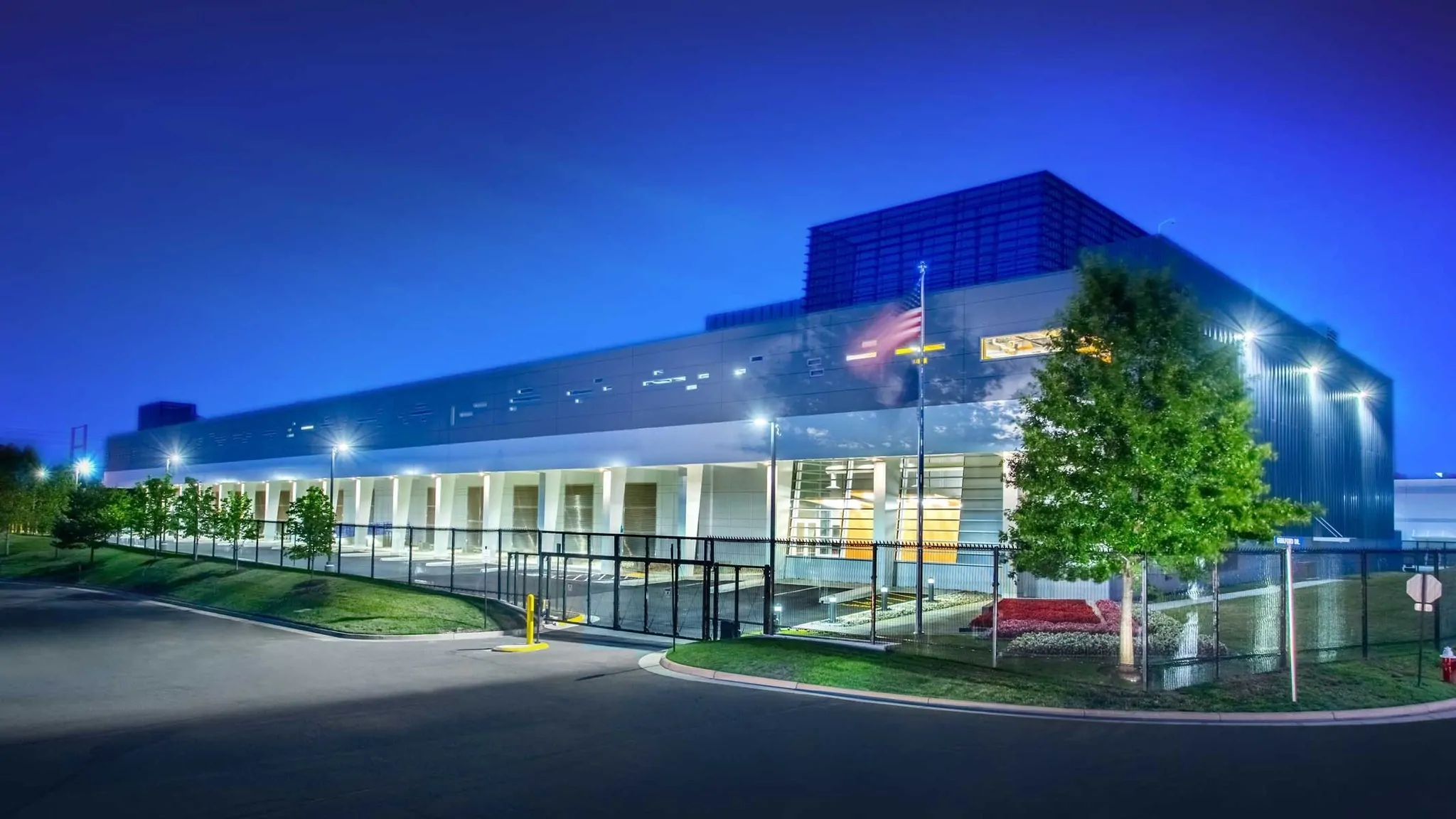
The AI Transformation: Power Density and Closed Loop Cooling
How generative artificial intelligence models changed the physics of data hall engineering.
The explosive adoption of large language models and generative AI between 2023 and 2026 shattered traditional data center design assumptions. Traditional cloud compute racks hosting general enterprise workloads historically consumed between 6 kW and 15 kW of electrical power per cabinet. High density artificial intelligence training clusters packed with advanced GPU accelerators now require 40 kW, 80 kW, or even 100+ kW per single rack.
Air cooling techniques, which blow chilled air through raised floor plenums, reach thermodynamic limits above 30 kW per cabinet. As a result, facilities in Ashburn have rapidly transitioned to direct to chip liquid cooling and closed loop water circulation systems.
| Operational Metric | Traditional Enterprise Cloud | Generative AI Acceleration Cluster |
|---|---|---|
| Rack Power Density | 6 kW to 15 kW per cabinet | 40 kW to 120 kW+ per cabinet |
| Primary Cooling Medium | Perimeter CRAH units, cold aisle containment | Direct to chip liquid cooling, dielectric fluids |
| Campus Power Demand | 20 MW to 60 MW facility total | 100 MW to 400 MW+ hyper campus total |
| Backup Diesel Generation | 2 MW per generator, 24 to 48 hour runtime | 3 MW to 4 MW units, multi day fuel stores |
| Latency Sensitivity | General web traffic (10 to 50 ms acceptable) | Ultra low latency inter GPU fabric (sub microsecond) |
The 2026 Grid Flashpoint: High Voltage Transmission and Rate Battles
CNN October 2026 investigation exposes the fierce standoff between utility expansion and rural preservation.
By October 2026, the unprecedented appetite of artificial intelligence data centers triggered an acute energy crisis across Virginia. In an investigative report, CNN spotlighted the intense community battles over high voltage 500 kV transmission lines planned by Dominion Energy and regional grid operator PJM Interconnection.
To channel gigawatts of electricity into Data Center Alley, utilities proposed massive overhead transmission corridors slicing through rural Piedmont farmland, historic civil war sites, and established residential suburbs. The proposals ignited widespread public demonstrations and organized pushback from groups like the Piedmont Environmental Council and Protect Loudoun.
500 kV Transmission Battles
Rural landowners in western Loudoun, Fauquier, and Prince William counties have vigorously contested the erection of towering 140 foot steel transmission towers, arguing that historic preservation and scenic rural vistas are being sacrificed for commercial cloud servers.
Ratepayer Cost Allocation Disputes
Before the Virginia State Corporation Commission (SCC), heated debates focus on who should pay for multi billion dollar grid expansions. Consumer advocates contend that tech trillionaires should fully finance their own substations and power lines rather than burdening residential ratepayer utility bills.
Security Concerns and Public Friction
CNN reporting confirmed that growing public frustration over grid instability, industrial zoning creep, and rising electric bills has prompted law enforcement investigations into security threats against data center construction jobsites and local planning officials across Northern Virginia.
Environmental Health: The Virginia DEQ Air Monitoring Initiative
Scientific tracking of emergency backup diesel generators and local ambient atmospheric quality.
Beyond electricity lines, data centers rely on massive arrays of industrial diesel generators to provide uninterrupted uptime during power failures. Across Loudoun County alone, thousands of emergency generators stand ready, capable of producing thousands of megawatts of backup combustion energy.
In response to community health concerns regarding periodic engine testing and potential prolonged emergency runs, the Virginia Department of Environmental Quality (DEQ) launched the EPA funded Data Center Air Monitoring Project. This state scientific program deploys solar powered Kunak AIR sensory pods and reference grade analyzers throughout Loudoun and Prince William data corridors.
Fine Particulate Matter (PM2.5)
Continuous sensor tracking monitors microscopic airborne particles smaller than 2.5 micrometers generated by heavy construction equipment, soil disturbance, and diesel combustion exhausts.
Nitrogen Dioxide (NO2)
High sensitivity electrochemical cells log nitrogen oxides emitted during scheduled monthly generator exercising and emergency diesel firing cycles to safeguard regional air standards.
Carbon Monoxide (CO)
Near real time tracking detects localized combustion spikes, providing transparent public datasets to verify whether server parks adhere to National Ambient Air Quality Standards.
Suburban Proximity: Living Next Door to the Cloud
The Statesboro Place reality and the acoustic dilemma of 230 server halls on suburban doorsteps.
In 2026, global headlines turned to Loudoun County through photographic reporting by Stephen Voss and an in depth feature by Spanish daily El Pais titled "Living with 230 data centers on the doorstep". A viral photograph of Statesboro Place in Ashburn (Arcola area) captured the surreal modern landscape: multi story, windowless concrete server buildings rising directly behind children wooden playsets and suburban backyard fences.
While many of these homes were built between 2013 and 2015, subsequent county zoning approvals allowed tech giants including Amazon and Microsoft to construct massive data campuses immediately adjacent to neighborhood lot lines. Residents report living with a persistent, low frequency acoustic hum produced by thousands of industrial cooling chillers and transformer banks running 24 hours a day, 365 days a year.
The Real Estate Paradox of Loudoun County
Despite the industrial backdrop and chiller noise, housing values in neighborhoods like Statesboro Place have remained remarkably strong. Homes purchased a decade ago for $650,000 routinely sell for $1.1 million to $1.35 million. Loudoun low residential property tax rates (made possible by corporate data center revenues) and top ranked school districts create continuous buyer demand even alongside server halls.
The Amazon Turning Point: Scrapping AI Data Centers in Ashburn
October 2026 landmark compromise marks the first major tech retrenchment under citizen pushback.
In October 2026, tech industry publication Tom Hardware reported a historic policy reversal: Amazon Web Services (AWS) officially abandoned plans to construct four massive AI data centers on a 122 acre property in Ashburn that it had acquired for $427 million on the former George Washington University campus.
The purchase had originally blindsided county supervisors and neighborhood organizations who were already battling unchecked data center sprawl. Rather than engaging in prolonged zoning litigation and public hostility, Amazon forged a breakthrough agreement with Loudoun County officials:
Mixed Use Residential Pivot
The 122 acre site will be completely redesigned for residential housing, retail commerce, and walkable parks tailored for working families, eliminating industrial generators and server buildings.
25 Acre Community Land Donation
Amazon formally donated 25 acres of the parcel directly to Loudoun County for the construction of a public recreational facility and community cultural arts center.
$5 Million Affordable Housing Contribution
In addition to the land grant, Amazon contributed $5 million into the Loudoun County Affordable Housing Trust Fund to assist teachers, emergency personnel, and municipal workers.
The Economic Engine: Tax Revenues, Schools, and New Zoning Rules
How Loudoun County captures $1.1 billion annually while establishing stringent architectural standards.
The rationale behind Loudoun aggressive embrace of data centers centers on municipal economics. Led by Buddy Rizer, executive director of the Loudoun County Department of Economic Development, the county established business friendly tax policies on computer equipment while building out fiber friendly business parks.
In 2026, data centers generate approximately $1.1 billion in annual local tax revenues for Loudoun County, accounting for nearly 40 percent of the county operating budget. For every $1 the county expends on services for data center sites, it receives more than $26 in tax revenues in return. This massive surplus has funded state of the art public schools, public libraries, recreation centers, and allowed the Board of Supervisors to lower the residential real estate tax rate to its lowest level in decades.
| Zoning & Design Criteria | Original 2010 Regulations | Updated 2025 to 2026 CPAM Standards |
|---|---|---|
| Residential Buffer Setbacks | 50 to 100 feet standard setback | Mandated 200 to 300+ feet with vegetative earthen berms |
| Noise Emissions Limits | Measured at property boundary general limits | Strict day and night decibel caps on chillers and transformers |
| Exterior Façade Requirements | Industrial concrete tilt up walls permitted | Mandatory architectural articulation, screening, and tree canopies |
| By Right Development | Allowed broadly in light industrial zones | Commission special exception review required near residential lines |
Featured Documentary: Inside the Data Center Capital of the World
The Free Press on the ground report hosted by Isabella Redjai exploring Ashburn infrastructure and community debates.
Video report featuring interviews with Loudoun economic chief Buddy Rizer, local homeowners, and aerial perspectives of Data Center Alley server parks.
Frequently Asked Questions
Direct technical answers to common inquiries regarding Data Center Alley operations and policy.
Why is Ashburn, Virginia specifically called Data Center Alley?
Ashburn earned this title because it contains the largest concentration of interconnected data centers anywhere in the world. Stemming from the historic MAE East exchange and Equinix carrier neutral campus in the late 1990s, today more than 230 facilities operate in Loudoun County, routing approximately 70 percent of global internet traffic through its local fiber conduits.
How much power do data centers in Northern Virginia consume?
Northern Virginia data centers currently draw over 3,000 megawatts (3 gigawatts) of electrical power, with planned expansions projected to demand over 10 gigawatts by the 2030s. In 2024 to 2026, data centers accounted for nearly a third of all electricity sales by Dominion Energy in Virginia.
Why do tech companies not simply build these facilities in rural areas far from homes?
While operators are expanding to southern Virginia, Ohio, and Indiana, AI training and real time financial applications require ultra low millisecond latency. The dense ecosystem of existing cross connects, telecommunication exchanges, and transatlantic subsea cable terminations in Ashburn makes physical proximity irreplaceable for high performance networking.
What is the Virginia DEQ doing regarding air pollution from backup generators?
The Virginia Department of Environmental Quality (DEQ) is conducting an EPA funded Data Center Air Monitoring Project. The initiative deploys near real time sensory networks across Loudoun and Prince William counties to evaluate ambient levels of fine particulate matter (PM2.5), nitrogen dioxide (NO2), and carbon monoxide (CO) generated during emergency diesel testing and operation.
How does Loudoun County benefit financially from hosting Data Center Alley?
Loudoun County receives approximately $1.1 billion annually in local business personal property and real estate taxes from data centers. This income supplies roughly 40 percent of the county general fund, financing public school construction, public parks, recreation facilities, and keeping residential property tax rates at four decade lows.
What was the outcome of Amazon AWS proposed project on the GWU campus?
In October 2026, Amazon bowed to intense community and county pushback and scrapped plans for four AI data centers on its 122 acre former George Washington University site in Ashburn. Instead, Amazon agreed to develop the land for residential housing, retail, and parks, donated 25 acres for a public recreation center, and gave $5 million to the county affordable housing fund.
RB Advertising Technology & Infrastructure Editorial Desk
Have questions regarding digital infrastructure research, custom technology conference merchandise, corporate apparel, or specialized high durability signage? Contact our team during regular business hours.