
Bislig City: Complete Guide, Barangays, Tourism, and Culture
Bislig is the easternmost city in the Philippines, the first to meet the sunrise over the Pacific coast of Surigao del Sur in the Caraga Region. Known in its timber era as the Paper City of the Philippines and celebrated today as The Organic City of the Philippines and The Booming City by the Bay, it brings together 24 barangays, the thundering Tinuy-an Falls, and the busy commercial downtown of Mangagoy.
The Official Vision, Mission, and Global Profile
Bislig is a component city of Surigao del Sur, created through Republic Act 8804 and ratified in a plebiscite on September 18, 2000. It belongs to the 2nd city income class and serves as the trade and commerce center on the eastern coast of Mindanao.
The City Vision
The official vision of the City Government of Bislig is a highly livable agri tourism center and investor friendly city, where empowered Bisliganons live in a vibrant and self sustaining economy supported by resilient infrastructure and led by transparent, God loving stewards.
The City Mission
The mission is to deliver quality basic services and support facilities, and to provide equitable access to wealth and economic opportunities towards a gender responsive, child friendly, and socio economically progressive community with a sustainable environment.
Governance and Global Ties
Bislig is governed by a city mayor and the Sangguniang Panlungsod, led in 2026 by City Mayor Florencio C. Garay. In 2023, the city became a founding member of the International Tourism Alliance of Silk Road Cities in Jingdezhen, China, and joined the Mount Tai International Mountain Climbing Festival, positioning its attractions on the global stage.
Geography, Territory, and Regional Connectivity
Bislig occupies the southeastern tip of Surigao del Sur, facing the Pacific Ocean, and serves as the commercial gateway between Caraga and southeastern Mindanao. It lies about 208 kilometers northeast of Davao City, 152 kilometers south of Tandag City, and 158 kilometers southeast of Butuan City.
Territorial Boundaries
Bislig is bounded on the north by Hinatuan, on the northwest by Tagbina, on the southeast by Lingig, on the southwest by Agusan del Sur (Trento, Bunawan, and Rosario), and on the northeast by Bislig Bay and the Pacific Ocean. Eleven of the 24 barangays are coastal.
Land, Forest, and Terrain
The PSA land area is 331.80 square kilometers, while the city government cadastral profile lists 40,503 hectares, of which about 63 percent is classified forestland. Roughly 42 percent of the land area is highland and forested mountain range. San Roque is the largest barangay by area, followed by San Jose and Burboanan.
Climate and Distances
Bislig has a Type II climate, meaning there is no pronounced dry season, with peak rainfall from November to January. Sitting below the main typhoon belt, it records a low frequency of cyclones. It sits within comfortable reach of the major Mindanao airports and provincial capitals.
The Easternmost City of the Philippines
No other city in the country sits farther east than Bislig, which means it meets the sunrise before anywhere else in the archipelago. That eastern edge defines the city: a Pacific facing coast, mangrove lined estuaries, and one of the largest remaining forest canopies in Caraga.
Poverty incidence eased to 13.35 percent in 2023 from 28.13 percent in 2021, while the city holds 24,348 households and recorded 72,369 registered voters in 2025 on the strength of organic high value crops, aquaculture, and a fast growing services sector.
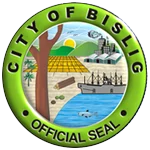 City of Bislig Official Seal
The 24 Barangays of Bislig City
Bislig is politically divided into 24 barangays, five urban and 19 rural, with 11 facing Bislig Bay and the Pacific. Its commercial and transport heart is Barangay Mangagoy, while Barangay Poblacion is the official seat of city government.
Understanding the Twin Centers: Mangagoy and Poblacion
During the twentieth century, the headquarters, factories, deep water port, and residential quarters of PICOP Resources were established in Mangagoy, turning it into an economic powerhouse nicknamed the little city within the city and the largest barangay in Surigao del Sur by population. Barangay Poblacion remains the historic administrative capital where City Hall, the legislative council, and the civic plazas sit along Bislig Bay.
| Barangay | Classification | Population (2020) | Key Role and Local Highlights |
|---|---|---|---|
| Mangagoy Commercial HubCoastal | Urban, downtown | 30,541 | Downtown business center, banks, Gaisano Capital, Integrated Bus Terminal, and the port district at Caramcam. |
| Tabon UrbanCoastal | Urban, residential | 13,560 | Second most populous barangay, with major subdivisions, a national high school, and coastal communities. |
| Poblacion Government SeatCoastal | Urban, administrative | 10,844 | Seat of city government, City Hall, civic plaza, baywalk, and the historic waterfront. |
| San Roque (Cadanglasan) Largest by Area | Rural, suburban | 6,562 | Largest barangay by land area at about 12.9 percent of the city total, with expanding residential links to the highway. |
| San Jose Adventure | Rural, agro tourism | 4,785 | Gateway to Kawa Kawa sa Awog natural stone pools, fertile river valleys, and farms. |
| Comawas UrbanVantage Point | Urban, hilltop | 3,560 | Home of Ocean View Park and the International Doll House, with sweeping views over Bislig Bay. |
| Maharlika Urban | Urban, forestry | 2,998 | Agroforestry plantations, rubber groves, and watershed reserves within the urban barangay set. |
| San Fernando | Rural, agricultural | 2,920 | Corn, coconut, and rootcrop production, plus the Maria Regina Highland Farm and Resort in Dao Dao. |
| San Vicente Coastal | Rural, coastal fisheries | 2,694 | Artisanal fishing, crab catching, and seaweed cultivation, with the Florland Inland Resort. |
| Labisma | Rural, agricultural | 2,683 | Inland zone producing upland rice, bananas, and diversified agroforestry crops. |
| San Isidro (Bagnan) | Rural, agricultural | 2,163 | Farming plains, livestock raising, and community irrigation systems. |
| Mone | Rural, agricultural | 1,842 | Upland community with cool forest breezes, organic gardens, and the man made Lake 77. |
| Burboanan Tinuy-an Falls | Rural, ecotourism | 1,790 | Home of the world famous Tinuy-an Falls, eco lodges, bamboo rafting, and souvenir shops. |
| Pamaypayan | Rural, riverine | 1,613 | Riverbank farming barangay with rice fields, copra drying, and inland waterways. |
| Coleto | Rural, forestry | 1,411 | Highland rainforest community near the old forest concession and bird watching zones. |
| San Antonio | Rural, agricultural | 1,376 | Known for the lively barangay fiesta, fruit orchards, and a friendly rural atmosphere. |
| Lawigan CoastalWhite Beach | Rural, coastal resort | 1,376 | Home to Lawigan Beach, often called the Boracay of Mindanao, plus seaport facilities facing the Pacific. |
| Kahayag | Rural, agricultural | 1,271 | Rolling terrain with family farms, cacao cultivation, and coconut groves. |
| Tumanan | Rural, agricultural | 1,021 | Peaceful farming settlement along the valley trails of southern Surigao del Sur. |
| Santa Cruz | Rural, inland | 951 | Countryside community with organic vegetable plots and community managed forests. |
| Sibaroy Waterfalls | Rural, inland | 931 | Forest streams and the Togonan and Sibaroy Falls, about a 30 minute ride from the city proper. |
| Caguyao | Rural, agricultural | 866 | Scenic upland landscapes, corn farms, and smallholder agroforestry plots. |
| Bucto | Rural, agricultural | 831 | Valley farms surrounded by hillside vegetation and freshwater streams. |
| Pamanlinan | Rural, riverine | 701 | Riverbank barangay along the Bislig river basin, with traditional fishing and farming. |
Top Attractions and Eco Adventures in Bislig
From the wide white curtain of Tinuy-an Falls to hilltop doll museums, cave systems, surf breaks, and forest lakes, Bislig delivers premier nature experiences a short ride from the city center.
Tinuy-an Falls
Dubbed the Little Niagara of the Philippines, Tinuy-an is a three tiered waterfall about 95 meters wide and 55 meters high, widely cited as the widest in the country. Visitors can ride a bamboo raft directly under the curtain for a natural water massage.
Arrive between 9:00 AM and 11:00 AM on sunny mornings to catch a rainbow across the mist over the second tier.
Ocean View Park and Doll House
Perched on a ridge overlooking Bislig Bay, the park houses the International Doll House with its collection of dolls, European inspired chalets, a garden cafe, and panoramic coastal views.
Visit in the late afternoon for golden hour views across the Pacific and cooler hilltop breezes.
Lawigan White Sand Beach
Locals affectionately call Lawigan the Boracay of Mindanao. It offers cream white sand, clear turquoise water, and coconut groves that stay peaceful through the week, making it ideal for camping and fresh seafood.
Buy grilled seafood straight from incoming fishermen at dawn, then set up a weekend camp under the palms.
Hagonoy Island
A pearl shaped island about three kilometers offshore in the center of Bislig Bay, reachable in around 30 minutes by motorized banca. White sand, coral gardens, and calm shallows reward a quiet day trip.
Bring your own snorkeling gear and drinking water, as the island has few commercial stalls.
Kawa Kawa sa Awog
A cluster of natural stone pools and deep rock basins carved into the shape of giant cooking woks, or kawa, by churning river currents over centuries, set within dense rainforest.
Wear high traction water shoes for the smooth submerged rock shelves.
Lake 77 and Mone River
A tranquil man made lake from the timber era, now repurposed for ecotourism with floating cottages, kayaking, and paddle boating, fed by the clear waters of the Mone River.
Rent a floating cottage for a shaded lunchtime picnic among pine and mahogany trees.
Delot and Hinayagan Caves
Twin subterranean wonders: light filters into Hinayagan Cave, while Delot Cave holds an underground river. Both make for a short trek and a cool midday adventure with a local guide.
Hire a registered local guide and bring a headlamp, as the interiors are unlit.
Forester's Park and Arboretum
A forested sanctuary and arboretum ideal for nature walks and bird watching, set within the former timber concession where the Philippine eagle has been recorded.
Go early in the morning for the best chance at bird sightings and cooler forest air.
Mabakat and Chocolate Beach
Mabakat Beach, the former Dampingan area, is gaining a following among surfers and hosts a surfing competition, while nearby Chocolate Beach is a favorite for mud skim boarding enthusiasts.
Surf conditions are best in the wetter months, so check with local guides before heading out.
Kamayo Heritage Park and City Baywalk
The Kamayo Heritage Park celebrates the local language and traditions, while the City Baywalk along Bislig Bay is a scenic strip for evening strolls and photos at the I Love Bislig marker.
Come at sunset, when the baywalk fills with families and food stalls.
Bislig Hot Spring and Inland Resorts
The Bislig Hot Spring offers a warm soak, while Florland Inland Resort in San Vicente and the Maria Regina Highland Farm in San Fernando round out a relaxed inland itinerary.
Pair the hot spring with a farm visit for a full day away from the coast.
History, Etymology, and the Timber Era
Bislig bridges indigenous folklore, early colonial gold trade, the largest timber empire in Asia, and a modern resurgence built on organic agriculture and ecotourism.
The Legend of the Vine and Gold
Local lore tells of a royal couple saved from a flooded river by clinging to a sturdy rattan vine called Bislig. Historical accounts trace the name to bizlin, a premium grade of gold worth two pesos a tael, recorded in the 1573 dispatches of royal auditor Andres de Mirandaola and later spelled Beslin, Bislin, and Baslig by Spanish chroniclers.
The PICOP Timber Era
Established in 1963, PICOP Resources was once the largest integrated timber and newsprint complex in Asia. It built ports, airstrips, housing colonies, and drew tens of thousands of workers to Mangagoy, earning Bislig the title Paper City of the Philippines before operations ended in the early 2000s.
From Paper to Organic City
After large scale logging closed, the city pivoted to ecotourism, marine aquaculture known for mud crabs and prawns, and diversified organic farming. In 2023 it became a founding member of the International Tourism Alliance of Silk Road Cities, putting its cultural and natural assets on the world map.
A Short Timeline
- 1573
Gold of Bizlin
Andres de Mirandaola reports much gold found in the district of Butuan and Surigao, including the Bislig hills.
- 1749
First Mapped as Bislig
Father Pedro Murillo Velarde publishes the first detailed Philippine map, fixing the spelling Bislig.
- 1921
Bislig Becomes a Town
Executive Order No. 62, issued on December 28, 1920, formalizes Bislig as a municipality effective January 1, 1921.
- 1963
PICOP Rises
PICOP Resources begins operations, transforming Mangagoy into a boomtown and Bislig into the Paper City.
- 2000
Cityhood
Republic Act 8804 converts Bislig into a component city, ratified in a plebiscite on September 18, 2000.
- 2023
Bislig Goes Global
Bislig joins as a founding member of the International Tourism Alliance of Silk Road Cities in Jingdezhen, China.
- 2026
26th Charter Day
The city marks its 26th Charter Day under the banner Duyog Saulog, alongside the 8th Tinuy-an Sayaw Festival.
Cultural Heritage, Language, and the Festival Calendar
The cultural fabric of Bislig weaves indigenous Manobo and Mandaya roots with Visayan migration, celebrated every year through colorful street dances, harvest rituals, and coastal fiestas.
Tinuy-an Sayaw Festival
Bislig's headline festival, celebrated every September 17, honors Tinuy-an Falls through dance and song. In 2026 the city marked the 8th Tinuy-an Sayaw Festival and the 15th Adlaw ng Tinuy-an in Barangay Burboanan.
Karawasan Festival
An ethnic street dance depicting the rhythmic clawing of crabs, or karawasan in the local Kamayo tongue. The celebration pays tribute to the rich marine life and mud crabs of Bislig Bay and was reinstated in 2019.
Kamayo and Cebuano
While Cebuano drives daily commerce and regional travel, native Bisliganons proudly speak Kamayo, an indigenous Austronesian language with a melodic southern dialect spoken along the coast.
The feast of St. Vincent de Paul, celebrated in the commercial heart of the city.
A dance honoring the Santo Nino, shared with the wider Cebuano speaking region.
A homecoming gathering that literally means going back home to Bislig.
Three days marking cityhood, headlined in 2026 by the 26th Charter Day, Duyog Saulog.
Dance and music celebrating the city's iconic waterfall, with Adlaw ng Tinuy-an in Burboanan.
A community celebration held four days after the Karawasan observance.
The feast of Santo Tomas de Villanueva at the administrative heart of the city.
How to Get to Bislig City
Bislig is linked by overland bus networks from Davao, Butuan, and Cagayan de Oro, with Mangagoy serving as the main arrival point for buses and vans.
By Air and Land
Fly into Davao (DVO) or Butuan (BXU), then take a bus or van to Mangagoy. Davao is roughly a 4.5 hour van ride and Butuan about 3 hours. Bislig Airport has a concrete runway that can take light commercial planes of the Fokker 50 class, though it mostly serves private and charter flights.
By Bus and Sea
Bachelor Express buses serve Bislig from Butuan, Cagayan de Oro, and Davao. By sea, the city has port facilities at Lawigan and at the Caramcam district of Mangagoy. Lawigan sea port operations are currently on hold, so traveler traffic moves mainly through the Mangagoy terminal.
Getting Around, Dining, and Stays
Motorized tricycles serve downtown Mangagoy and the run to Poblacion, while motorcycle taxis, locally called habal habal, and tourist vans reach the waterfalls and caves. For dining, try the Ocean View Park Restaurant, Gail's Resto and Coffee Shoppe for its Mutya ng Bislig crab soup, and Icebergs Restaurant. Homestays and hotels are widely available.
Equip Your Bislig Team, LGU, or Event
From Karawasan and Tinuy-an Sayaw street dance outfits and school sports tournaments to cooperative polo shirts and tour group dri fit shirts, RB Advertising provides direct factory manufacturing with fast freight delivery to Bislig City through Bachelor Express cargo.
Custom Full Sublimation Jerseys
Vibrant color, moisture wicking honeycomb fabric, and tailored cuts ideal for basketball leagues, volleyball cups, and inter barangay meets.
From ₱320.00 (about $5.10 / €4.45 / £3.85)Corporate and Barangay Polo Shirts
Cotton poly blends and dri fit polo uniforms with crisp embroidered or sublimated emblems for government staff, cooperatives, and resorts.
From ₱450.00 (about $7.20 / €6.25 / £5.40)Tour Group and Event Merchandise
Personalized quick dry rashguards, beach outing t shirts, UV DTF decals, and festival tarpaulins delivered direct to Mangagoy.
Wholesale Factory PricingDirect production facility in Tagum City with guaranteed express cargo shipments to the Mangagoy Integrated Bus Terminal.
Call Sales: 0946 048 0491Contact RB Advertising / PHShirt
For custom apparel quotations, cooperative uniform production, and wholesale merchandise inquiries, reach us through our official channels.
Branch 1: Mankilam Main Office
Naungayan Building, Aala Road, Barangay Mankilam, Tagum City, Davao del Norte
Business Hours: Monday to Friday, 8:00 AM to 5:00 PM
Branch 2: Cagayan de Oro Branch
Ficcoville, Iponan, Cagayan de Oro City, Misamis Oriental
Email: sales@phshirt.com
Frequently Asked Questions About Bislig City
Key facts on geography, travel planning, attractions, and civic history.