
Copenhagen Airport (CPH): Three Runways, Six Piers, One Metro
32,433,694 passengers in 2025, up 8.5 percent, on 256,737 movements. The airport sits on Amager, 8 kilometres south of Copenhagen and 24 kilometres west of Malmö. Three runways, one shared airside, six piers, a railway station under Terminal 3 and a metro two floors above it.
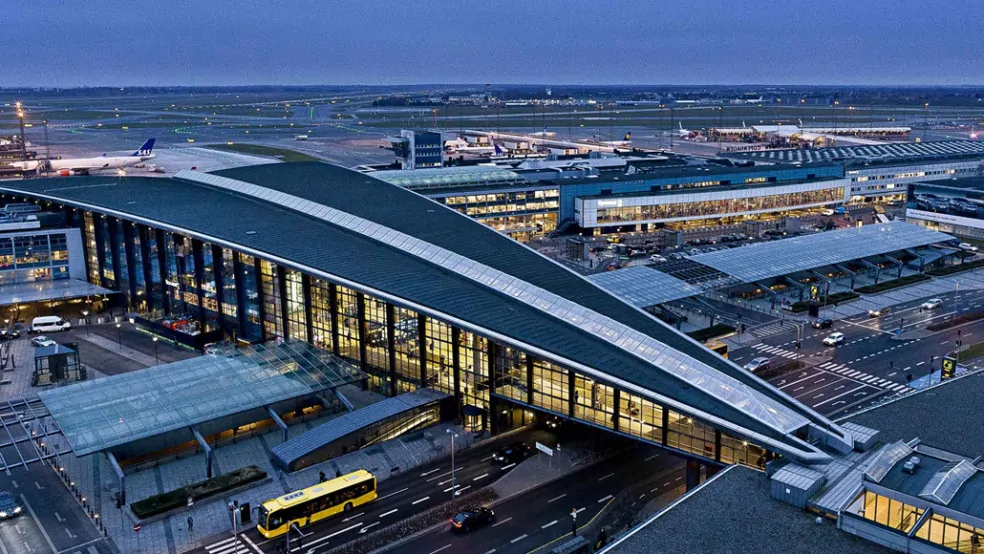
The largest airport in the Nordic countries and the busiest in Scandinavia for international travel.
Amager, the Øresund and a Site Shared Between Two Municipalities
Copenhagen Airport is on Amager, 8 kilometres (5 miles) south of Copenhagen city centre and 24 kilometres (15 miles) west of Malmö. The Øresund Bridge carries road and rail to Sweden from the same island.
The site covers 11.8 square kilometres (4.6 square miles). Most sits in Tårnby municipality, with a small part in Dragør. The coordinates are 55 degrees 37 minutes 05 seconds north and 12 degrees 39 minutes 22 seconds east, at 5 metres (16 feet) above sea level. CPH is the IATA code and EKCH the ICAO code. The formal name remains Copenhagen Airport, Kastrup, which separates it from Roskilde Airport, also owned by Københavns Lufthavne.
The article calls it the largest airport in the Nordic countries, the fourth busiest in Northern Europe and the busiest in Scandinavia for international travel. Københavns Lufthavne reports 2,800 direct employees and 18,000 jobs across the site. Around 60 scheduled airlines appear, with a maximum of 83 operations per hour across 108 jet bridges and remote stands.
20 April 1925, a Wooden Terminal and Sheep on the Runway
The airport was inaugurated on 20 April 1925 and counts as one of the first civil airports in the world. The first site had a large wooden terminal, a couple of hangars, a balloon mast, a hydroplane landing stage and grassy meadows for runways.
Sheep kept the grass short and were shepherded away before take off and landing. Between 1932 and 1939 movements rose from 6,000 to 50,000 and annual passengers reached 72,000. A new terminal followed between 1936 and 1939, designed by Vilhelm Lauritzen and treated as a leading example of Nordic functionalism.
War closed the airport to civil traffic except for periodic flights to Sweden and Germany. The first hard surface runway opened in summer 1941 at 1,400 metres (4,600 feet) by 65 metres (213 feet). Because the site escaped damage, the article says it was the most modern international airport in Europe by May 1945, a sentence carrying a citation request. The VIP terminal is the 1920s building, moved about 2 kilometres in the 1990s.
1947, SAS and a Terminal That Became Terminal 2
Scandinavian Airlines was founded on 1 August 1947 with Copenhagen as its main hub. By 1948 the airport was the third largest in Europe, with 150 daily take offs and almost 300,000 passengers.
The terminal that is now Terminal 2 opened on 10 May 1960, when the daily count had reached 28 jet operations. A 1969 programme moved domestic traffic to the eastern part of Terminal 1, added Pier C, a separate arrivals hall between Terminals 2 and 3, a new control tower and 3,600 metres of runways. By 1972 movements passed 180,000 and passengers passed eight million.
The 1982 expansion aimed at the transit passenger rather than size, and built the cargo terminal in the eastern area. From 1984 SAS ran a marine link to Malmö, by hovercraft until 1994 and catamaran until 2000. In 1998 came the pier linking domestic and international, a new arrivals hall, baggage facilities, an underground station, two car parks with 2,400 spaces and Terminal 3, with capacity for 17 million passengers. The first stage of Pier D was completed in spring 1999.
2000 to 2025, a Bridge, a Metro and a Record Year
The Øresund Bridge opened on 1 July 2000 and the last marine link closed with it. A 382 room Hilton followed in 2001, the 20 million passenger mark fell in 2006 and the metro station opened in October 2007.
A new control tower opened in 2008 under Naviair. On 31 October 2010 CPH Go opened with easyJet, now Pier F. The history section records 24,067,030 passengers in 2013 while the traffic table says 24,066,917, a gap of 113.
In 2014 the airport set a 40 million capacity target. On 29 March 2015 all departures moved into Terminals 2 and 3. Pier C gained a jet bridge at DKK 10 million for the Emirates A380 from December 2015, the first scheduled A380 in Scandinavia. Pier E opened on 4 June 2019 and took most SAS long haul flying. In 2018 the total reached 30,298,531.
Passengers fell to 7,525,441 in 2020, down 75.1 percent, with a group deficit of 600 million Danish kroner. The 2024 total was 29,882,553 and 2025 set the record at 32,433,694, up 8.5 percent, on 256,737 movements, up 6.7 percent. The 2025 total is about 7.2 percent above 2019, arithmetic done here.
Three Runways, Two Pointing at the Øresund and One Across Them
The article lists three runways. Two are parallel and carry the main traffic. The third crosses them and has a noise restriction in one direction. All three are between 2,800 and 3,600 metres.
| Designation | Length | Surface | Note |
|---|---|---|---|
| 04L/22R | 3,600 m (11,810 ft) | Asphalt | Longest strip; widened for the A380 |
| 04R/22L | 3,300 m (10,827 ft) | Asphalt | Runway 22L has ILS category IIIC |
| 12/30 | 2,800 m (9,186 ft) | Asphalt and concrete | Crosswind strip; noise limits one way |
The parallel strips point at the Øresund, so approaches and departures cross water in both directions. The crossing strip has one direction over water and the other over housing, with noise limits. The site is low and flat, with no hills or tall buildings under the approach.
Runway 22L carries an ILS category IIIC system for zero visibility landings. Runway 04R/22L was widened by 4 metres each side at DKK 30 million for the A380, within a DKK 300 million concrete renewal. The article gives no width for the other strips and no declared distances.
Terminal 2, Terminal 3 and Six Piers Behind One Security Check
Two check in terminals, Terminal 2 and Terminal 3, handle all flights. They share one airside concourse and one security check between them, and the arrivals hall, customs and baggage claim sit inside Terminal 3.
Terminal 2
Opened on 10 May 1960 as the new airport terminal. Domestic flights moved here from Terminal 1 on 29 March 2015. It shares check in and the airside with Terminal 3.
Terminal 3
Completed in 1998 in a delta shape with capacity for 17 million passengers. Arrivals, customs and baggage claim are here, and the railway station sits directly underneath.
Piers A to F
Piers A and B are Schengen only, C is mostly non Schengen, D is mostly Schengen, E opened in June 2019 and F is CPH Go.
Pier F began as CPH Go, the low cost facility opened on 31 October 2010. The article says easyJet, Transavia and Ryanair are the only airlines operating from it. Pier E took most SAS long haul traffic after June 2019. An all new Terminal 4 has been discussed but was replaced by plans to expand the current buildings in increments.
The article gives no terminal floor area, check in desk count, baggage system capacity or walking time between the farthest piers. It does give 108 jet bridges and remote stands, which is the figure to use when someone asks how many aircraft can be parked at the building.
SAS, DAT and a Network Built on Short Haul Feeding Long Haul
Scandinavian Airlines uses Copenhagen as the main hub of its three. DAT also lists it as a hub. Air Greenland and Finnair are focus cities, though the Finnair entry carries a citation request. Jettime, Norwegian, Ryanair and Sunclass are operating bases.
In 2015 the split was 6.1 percent domestic, 83.5 percent other European and 10.4 percent intercontinental. For 2023 the table gives 1,198,624 domestic, 22,697,847 European and 2,868,975 transatlantic passengers, which sum to the 26,765,446 total.
A hub of this shape lets a consignment ride in a passenger belly on a European or long haul leg and transfer to a truck or feeder flight. The article publishes no minimum connecting time, transfer desk location or bag transfer procedure.
The Asian Points the Airline Table Actually Lists
The passenger table names Doha, Dubai, Abu Dhabi, Singapore, Bangkok, Beijing, Shanghai, Seoul, Tokyo and Mumbai. It names no Philippine airport. These are the transfer points a Philippine shipment or traveller would use on this evidence.
Gulf gateways
Doha with Qatar Airways, Dubai with Emirates, Abu Dhabi with Etihad. The Gulf transfer points a Philippine routing would use.
Qatar Airways, Emirates, EtihadSoutheast and South Asia
Singapore with Singapore Airlines, Bangkok with Thai Airways and a seasonal SAS service, Mumbai with SAS. Beijing and Shanghai also appear, with Air China and China Eastern.
Singapore, Bangkok, Mumbai, Beijing, ShanghaiEast Asia
Seoul Incheon and Tokyo Haneda, both under SAS. These are the easternmost passenger points in the table.
Seoul Incheon, Tokyo HanedaThe table also carries a large North American and European network, from Toronto, Boston, Chicago, Los Angeles and San Francisco to London, Oslo, Stockholm, Amsterdam and Frankfurt. It is a destination list, not a timetable: no frequencies, aircraft types or season dates appear except where a new route is noted.
A Record Year in 2025 and a Recovery That Took Five Years
Passengers ran from 30,256,703 in 2019 to 7,525,441 in 2020 and back to 32,433,694 in 2025. The 2025 figure is about 7.2 percent above 2019, arithmetic done here from the two totals.
| Year | Passengers | Change | Movements | Change |
|---|---|---|---|---|
| 2019 | 30,256,703 | down 0.1 percent | 263,411 | down 1 percent |
| 2020 | 7,525,441 | down 75.1 percent | 98,239 | down 62.7 percent |
| 2021 | 9,179,654 | up 22.0 percent | 109,925 | up 11.9 percent |
| 2022 | 22,143,135 | up 141.0 percent | 202,232 | up 84.0 percent |
| 2023 | 26,765,446 | up 21.0 percent | 227,343 | up 12.0 percent |
| 2024 | 29,882,553 | up 11.6 percent | 240,680 | up 5.9 percent |
| 2025 | 32,433,694 | up 8.5 percent | 256,737 | up 6.7 percent |
For 2023, domestic traffic was 1,198,624 passengers, about 4.5 percent of the total. Europe was 22,697,847, about 84.8 percent. Transatlantic was 2,868,975, about 10.7 percent. The 2025 infobox gives 1,329,005 domestic and 31,104,689 international, about 4.1 and 95.9 percent.
The route table is dated 2023. London leads at 1,822,894 across Heathrow, Gatwick and Stansted, then Oslo at 1,355,213, Stockholm at 1,187,479, Amsterdam at 1,124,306 and Aalborg at 792,198. Istanbul, Helsinki, Frankfurt, Vienna and Paris follow. No 2025 route table is published.
Five Freighter Operators and a Cargo Terminal in the Eastern Area
The article lists five cargo carriers and their destination points. It publishes no tonnage, warehouse area, unit load device count or cut off time. The cargo terminal was built during the expansion that began in 1982 and sits in the eastern area of the airport.
| Carrier | Destinations listed |
|---|---|
| Emirates SkyCargo | Atlanta, Chicago O'Hare, Columbus Rickenbacker, Dubai Al Maktoum, Houston Intercontinental, Los Angeles, Mexico City |
| Ethiopian Airlines Cargo | Addis Ababa, Liège |
| FedEx Express | Liège, Paris Charles de Gaulle |
| LATAM Cargo Brasil | Campinas |
| West Atlantic | Kristiansand |
Read the list carefully. Emirates SkyCargo connects Kastrup to the United States, Mexico and Dubai Al Maktoum, with no Southeast or East Asian point on its list. Ethiopian links Addis Ababa and Liège, FedEx links Liège and Paris, LATAM links Campinas and West Atlantic links Kristiansand. None of the five lists a Philippine airport.
The article does not describe apparel capacity. In practice it would be a mix of freighter space and belly space on the passenger network. The article makes no claim about garment on hanger handling, temperature control, hanging storage or a fashion facility. Before quoting air, ask the forwarder which carrier and leg, whether the cargo moves as loose cartons or pallets, the origin cut off, and whether the consignee can clear under its own EORI number.
Gap recorded: the article gives no cargo tonnage for Copenhagen, so this page does not publish one.
Toldstyrelsen, REX Origin and Reverse Charge Import VAT
Toldstyrelsen handles Danish customs. Two mechanisms matter for Philippine apparel: GSP plus origin and reverse charge VAT. The airport article covers neither, so this section is programme guidance rather than a reading of the article.
GSP plus and the REX statement
A valid statement on origin from a Registered Exporter, carried on the export invoice, supports the preferential rate for covered goods.
- Confirm the commodity code before production.
- Keep the REX number and invoice wording with the production records.
- Do not assume origin from the sewing country alone.
Reverse charge import VAT
Omvendt betalingspligt lets a VAT registered importer declare and deduct import VAT on the periodic return instead of paying cash at the cargo counter.
- The importer needs a Danish VAT registration and EORI number.
- The forwarder needs the number before the declaration is filed.
- Cash flow improves, but the return still has to be correct.
No tariff rate is published here. The article states none and this page does not invent one. Confirm the current treatment with Toldstyrelsen or a Danish customs broker before the commercial invoice is issued.
The document set is commercial invoice, packing list, air waybill, REX statement, EORI and a description precise enough to classify the goods. Vague wording invites a query. The article says nothing about customs hours or a bonded warehouse at the airport, so confirm those with the forwarder.
A Station Under Terminal 3 and a Metro Two Floors Above It
The railway station sits underneath Terminal 3 on the Øresund Line. The metro station is two floors above the rail station, and line M2 links the airport with the city centre in around 15 minutes.
Øresundståg runs to Malmö, Gothenburg, Helsingborg, Kalmar, Karlskrona and Kristianstad. DSB runs InterCity and InterCityExpress trains to Esbjerg, Aarhus, Aalborg and Sønderborg. SJ runs high speed trains between Copenhagen Central Station and Stockholm and Gothenburg, and all of them call at the airport station.
Metro trains run every four minutes in rush hour, every six outside rush hour and at weekends, and every 15 to 20 minutes at night. The station is elevated at the airport and the line goes underground after five stations. Kongens Nytorv connects to the City Circle. The article gives no fares and no first or last train times.
The E20, a Toll Bridge and 8,600 Parking Spaces
The E20 motorway runs past the airport and crosses the tolled Øresund Bridge to Sweden. The article records 8,600 parking spaces on the site.
Movia routes 5C, 35 and 36 stop at the airport, as do Gråhundbus line 999 and express route 888 to Jutland. Swebus 820 runs to Oslo via Gothenburg and 832 to Uppsala via Stockholm, with GoByBus and Bus4You on the same routes. Taxis, car rental desks and drop off charges are not mentioned.
What the Article Supports and What It Leaves Out
The article names one security check between Terminals 2 and 3, a rail station under Terminal 3 and a metro two floors above it. That is a three level complex, and vertical circulation is what an accessible journey depends on.
Beyond that there is no audit. The article does not describe lifts, tactile paving, induction loops, accessible toilets, an assistance desk, accessible parking or a booking lead time, and it does not say whether the rail and metro platforms connect step free. Those gaps are stated, not guessed.
Arrange assistance through the airline before travel and confirm the meeting point with the airport. Allow more than the 15 minute metro ride, because the walk from a pier to the station is not published. Ask at the information desk for the step free route.
This page meets WCAG AA contrast, shows focus outlines, reflows at 640 pixels and disables animation under prefers reduced motion.
From the Gate to the Metro in Seven Steps
This is a reading of the terminal description, not a measured route. The article publishes no walking times, so the sequence uses only the spaces it names.
- Read the pier letter. A and B are Schengen, C is mostly non Schengen, D is mostly Schengen, and E carries most SAS long haul flying.
- Follow signs into the common airside. All six piers share it, so a transfer stays inside the secure area.
- If connecting, follow transfer signs. The article describes one security check for entry to the airside. It does not describe a separate transit screening step.
- If terminating, go to Terminal 3. Baggage claim and customs are there, not in Terminal 2.
- Take the railway station under Terminal 3. Øresundståg, DSB and SJ all call there.
- Go up two floors for the metro. Line M2 reaches the centre in around 15 minutes.
- For Sweden, choose rail or road. Øresundståg crosses to Malmö, and the E20 crosses the toll bridge.
The 15 minutes is the ride, not the journey from an aircraft seat to a city desk. No minimum connecting time is published, so a short connection should be checked with the airline.
What a Manila or Cebu Shipper Can Conclude From the Table
RB Advertising manufactures in Tagum City and Cagayan de Oro. A Danish buyer asking about air freight to Copenhagen is really asking how the cargo gets there and how the programme holds up after arrival.
The passenger table lists no Philippine airport. Its Asian points are Doha, Dubai, Abu Dhabi, Singapore, Bangkok, Beijing, Shanghai, Seoul, Tokyo and Mumbai. The cargo table lists five operators and no Philippine point. A routing that uses one of those gateways would connect there, but the article publishes no schedules, sector times or capacity figures, so none are quoted here.
Copenhagen's value is the market it opens: Denmark and southern Sweden, with the Øresund Bridge putting both within a road leg of the cargo terminal. A programme usually needs one specification, a fabric and colour standard held in stock, size sets for a dispersed workforce and small quantity reorders.
The buyers who fit are hospitality groups, retail chains, facilities management firms, marine and port services, sports organisations and corporate uniform programmes. The article gives no nationality breakdown and no business travel share, so the demand case has to come from the buyer.
Table scoped statement: no Philippine airport appears in the passenger or cargo tables as published. This page does not claim that no nonstop service exists beyond those tables.
Rank 11, Two Conflicting Totals and the Figures the Article Does Not Publish
The series directory places Copenhagen at rank 11 in the Large tier. The article does not discuss the ranking, so it is stated separately and kept out of the airport figures.
The article contradicts itself in three places. The 2013 total is 24,067,030 in the history and 24,066,917 in the table. The 2006 total is 20,900,000 and 20,877,533. The crossing runway is 30/12 in prose and 12/30 in the table. The route table is dated 2023, not 2025.
| Item | What the article says | How this page treats it |
|---|---|---|
| 2013 passengers | 24,067,030 in history, 24,066,917 in the table | Both reported, 113 gap flagged |
| 2006 passengers | 20,900,000 in history, 20,877,533 in the table | Both reported, difference flagged |
| Runway 12/30 | 30/12 in prose, 12/30 in the table | Both forms noted |
| Busiest routes | Table dated 2023, not 2025 | Year attached wherever quoted |
| Cargo | Five operators, no tonnage, no Philippine point | Operators listed, tonnage left blank |
| Terminal detail | No floor area, desk count or baggage capacity | Recorded as a gap |
| Accessibility | No audit, assistance provider or step free map | Recorded as a gap |
It also publishes no runway width for two strips, no declared distances, no frequencies, no minimum connecting time, no taxi or car rental detail and no accessibility audit. Arithmetic on this page is labelled as arithmetic: the 2025 comparison with 2019 and the regional shares are calculated from published figures.
Copenhagen Airport Frequently Asked Questions
Short answers on location, runways, terminals, traffic, rail, metro, cargo and Philippine routing, each tied to the source article.
Where is Copenhagen Airport?
On Amager, 8 kilometres (5 miles) south of Copenhagen city centre and 24 kilometres (15 miles) west of Malmö. Most of the site is in Tårnby municipality, with a small part in Dragør.
What are the IATA and ICAO codes for Copenhagen Airport?
CPH is the IATA code and EKCH the ICAO code. The formal name is Copenhagen Airport, Kastrup, which separates it from Roskilde Airport.
When did Copenhagen Airport open?
It opened on 20 April 1925 and counts as one of the first civil airports in the world. The first site had a wooden terminal, hangars, a balloon mast and grassy runways kept short by sheep.
How many runways does Copenhagen Airport have?
Three. Runway 04L/22R is 3,600 metres, 04R/22L is 3,300 metres and 12/30 is 2,800 metres. The first two are parallel; the third crosses them and has a noise restriction in one direction.
Which runway is used in zero visibility?
Runway 22L carries an ILS category IIIC system, which the article says allows modern aircraft to land with zero sight. The site is low and flat with no hills under the approach.
How many terminals are there at Copenhagen Airport?
Two check in terminals, Terminal 2 and Terminal 3, handling all flights. They share one airside concourse, and arrivals, customs and baggage claim are inside Terminal 3.
What are the piers at Copenhagen Airport?
Piers A and B are Schengen only, C is mostly non Schengen, D is mostly Schengen, E opened on 4 June 2019 and F is CPH Go, the low cost facility opened in October 2010.
How many passengers did Copenhagen Airport handle in 2025?
32,433,694 passengers, up 8.5 percent, on 256,737 movements, up 6.7 percent. That is the current record, above the 30,256,703 passengers recorded in 2019.
Which airlines use Copenhagen as a hub?
Scandinavian Airlines uses it as its main hub, and DAT also lists it as a hub. Jettime, Norwegian, Ryanair and Sunclass use it as an operating base, among around 60 scheduled airlines.
Is there a metro from Copenhagen Airport to the city?
Yes. Line M2 reaches the city centre in around 15 minutes, with trains every four minutes in rush hour, every six outside rush hour and every 15 to 20 minutes at night.
Is there a train station at Copenhagen Airport?
Yes. The station is under Terminal 3 on the Øresund Line. Øresundståg, DSB and SJ call there, with trains to Malmö, Gothenburg, Stockholm, Esbjerg, Aarhus, Aalborg and Sønderborg.
Which cargo airlines serve Copenhagen Airport?
The article lists Emirates SkyCargo, Ethiopian Airlines Cargo, FedEx Express, LATAM Cargo Brasil and West Atlantic. It publishes no cargo tonnage, warehouse area or cut off time.
Does Copenhagen Airport have a direct flight to the Philippines?
No Philippine airport appears in the passenger or cargo tables as published, so no direct route is listed. The Asian points listed are Doha, Dubai, Abu Dhabi, Singapore, Bangkok, Beijing, Shanghai, Seoul, Tokyo and Mumbai.
How far is Copenhagen Airport from Sweden?
Malmö city centre is 24 kilometres (15 miles) west of the airport. The Øresund Bridge carries road and rail across the strait, and the E20 motorway runs past the airport to the bridge.
Other Airport, Port and Sourcing Pages
Connect this airport file to the wider European freight network and to the manufacturing side of the programme.
Bilateral sourcing overview for Danish buyers.
Danish maritime gateway for Jutland.
Swedish air gateway north of the Øresund.
Central European cargo platform.
Bonded trucking between air hubs.
Swedish container terminal and feeders.
Uniform, workwear and performance garments.
Reach the international export desk.
Talk to the RB Advertising Export Desk
Four channels, one sales desk. Tell us what you are making, where it ships and when you need it. RB Advertising is a manufacturer in Tagum City and Cagayan de Oro, in the Philippines.
Business hours: Mon to Sat, 8:30 AM to 5:00 PM