
Lacoste pique
Cotton polyester knit, 180 to 200 gsmThe default office grade. Holds a crisp collar, resists creasing, and takes embroidery cleanly through repeated washing.
Reception, sales floors, daily office wear
When you visit our website, it may store or retrieve information on your browser, mostly in the form of cookies. This information might be about you, your preferences or your device and is mostly used to make the site work as you expect it to. You can choose not to allow some types of cookies. Read our Privacy Policy
These cookies are necessary for the website to function and cannot be switched off in our systems.
These cookies allow us to collect information about website traffic and technical performance.
These cookies enable enhanced functionality and personalisation.
These cookies may be set through our site by our advertising partners to build a profile of your interests.
A polo jacket sits between a shirt and a coat. It keeps the stand collar, the full placket and the clean shoulder of a polo shirt, then adds the contrast yoke, chest pocket flaps and shaped hem that a working jacket needs. This page covers how the garment is built, which fabrics survive a Philippine shift, what a 50 piece program costs, and how long the order takes.
Front elevation, short sleeve block. Flat chest 56 cm at size L. Body length 74 cm. Sleeve 24 cm.
The polo coat entered menswear in the 1920s as a long camel hair wrap coat with a belt, borrowed from the trench coat and worn by spectators and racing drivers. The office version kept the name, the collar and the panel work, and gave up almost everything else.
The name survived because the garment solved a real problem. A full coat was too warm and too long for a shop floor or a front desk, and a plain shirt looked unfinished next to a client in a suit. Shortening the coat to the hip, lightening the cloth and keeping the collar and button front produced something that reads as formal at three meters and behaves like a shirt for eight hours.
In the Philippines the adaptation went further. Uniform houses here cut the body roomier to clear a lanyard and a shoulder bag, shorten the sleeve to sit above the elbow, and finish the hem with side vents so the jacket does not ride up when the wearer sits. What remains of the original coat is the collar, the placket and the panel seam across the chest.
The garment is sold under three names: polo jacket, polo jack and polo coat. They describe the same construction. When you ask for a quotation, the useful words are the ones that describe the block, the fabric and the logo method, not the name.
Beyond the jacket, the same workshop cuts corporate polo shirts for teams that want a lighter layer, and runs corporate apparel programs that put jackets, aprons and name tapes into a single production slot.
Two jackets in the same fabric can wear very differently. The difference sits in six places, and each one can be specified before the first meter of cloth is cut.
Construction callouts, front elevation. Numbers match the list beside the drawing.
Two leaves on a short stand. A soft fused interlining stops the points from curling after a season of washing. Specify a two button closure if the team wears lanyards, because a loose point catches the cord.
The placket holds its line only when the interfacing matches the fabric weight. A two ply placket is worth the small upcharge on light cotton, where a single ply folds and puckers down the front.
The yoke carries the logo and hides the shoulder seam. A split yoke costs more and gives the fitter room to adjust the blade of the back. On a printed block, the yoke seam is also the cleanest place to change color.
Short sleeves end above the elbow with a band of about 3 cm. A banded hem keeps its shape far better than a plain turn back on pique, and it gives the sleeve logo a defined edge to sit inside.
Patch pockets with a flap read as uniform rather than casual. Bar tack the flap corners and the pocket mouth, because those are the first points to fray on a garment worn eight hours a day.
A curved hem with side vents clears the hip when the wearer sits and stands through a shift. Two button tabs at the lower back give shape without a belt, which is what replaced the wrap belt of the original coat.
A woven name tape at the inside back neck costs less than a second embroidery position and settles the laundry question before the first wash.
Fabric is the largest single line in a polo jacket quotation, and the easiest to get wrong. Weight and fibre decide whether the collar stands, whether a logo holds its edge, and whether the wearer survives an afternoon without air conditioning.
The default office grade. Holds a crisp collar, resists creasing, and takes embroidery cleanly through repeated washing.
Reception, sales floors, daily office wear
An airier knit with a visible cell. Cooler under direct sun and faster to dry after rain or sweat.
Field teams, drivers, site coordinators
Smooth, matte and formal in the hand. It wrinkles more than a blend, so it belongs in air conditioned rooms and client facing roles.
Banks, law offices, hotel front desk
A brushed surface with a soft hand. It hides abrasion and holds dark colors through industrial laundering better than pique.
Utilities, security, logistics
Light and dressy with a flat drape. Reads closer to a barong cut shirt than a knit polo, which suits ceremonial and executive use.
Executive offices, government front counters
A water repellent finish that beads light rain. The treatment fades with abrasive washing, so keep the care instructions with the garment.
Field crews, riders, event marshals
Fabric names follow the trade naming used by Philippine uniform houses. Ask for the actual fibre composition and the weight in grams per square meter before you approve a swatch, because the same name can cover a 140 gsm and a 210 gsm cloth.
Most uniform programs settle on one of four panel layouts. Choosing the block first keeps the fabric and logo decisions short, because each block already implies where a logo can sit and how the garment reads at a distance.
Scroll the table sideways
| Block | How it reads | Where it works | Logo position |
|---|---|---|---|
| Classic single block | One body color, matching collar, placket and sleeve band. No contrast panel. | Banks, law offices, clinics, schools | Left chest, one position |
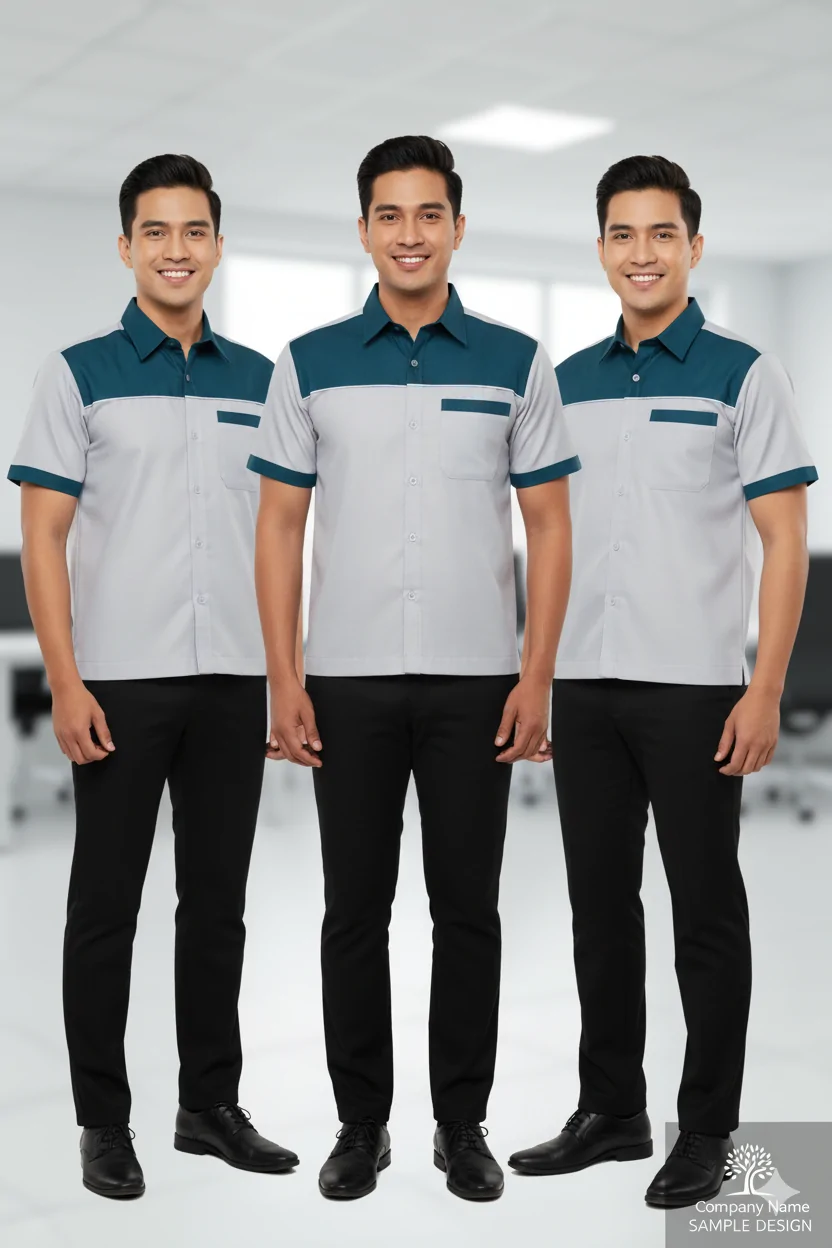
| Contrast yoke | Light body with the yoke, collar, pocket flaps and sleeve band in the brand color. | Front desk, retail, telco, property | Left chest over the yoke |
| Panel blocked | Two tone vertical body panels with a contrast side seam and matching sleeve. | Logistics, automotive, service crews | Left chest or sleeve |
| Utility multi pocket | Patch pockets, pen slot, radio loop, reinforced elbow and a longer body. | Field, maintenance, security, warehouse | Left chest and back |
The contrast yoke is the block most teams ask for, because it produces a uniform that is recognisable without printing a logo three times across the body. The body stays in a light neutral, and the yoke, collar, pocket flaps and sleeve band carry the brand color.
Two details make it work. First, the yoke seam must run on the same line front and back, otherwise the shoulder reads crooked from the side. Second, the pocket flap has to be cut from the contrast fabric and bar tacked at both corners, or it will lift after a month of washing and expose the pocket mouth.
Keep the contrast to three surfaces. Body, yoke group, and one accent such as piping along the placket. A fourth tone turns a uniform into a team jersey.
Choose the block first, then the fabric, then the logo method. Reverse that order and you will pay for a print that the fabric cannot hold, or a yoke seam that the logo has to cross.
The logo method decides how the garment survives the laundry, not how it looks on the approval sheet. Pick the method from the artwork and the wash cycle, then place it where the seam structure will not distort it.
Scroll the table sideways
| Method | Best for | Wash life | What to watch |
|---|---|---|---|
| Direct embroidery | Company marks with four colors or fewer, chest and sleeve | Longest, 50 washes and up | Digitize the artwork first. Type under 6 mm fills in on pique, so simplify small text. |
| Direct to film print | Multi color logos, fine type, gradients | 30 to 40 washes when cured correctly | Sits on top of the fabric. Expect a light hand feel on a textured knit. |
| Woven or embroidered patch | Crests, anniversary marks, name badges | Longest on heavy twill | Adds structure. Keep a chest patch under 90 mm across so it does not stiffen the front. |
| Sublimation panel | Full bleed graphics, photographs, event art | Permanent on polyester | Polyester only. The ink will not bond to cotton, so a cotton body needs a separate print method. |
Placement follows the garment, not the artwork. A left chest mark sits about 8 cm below the shoulder seam and 10 cm from the placket, with the top of the logo level with the pocket flap. Sleeve marks sit on the outer face of the band, and back marks sit between the yoke seam and the shoulder blades. Send a vector file with outlined text; a raster logo will be redrawn and the type will shift.
Most uniform failures are sizing failures, not fabric failures. Five measurements and one sample are enough to avoid them.
Collect the measurements in one file with names and departments. A spreadsheet with 50 rows is faster to verify than 50 photographs of a tape measure.
Scroll the table sideways
| Size | Chest, in | Chest, cm | Body, in | Body, cm |
|---|---|---|---|---|
| S | 36 to 38 | 91 to 97 | 27 | 69 |
| M | 39 to 41 | 99 to 104 | 28 | 71 |
| L | 42 to 44 | 107 to 112 | 29 | 74 |
| XL | 45 to 47 | 114 to 119 | 30 | 76 |
| 2XL | 48 to 50 | 122 to 127 | 31 | 79 |
| 3XL | 51 to 53 | 130 to 135 | 32 | 81 |
| 4XL | 54 to 56 | 137 to 142 | 33 | 84 |
Illustrative unisex block for guidance only. Every factory cuts its own grade, so confirm against the sizer set attached to your quotation before the bulk is released.
Indicative per piece rates for a 50 piece program on one block, with one embroidery position included. The final quotation moves with fabric grade, panel count, pocketing, logo method and quantity, so treat these figures as the shape of the budget rather than the invoice.
Scroll the table sideways
| Block | PHP | USD | EUR | GBP |
|---|---|---|---|---|
| Classic single block Lacoste pique, one embroidery position, matching trims | ₱450.00 | $7.20 | €6.25 | £5.40 |
| Contrast yoke Two tone yoke, collar, flap and sleeve band | ₱520.00 | $8.30 | €7.25 | £6.25 |
| Premium cotton Swiss cotton or superfine shirting body | ₱640.00 | $10.20 | €8.90 | £7.70 |
| Utility and executive Multi pocket build or lined executive cut | ₱780.00 | $12.45 | €10.85 | £9.40 |
Scroll the table sideways
| Item | PHP | USD | EUR | GBP |
|---|---|---|---|---|
| Name embroidery, per piece | ₱45.00 | $0.70 | €0.65 | £0.55 |
| Woven or embroidered patch | ₱60.00 | $0.95 | €0.85 | £0.70 |
| Sample jacket before bulk | ₱3,000.00 | $47.80 | €41.70 | £36.10 |
| Below minimum program fee | ₱5,000.00 | $79.70 | €69.55 | £60.15 |
Five stages, with the published lead time for each. The clock starts when the sample is approved, not when the enquiry lands, and that single fact explains most schedule surprises.
Send the logo file, the headcount, the size spread and where the team works. We shortlist two blocks and two fabric grades rather than ten, so the decision stays inside one meeting.
A mockup shows the panel layout, the logo position and the thread or ink colors against the chosen fabric. Nothing is cut before this is approved in writing.
One finished jacket in the agreed size, fabric and logo method. Philippine houses publish sample windows from 7 to 10 working days, and most credit the sample fee against the bulk order.
Cutting, sewing, embroidery and finishing. Published production windows run from 2 to 4 weeks on simpler runs, and 22 to 30 working days on fully patterned jackets.
Sizes are packed per department or per branch, labelled, and shipped nationwide door to door. Confirm the delivery window on the quotation before production is released.
Minimums and lead times are the two numbers that decide whether a program is feasible, and Philippine uniform houses publish them openly. The figures below are theirs, quoted as published in November 2026, so check them again before you commit to a date.
Scroll the table sideways
| Supplier | Stated minimum | Stated lead time | Stated logo method |
|---|---|---|---|
| Craft Clothing | 12 pcs on stock designs, 50 pcs on full design, 5,000 peso charge below minimum | 2 to 4 weeks from sample approval | Embroidery and print |
| Fabrica MNL | 50 pcs | 12 days sampling, 22 to 30 working days production | Digital embroidery only |
| Bluefly Garments | 30 to 50 pcs | 1 to 4 weeks, about 2 weeks for 100 pcs | Print and embroidery |
| Tailored Projects | Minimum order quantity applies, free sampling above the threshold | 7 to 10 working days for a custom sample | Embroidery and print |
Source: the suppliers' own product pages and published frequently asked questions, read in November 2026. Craft Clothing lists 23 polo jack styles coded PJ00 to PJ22 from 480 to 695 pesos, with a 5,000 peso less than minimum charge and a 3,000 peso jacket sample. Fabrica MNL states Lacoste polo fabric as its usual material and digital embroidery as its only logo method. Bluefly Garments publishes 30 to 50 pieces as typical and about two weeks for 100 pieces. Tailored Projects publishes 7 to 10 working days for a custom sample.
Short answers to the questions that come up in almost every program briefing, from fabric choice to sizing a whole department.
A polo jacket is a short collared jacket built like a polo shirt, with a stand collar, a button placket, a yoke seam, chest pocket flaps and side vents. Philippine uniform houses also call it a polo jack or a polo coat. It is worn as an outer layer over a shirt, or on its own in warm weather.
A polo shirt is a knit pullover. A polo jacket opens down the front with a full placket, carries chest pockets and usually a contrast yoke, and has a shaped hem at the hip. The body is cut slightly roomier so it can sit over a tee or a dress shirt.
Lacoste pique in a 180 to 200 gsm cotton polyester blend is the safest default for an air conditioned office. Field teams and drivers do better in honeycomb CVC, which is lighter and moves air. Client facing roles that need a matte and formal surface should look at Swiss cotton or superfine shirting.
Program pricing starts at 50 pieces on a single block. Stock blocks can go lower. Several Philippine suppliers publish 12 pieces on stock designs and 50 pieces on a fully designed jacket, and below that minimum expect a fixed less than minimum charge.
Embroidery for company marks with four colors or fewer, especially on the chest and sleeve, because it outlasts print through washing. Direct to film print for multi color logos, fine type and gradients. Woven patches for crests and anniversary marks. Sublimation only on polyester.
Allow 7 to 12 working days for a sample, then 22 to 30 working days for bulk production after the sample is approved. Philippine suppliers publish 2 to 4 weeks for production, and Bluefly states about 2 weeks for 100 pieces. Rush schedules are quoted case by case.
Measure chest, shoulder, body length and sleeve on each wearer, or collect sizes from a sizer set. Order two sample sizes for the two most common builds before releasing the bulk, because correcting a finished run costs far more than a sample jacket.
Yes, with the fabric reference or Pantone number and a physical swatch where possible. Dye lots shift between mills, so approve a lab dip against the old garment in daylight before bulk cutting.
Yes, nationwide door to door. Freight is quoted separately and confirmed on the quotation, with delivery windows set after production is released.
We manufacture polo jacket uniforms for offices, government units, schools, hotels and field teams, with embroidery, print and patch work done against your artwork. Send the logo, the quantity, the size spread and the wear scene, and we will return a mockup and a quotation.