
SIN / WSSS / Changi, Singapore
Singapore Changi Airport and the Philippines
Four hours to Manila, the same clock, and nonstop links to five Philippine gateways. Changi is the Southeast Asian hub with the widest nonstop choice into the archipelago and the one most Singapore buyers already know. This page covers the terminals and the rail link, the routes into Manila, Cebu, Clark, Davao and Iloilo, the 30 day visa free rule, the investment case, and the factories that turn Philippine labour and Singapore capital into export goods.
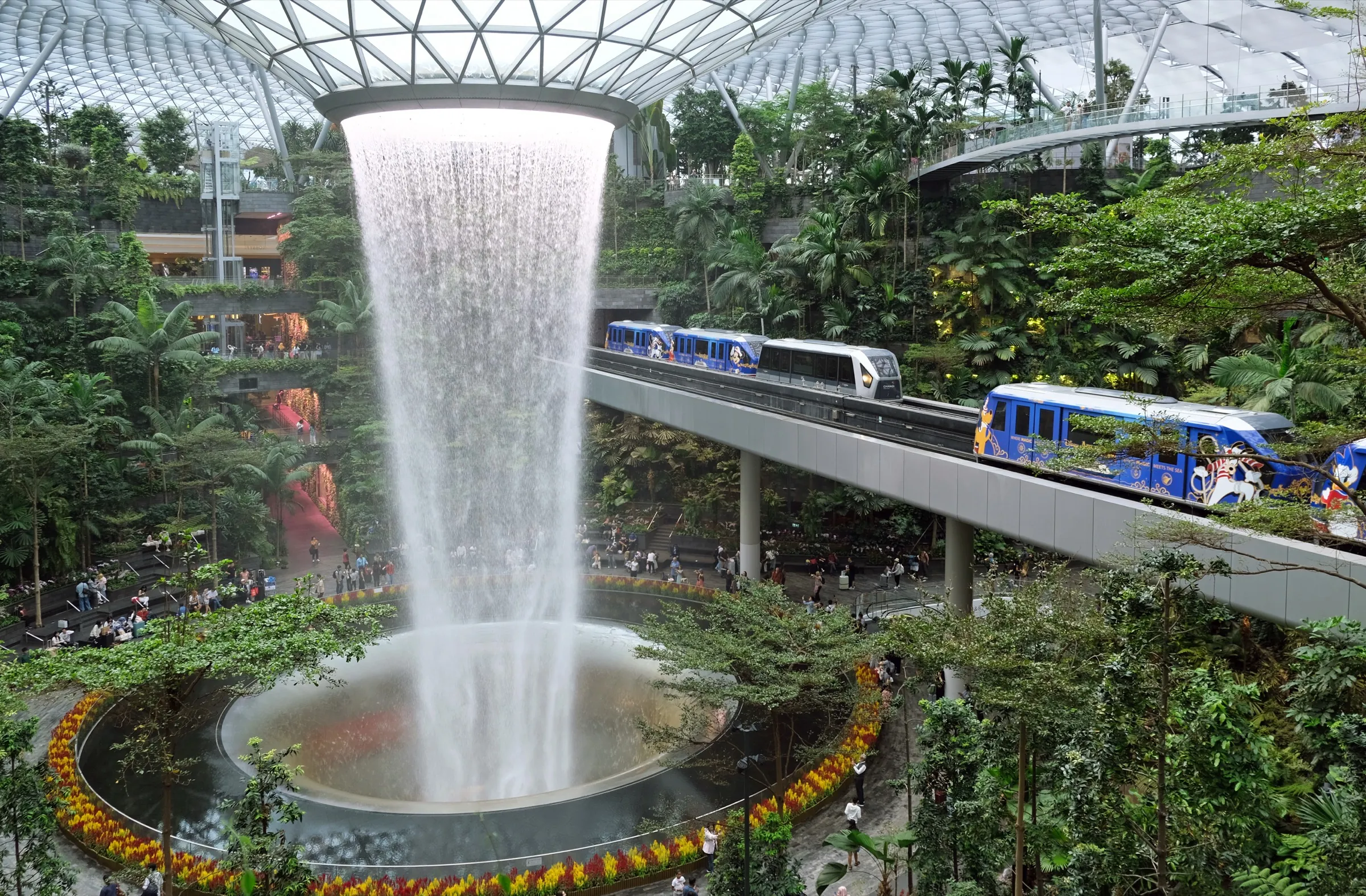
Rain Vortex at Jewel Changi Airport. Photo by Kallerna, CC BY-SA 4.0, via Wikimedia Commons.
A record year, four terminals, and a fifth one already under construction
Changi handled 69.98 million passenger movements in 2025, up 3.4 percent on 2024 and above the 68.3 million record set in 2019. It did that with four terminals that were designed for about 90 million, which leaves roughly twenty million movements of headroom before Terminal 5 arrives in the middle of the 2030s.
Why this matters for a Philippine trip. Changi is not a stopover airport you endure. It is a destination in its own right, and it is the point where a Singapore traveller, investor or buyer decides whether the Philippines is a four hour add on or a separate journey. The answer is usually the former: the flight is shorter than Singapore to Tokyo, the time zone does not change, and the arrival airports put you within a road transfer of a beach, a factory or both.
A short history of the airport
Changi opened in 1981 after Singapore moved commercial aviation out of Paya Lebar, which could not expand beyond about eight million passengers a year. Terminal 1 came first, Terminal 2 followed in 1990, Terminal 3 in 2008 and Terminal 4 in 2017. Jewel opened in 2019 on the site of the old Terminal 1 car park. The airport has been voted the world's best at various points, but the more useful measure for a business traveller is the one above: it keeps absorbing growth without turning transfers into a bus ride.
One airport, five stops, and a terminal for every kind of Philippine flight
The terminals are not interchangeable. Singapore Airlines and Philippine Airlines use Terminal 2. Cebu Pacific uses Terminal 4. Scoot uses Terminal 1. If you are connecting to a Philippine flight, the terminal on your ticket decides whether the transfer is a train ride, a walk or a shuttle bus.
The oldest terminal and the one closest to Jewel, with a direct link from the arrival hall. Scoot uses it for its Philippine departures.
Singapore Airlines and Philippine Airlines both depart from T2. The MRT station sits underneath the terminal, between T2 and T3.
The biggest of the four, with the Crowne Plaza hotel and a link bridge to Jewel. It shares the MRT station with T2.
Cebu Pacific departs from T4. There is no Skytrain, so the free shuttle bus from T2 or T1 is the connection. A new self service check in row is being added to lift throughput by about 15 percent.
Ground was broken in May 2025. The first phase handles about 50 million movements, with a four minute people mover link to T2.
Jewel is the reason some people build a long layover
Jewel Changi Airport opened in 2019 as a ten storey retail and leisure complex wrapped around a rainforest valley. The Rain Vortex in the centre is the tallest indoor waterfall in the world at about 40 metres, and the Canopy Park above it has mazes, sky nets and a garden walk. It is open 24 hours, though most shops run from 10 AM to 10 PM.
For a Philippine connection, Jewel is a genuine option if your layover is five hours or more and you can clear immigration. It is in the public area, not the transit area, so a transit passenger has to enter Singapore to see it. That is a useful excuse to spend a night in the city rather than a reason to stay airside.
At a glance
- Rain VortexAbout 40 metres, the tallest indoor waterfall in the world
- AccessDirect from T1 arrival hall, link bridges from T2 and T3
- HoursOpen 24 hours, shops mostly 10 AM to 10 PM
- TransitRequires arrival immigration clearance
- WalkFive to ten minutes from T2 or T3
Allow two hours for the waterfall, the canopy and a meal. Allow three if you are travelling with children.
One MRT station, thirty five minutes to the edge of the city, fifty to Marina Bay
Changi is close to the city by the standards of a major hub, but it is not a taxi ride from the gate. The rail link is cheap and reliable, a taxi is faster outside peak hours, and the T4 shuttle is the one connection that catches people out.
The East West Line branch, as it works today
| Mode | Time and detail |
|---|---|
| MRT | CG2 sits under T2 and T3. Trains run to Tanah Merah, where you change for the city. Allow 50 minutes and about S$2 in fare to Marina Bay. |
| Taxi | 20 to 30 minutes to the CBD outside peak hours. The rank is at each terminal arrival hall. Expect a queue on Friday evenings and during rain. |
| Bus | Public buses serve the terminals and the surrounding estate. Slower than rail, useful only if you are staying in the east. |
| T4 shuttle | Free, every five to nine minutes from 6 AM to midnight, about ten minutes to T2. Outside those hours the all terminals loop is less frequent. |
| Skytrain | Free, normally 5 AM to 2 AM, linking T1, T2 and T3 in both the public and transit areas. During the current renewal works the service closes from midnight to 5 AM, when the link bridges and the overnight loop bus take over. It does not serve T4. |
Five Philippine gateways, and not one of them needs a connection
Changi has nonstop service to Manila, Cebu, Clark, Davao and Iloilo. Frequency varies by season and airline, but the useful fact is structural: the Philippines is a short hop from Singapore, not a long haul. A Friday evening departure puts you in Manila before midnight, and a Monday morning flight gets you back for the office.
| Destination | Code | Airlines | Flight time | Weekly departures |
|---|---|---|---|---|
| Manila | MNL | SQPR5JTR | 3h 35m to 4h 05m | 87 to 98 |
| Cebu | CEB | SQTR5J | 3h 45m to 3h 55m | About 17 |
| Clark | CRK | TR5JSQ | 3h 15m to 3h 25m | About 17 |
| Davao | DVO | TR | 3h 35m to 3h 45m | About 11 |
| Iloilo | ILO | TR5J from Dec | 3h 45m to 3h 50m | About 3 to 4 |
The Davao advantage. Scoot is the only nonstop operator between Changi and Davao, and Davao is the airport for Tagum City, Samal Island and the northern Mindanao manufacturing belt. A buyer who wants to see a factory in Tagum and a beach on Samal can land at DVO in the morning, inspect the line after lunch, and be on the water before sunset. That is not a figure of speech: the drive from DVO to Tagum is about an hour and a half, and Samal is a ferry ride from Davao City.
Thirty days without a visa, one free form, and a dry season that fits a Singapore calendar
A Singapore passport holder can enter the Philippines for tourism or business for up to 30 days without a visa. The paperwork is a return ticket, a passport with six months of validity, and an eTravel declaration filed within 72 hours of arrival. The rest is choosing the season.
30 days, no visa
Singapore passport holders may enter for tourism or business for a stay not exceeding 30 days. Carry a passport valid for at least six months beyond the stay, a confirmed return or onward ticket, and proof of accommodation.
eTravel, free
File at etravel.gov.ph within 72 hours before arrival. It replaces the old arrival card, it is free, and it produces a QR code that is checked at check in and at immigration. One filing per traveller, including children.
Extensions and the 9(a) visa
A 30 day visa free stay can be extended at a Bureau of Immigration office in the Philippines, subject to approval and a fee. Work, study and stays planned beyond the extension window need the proper visa before departure.
When to go, month by month
The Philippine dry season runs from December to May. The wet season runs from June to October, with the highest typhoon risk between August and October. Christmas and New Year are peak domestic travel periods, so flights and island hotels tighten even though the weather is good.
Five trip shapes that work from a Singapore calendar
Manila long weekend
3 daysFly in on Friday night, stay in Intramuros or Makati, and spend Saturday on the National Museum, Fort Santiago and the food in Poblacion. Sunday is a day trip to Tagaytay or a slow brunch before the evening flight home.
Cebu and Bohol
5 daysNonstop to Cebu, two nights on Mactan or in the city, then the fast ferry to Bohol for the Chocolate Hills, the tarsier sanctuary and Panglao. Return from Cebu on the direct flight.
Davao and Tagum
5 daysNonstop to Davao, a day in the city, then the coastal road north to Tagum for a factory visit and the mangroves. Cross to Samal Island for two nights and fly home from DVO.
Palawan and El Nido
6 daysFly via Manila to Puerto Princesa, see the Underground River, then take the coastal road north to El Nido for island hopping. This is the trip that needs the most internal flight planning.
Three islands, one visa free month
21 to 30 daysManila, Palawan, Cebu, Bohol and Siargao in one arc. The 30 day visa free window is enough if you keep the internal flights tight and do not try to see everything. The reward is the range: colonial history, limestone karsts, coral, surf and food, all inside a month and all inside the same time zone.
Singapore is the Philippines' largest source of approved foreign investment
In 2025, Singapore committed ₱92.78 billion in approved foreign investment pledges, 34.1 percent of the national total and more than the Netherlands and Japan combined. The incentive regime is built for the sectors that follow: manufacturing, logistics, electronics and the supply chains behind them.
The Philippine Statistics Authority recorded ₱272.38 billion in approved foreign investment commitments for 2025 across the investment promotion agencies. Singapore was the top source, followed by the Netherlands at ₱35.98 billion and Japan at ₱34.03 billion. The Board of Investments alone approved ₱1.56 trillion in projects, of which ₱149.45 billion was foreign, with Singapore again leading at ₱80.37 billion.
Those are approvals, not money already spent. They are a signal of intent: Singapore based companies keep choosing the Philippines for projects that need land, power, labour and a port within a short flight of Singapore.
The incentive ladder under CREATE MORE
- Income tax holiday, 4 to 7 yearsAvailable to registered export enterprises in priority sectors, with the length set by location and tier.
- 20 percent corporate income taxUnder the enhanced deductions regime, registered projects pay 20 percent on net taxable income, with a 100 percent additional deduction on power and 50 percent on trade fairs.
- 5 percent special corporate income taxAn alternative on gross income, in lieu of national and local taxes, available for 10 to 20 years after the holiday.
- Duty and VAT reliefDuty exemption on imported capital equipment and raw materials, VAT zero rating on local purchases, and VAT exemption on imports, all directly attributable to the registered activity.
- Full foreign equity in export manufacturing. The negative list reserves certain sectors for Filipino ownership, but export manufacturing in a PEZA zone is open. Foreign owned registered exporters must ship at least 70 percent of production.
- 422 economic zones. PEZA administers manufacturing, IT, tourism, medical tourism, logistics and agro industrial zones across the country. Locating inside a zone is what makes the duty and VAT treatment work.
- Board of Investments and PEZA. The two lead promotion agencies. BOI handles the strategic investment priority plan, PEZA handles zone location and the one stop shop for imports and exports.
- What Singapore capital is buying. Electronics and semiconductor assembly, aerospace maintenance, logistics, food processing, and the apparel and uniform supply chain that serves regional corporate accounts.
The lane is electronics first, but apparel is the gap a Singapore buyer can close
Philippine exports to Singapore were worth US$3.53 billion in 2025. Almost 80 percent of that was electrical machinery and electronics. Apparel is a small line in the customs record, which is exactly why a buyer who wants a factory direct programme has room to move.
The apparel lane
Contract production for polos, athletic kit, workwear, jackets, rash guards and bags. The minimums are built for a buyer testing a design or supplying a single site rather than filling a container.
- 20 pieces for polos and athletic kit
- 50 pieces for workwear and jackets
- Samples by air before bulk release
- Three to six weeks production after sample, artwork and payment approval
- Four currency pricing on the product pages, settled in the currency you choose
What else Philippine factories make
The same industrial base that supplies Singapore's electronics and aerospace chains can support a corporate apparel programme: uniforms for plants, technical wear for field teams, and branded merchandise for regional offices.
- Semiconductor and electronics assembly
- Aerospace parts and maintenance, repair and overhaul
- Wire harnesses and precision components
- Food processing and agro industrial products
- Garments, uniforms, bags and corporate gifts
Why apparel is underweight. The customs record reflects volume, not opportunity. Philippine garment factories already serve regional uniform and merchandise programmes, but most of that volume is booked through Manila or Cebu agents rather than counted as a direct Singapore lane. A buyer who goes factory direct, with a Singapore purchase order and a Philippine production run, is using a corridor that already exists but is not yet crowded.
A US$9.5 billion lane, a four hour flight, and a form that removes most of the duty
Bilateral merchandise trade between the Philippines and Singapore reached US$9.5 billion in 2025. The Philippines sold US$3.53 billion and bought US$5.97 billion. For an apparel or uniform programme, the practical questions are freight mode, origin paperwork and the Singapore tax that applies on import.
| Mode | Transit and detail |
|---|---|
| Air freight | Three to five days door to door on the belly network, plus clearance. Changi has direct capacity to Manila, Cebu and Davao. Samples usually fly; bulk can follow. |
| Sea freight | About five to eight days port to port on a direct service to Manila, plus clearance and inland haulage. Singapore is a transshipment hub, so consolidation options are broad. |
| Origin paperwork | ATIGA Form D removes duty on most originating goods inside ASEAN. Keep the certificate consistent with the invoice, packing list and bill of lading. |
| Singapore tax | Most goods enter Singapore duty free, but GST applies at 9 percent on the import value. The rate is not zero, even when the duty is. |
| RCEP | The Regional Comprehensive Economic Partnership adds a second origin route for goods that do not meet the ATIGA rule. Use the agreement that fits the bill of materials. |
Lead time, end to end. A uniform programme shipped by air from Manila to Singapore can be with the buyer in under a week after production. On sea freight, allow two to three weeks door to door once the container is loaded. Production is the long pole: three to six weeks after sample approval, which is why the sample stage matters more than the freight mode.
What travellers and buyers ask about Changi
The short answers, with the details that decide a booking or a production run.
Is Changi the closest airport to the Philippines?
Not the closest in raw distance, but the most useful major hub in Southeast Asia for a Philippine trip. Changi has nonstop service to five Philippine gateways, the same UTC +8 clock, and a four hour flight to Manila. That is shorter than Singapore to Tokyo or Seoul, and about the same as Singapore to Hong Kong, which makes the Philippines a regional trip rather than a long haul.
Do Singapore passport holders need a visa for the Philippines?
No, for tourism or business stays of up to 30 days. Carry a passport valid for at least six months beyond the stay, a return or onward ticket, and proof of accommodation. File the free eTravel declaration within 72 hours before arrival.
How long is the flight from Changi to Manila?
Between 3 hours 35 minutes and 4 hours 5 minutes, depending on the airline, aircraft and winds. Singapore Airlines, Philippine Airlines, Cebu Pacific and Scoot all fly the route nonstop, with 87 to 98 departures a week in the late 2026 schedule.
Which Changi terminal do Philippine flights use?
Singapore Airlines and Philippine Airlines use Terminal 2. Cebu Pacific uses Terminal 4. Scoot uses Terminal 1. Terminal 4 has no Skytrain, so a T1 or T2 connection to a Cebu Pacific flight needs the free shuttle bus.
Can I visit Jewel during a transit stop?
Only if you clear arrival immigration, because Jewel sits in the public area between T2 and T3. A transit passenger cannot walk there from the transit hall. If the layover is five hours or more, entering Singapore for the Rain Vortex and a meal is realistic. Under three hours, stay airside.
How do I get from Changi to the city?
Take the MRT from CG2, the station between T2 and T3, change at Tanah Merah, and allow about 50 minutes to Marina Bay. A taxi takes 20 to 30 minutes outside peak hours. The Skytrain is free but only links T1, T2 and T3, not T4.
When does Terminal 5 open?
Terminal 5 is scheduled for the middle of the 2030s. Ground was broken in May 2025. Its first phase will handle about 50 million passenger movements a year, with a four minute people mover link to Terminal 2 and a new MRT interchange station serving the Thomson-East Coast Line and the Cross Island Line.
How do I ship apparel from the Philippines to Singapore?
Air freight is three to five days door to door and suits samples and replenishment. Sea freight is about five to eight days port to port on a direct service, plus clearance and inland haulage. Use ATIGA Form D for duty free entry on most originating goods, and budget for Singapore GST at 9 percent on the import value.
Planning a trip or a production run from Singapore?
Send your travel dates, flight routing or apparel specification and our team in Tagum City will reply. Business hours: Mon to Sat, 8:30 AM to 5:00 PM (PHT).
Passenger, cargo, aircraft movement and terminal capacity figures for 2025 come from Changi Airport Group, the Changi Airport annual report and the January 2026 traffic release. Terminal 5, the Changi East development, the third runway, the tunnel link and the mid 2030s timeline come from Changi Airport Group, the Ministry of Transport and the Land Transport Authority. MRT station detail, travel times, the Thomson-East Coast Line extension and the future T5 interchange come from the Land Transport Authority and SMRT. Visa free entry for Singapore passports, the 30 day limit, the return ticket rule and the eTravel requirement come from the Ministry of Foreign Affairs of Singapore, the Philippine Embassy in Singapore and the Bureau of Immigration. Philippine visitor totals and receipts come from the Department of Tourism. Approved investment figures come from the Philippine Statistics Authority and the Board of Investments. Incentive terms, the 20 percent corporate income tax, the income tax holiday, the special corporate income tax and the duty and VAT treatment come from Republic Act 12066, the CREATE MORE Act, PEZA and the Fiscal Incentives Review Board. Bilateral merchandise values and product shares come from UN Comtrade data reported by the Philippines. Airline routings and journey times are planning figures from published schedules and should be confirmed before booking.