
ORD / KORD Chicago O Hare International Airport, Illinois
Chicago O'Hare International Airport and the Philippines: Travel, Investment and Manufacturing
The world's busiest airfield by movements now has a nonstop to Manila. Philippine Airlines starts Chicago O'Hare to Manila on 9 November 2026, three times a week, on the A350. This page covers the airport, the route, the visa, the incentives and the trade lane, for travellers, investors and buyers in the American Midwest.
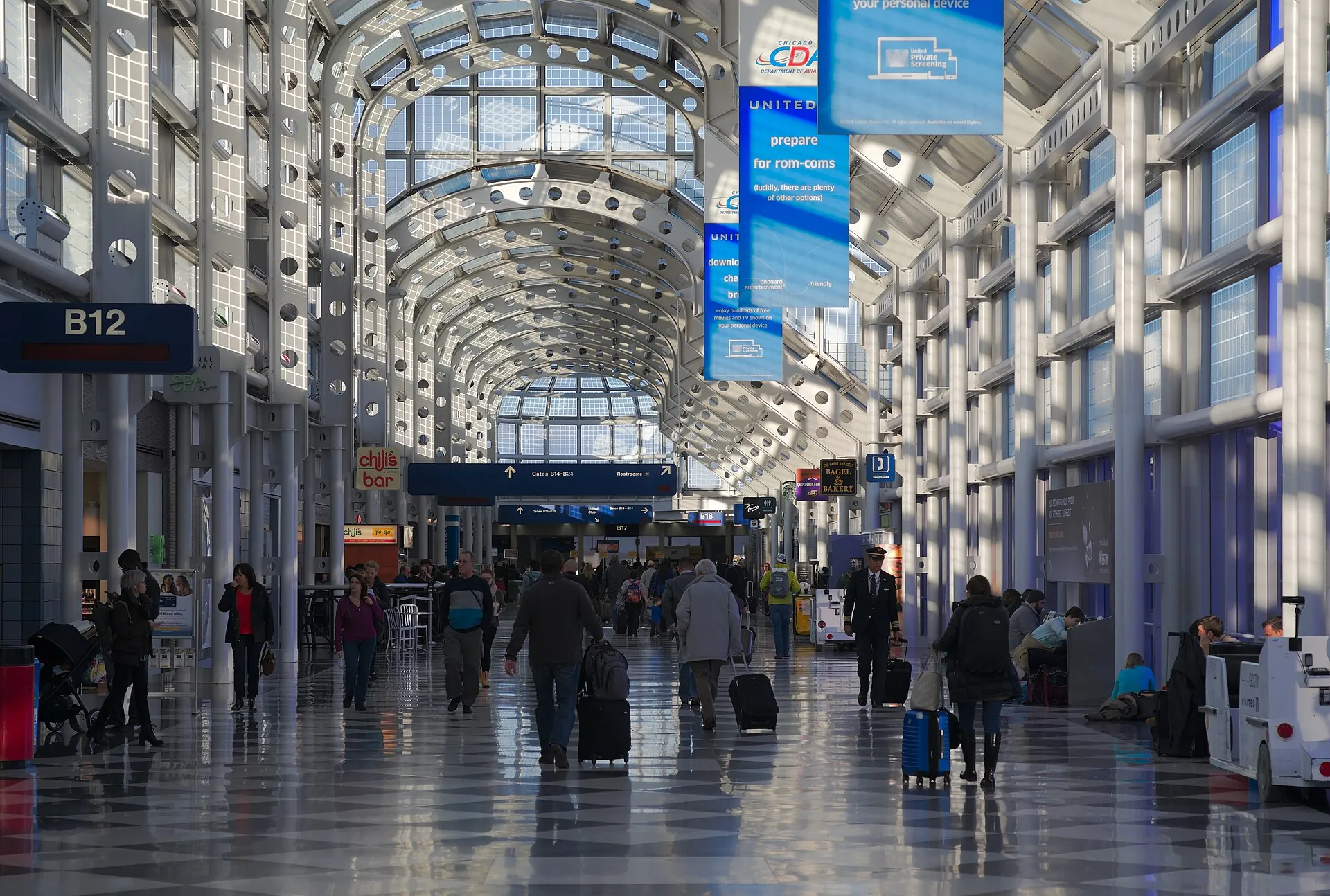
Concourse B in Terminal 1 at Chicago O'Hare. Photo by Dllu, CC BY-SA 4.0, via Wikimedia Commons.
Eight runways, one city block of sky, and a record that came back
O'Hare sits inside the Chicago city limits, straddling Cook and DuPage counties on 7,200 acres. It cleared 857,392 takeoffs and landings in 2025, more than any other airport in the world, which works out to one movement every 37 seconds around the clock. It carried 84.85 million passengers, the sixth highest total on earth, and handled about 2.2 million tonnes of freight.
- Codes
- ORD for IATA, after Orchard Field, and KORD for ICAO
- Position
- 41°58'N 087°54'W, elevation 205 metres or 672 feet, about 27 km northwest of the Loop
- Opened
- 1944 as Orchard Field, renamed O'Hare in 1949 for Edward "Butch" O'Hare, the naval aviator
- Runways
- Eight: six parallel east to west, four crosswind, the longest at 3,962 metres
- Gates
- 199 in April 2026, of which United leases 99 and American 66
- Terminals
- Four passenger buildings, numbered 1, 2, 3 and 5. There is no Terminal 4
- Reach
- Nonstop to 249 destinations, and the most cargo by value of any gateway in the Americas
- Share of trade
- O'Hare handled 7.6 percent of all United States trade by value in 2025, and supports about 70 billion dollars of annual economic activity
The eight runway field
Bar length is proportional to runway length
North airfield
South airfield
Crosswind
Six parallel runways in two sets of three is what makes the movements record possible: arrivals and departures can run at the same time in poor weather, which single pair airports cannot do. The two crosswind runways handle the days when the wind will not cooperate.
Four buildings, one missing number, and a rebuild that runs to 2034
Terminals 1, 2 and 3 sit in a line and connect inside security, so a domestic connection is a walk. Terminal 5 is the international building and sits across the airfield, reached by the free Airport Transit System train, which means clearing security again on the way back in.
| Terminal | Concourses | Who uses it | What to know |
|---|---|---|---|
| Terminal 1 | B and C | United, ANA, Lufthansa and Star Alliance partners | Helmut Jahn's 1987 building, the one with the white steel vault and the dinosaur in the concourse. United's main hub operation. |
| Terminal 2 | E and F | Air Canada and some United and United Express flights | The oldest of the four, and the one scheduled to come down. The O'Hare Global Terminal replaces it. |
| Terminal 3 | G, H, K and L | American and American Eagle | The largest by gate count, with the rotunda that survived the rebuild. American's Midwest hub. |
| Terminal 5 | M | Delta, the international carriers, and Philippine Airlines from November 2026 | The international terminal. Expanded and renovated, with 10 added gates and about 25 percent more gate capacity. Arrivals clear customs here. |
The construction sequence changed in August 2026. The Global Terminal was originally the next build after Concourse D, but the city moved Concourse E forward so the airport keeps its gate count while the terminal is built. Dates are the operator's published plan and they have moved before.
A two airline town, with everyone else at Terminal 5
O'Hare is a fortress hub for United and American at the same time, which is unusual in the United States. Between them the two carriers lease 165 of the 199 gates. Domestic scheduled traffic in the year to June 2026 split 27.1 percent United, 15.9 percent American, and 26.8 percent across every other carrier.
United
Terminal 1, with some flights from Terminal 2
O'Hare is United's largest hub by departures. The airline runs the domestic spine of the airport, plus the Star Alliance long haul: ANA to Tokyo, Lufthansa to Frankfurt and Munich, and the European partners.
- 99 leased gates
- Concourses B and C, joined by the underground walkway
- International departures from Terminal 1 and arrivals at Terminal 5
American
Terminal 3
American's Midwest hub, and the largest terminal by gate count. Domestic and Caribbean flying runs from G, H, K and L, with oneworld partners alongside.
- 66 leased gates
- Concourses G, H, K and L
- Flagship check in and lounges in Terminal 3
International
Terminal 5, Concourse M
Delta moved here in 2022, which put the international carriers and one SkyTeam hub under one roof. The list runs from Air France, KLM, Iberia and British Airways to Turkish, Emirates, Qatar, Korean Air, EVA Air, Cathay Pacific and, from November 2026, Philippine Airlines.
- Arrivals clear customs in Terminal 5
- Free Airport Transit System train from Terminals 1, 2 and 3
- Reach it from the Multi Modal Facility by walkway
Terminal assignments change with schedules and construction. Check the boarding pass or the airline app on the day, not the itinerary email from six months ago.
The first nonstop between the two cities, and what it changes
Before 9 November 2026 every Chicago to Manila trip was a connection through the west coast, Tokyo, Seoul or Hong Kong, with a minimum of about 19 hours of elapsed travel. Philippine Airlines now flies the city pair nonstop three times a week on the A350-900, which is 295 seats in three classes: 30 business, 24 premium economy and 241 economy.
The eastbound leg is shorter because it runs with the prevailing winds. The westbound leg leaves Chicago after the working day and lands in Manila before the working day starts, which is what makes a Monday meeting in Makati possible from a Friday departure. Manila is 14 hours ahead of Chicago on Central Standard Time and 13 hours ahead during daylight saving, and the Philippines does not change clocks.
If you are not on the nonstop
The one stop options are still useful, particularly for domestic US connections or for a stopover. These are the practical routings, with approximate total elapsed times.
| Routing | Carrier | Elapsed | Best for |
|---|---|---|---|
| Nonstop | Philippine Airlines | About 15 hours | The shortest trip, and the only same airline bag transfer |
| Via San Francisco | United | About 19 to 21 hours | Star Alliance ticketing and a US west coast stop |
| Via Los Angeles | Philippine Airlines, or American to Los Angeles | About 19 to 22 hours | The widest choice of Manila connections |
| Via Tokyo or Seoul | ANA, JAL, Korean Air, Asiana | About 20 to 23 hours | A Japan or Korea stopover, and a second Asian gateway |
| Via Hong Kong or Taipei | Cathay Pacific, EVA Air | About 21 to 24 hours | South China and Taiwan add ons |
| Via the Gulf | Qatar Airways, Emirates | About 24 to 27 hours | A Doha or Dubai stop, at the cost of the long way round |
Manila arrivals use Ninoy Aquino International Airport. Terminal 1 handles most foreign carriers, Terminal 2 is Philippine Airlines, Terminal 3 is Cebu Pacific and several foreign airlines, and Terminal 4 takes the domestic turboprops. A domestic connection to Cebu, Davao, Bohol or Siargao normally needs a terminal change and a fresh bag drop, so leave three hours or more.
Thirty days without a visa, and an archipelago that suits a week or a month
The United States is the Philippines' largest source market. 1,323,142 American passport holders arrived in 2025, and the January to August 2026 count of 926,575 was 21 percent of all arrivals, ahead of South Korea for the first time. The country took 6.48 million visitors in 2025, about 694 billion pesos in receipts, and tourism supported roughly 7.7 million jobs.
Entry rules for a US passport
No visa is needed for tourism or business for an initial stay of 30 days under Executive Order 408. You need a passport valid for at least six months beyond the stay, a return or onward ticket, and eTravel registration inside 72 hours of arrival. The 30 days can be extended at a Bureau of Immigration office in Manila, Cebu or Davao, and the first extension adds 29 days.
- Former Filipino citizens and their spouse and children travelling with them can use the Balikbayan privilege for one year on arrival.
- Longer stays should be arranged before the flight as a temporary visitor visa, not left to the airport.
- Onward travel matters at check in: the airline will ask for the ticket out before it boards you.
Four ways to spend the trip
Nonstop into Manila makes a short trip viable. These are four shapes that work from a Monday arrival, all of them with the internal flights booked in the same week.
Manila, on the way to a meeting
Intramuros and Fort Santiago, the National Museum, the American cemetery in Taguig, and dinner in Poblacion or Bonifacio Global City. Enough for a first trip that is really a business trip.
Base: Makati or BGC. No internal flight needed.
Luzon north, rice terraces and colonial towns
Banaue and Batad on foot, then Vigan, a UNESCO town of Spanish era houses on the Ilocos coast. The drives are long and the reward is the landscape, which does not look like the beach brochures.
Route: Manila, Banaue, Sagada, Vigan, Manila.
The Visayas, island by island
Cebu, Bohol and Siquijor, with the chocolate hills, whale sharks at Oslob and reef diving at Moalboal. Ferries and short flights do the moving, and the pace is deliberately slow.
Route: Cebu, Bohol, Siquijor, back through Cebu.
Palawan and Mindanao
El Nido and Coron for the limestone and the lagoons, then Siargao for surf and Camiguin for volcanoes. This is the itinerary that needs the domestic connections to work, so book the early flights.
Route: Manila, El Nido, Coron, Cebu, Siargao, Manila.
The dry season runs from December to May and is the easier window. June to November brings the rain and, from July to October, the typhoon risk, which is why travel insurance with interruption cover is worth the small cost. The heat is constant: expect 30 to 33 degrees Celsius on the coast most of the year.
A 20 percent corporate rate and full foreign equity in export manufacturing
The CREATE MORE Act, Republic Act 12066, reset the incentive regime in 2024. For a US manufacturer setting up an export line, the headline is a 20 percent corporate income tax, an income tax holiday of four to seven years, and 100 percent foreign ownership in export enterprises, with no minimum export ratio.
Corporate income tax for the standard regime, down from 25 percent, applied to taxable income rather than gross revenue.
Income tax holiday for registered projects, tiered by location and industry, counted from commercial operation rather than from registration.
Special corporate income tax for export enterprises after the holiday, in place of all national taxes, with VAT zero rating on local purchases and duty free capital equipment.
Foreign equity in export manufacturing and in domestic market enterprises outside the negative list, under CREATE MORE and the amended Public Service Act.
Minimum paid in capital for a foreign owned domestic market enterprise, reduced to $100,000 with advanced technology or at least 50 direct employees.
The practical case for a Midwest firm is not the tax rate on its own, it is the combination: English as the language of business and law, a workforce that is young relative to the American and European average, a domestic market of more than 110 million people, and a legal system built on the American model. The United States is the Philippines' largest single export market, and one of its largest sources of foreign direct investment.
On the Chicago side of the same lane, Foreign Trade Zone 22 covers Cook, DuPage, Grundy, Kankakee, Kendall, Lake and Will counties, with active sites at the airport and at the CenterPoint intermodal center. Goods held in a zone are not subject to duty until they leave it, which is a useful hedge when a tariff line is moving.
What a Chicago buyer sources from the Philippines
Philippine garment and apparel exports were about 1 billion US dollars in 2025, and the trade association expects 2 to 5 percent growth in 2026. Electronics remain the largest export by value, with auto parts, food processing, furniture, medical devices and aerospace components behind them. For a Midwest buyer the realistic categories are the ones with a design and small batch requirement rather than a pure volume play.
Uniform and workwear
Corporate, hospitality, healthcare and industrial programmes, with embroidery, screen print, sublimation and heat transfer in house. Buyer supplied fabrics are accepted.
3 to 6 weeksKnitwear and performance apparel
Polos, tees, rash guards, cycling and running kit, and teamwear. Low minimums per design make a test run possible before a seasonal commitment.
4 to 6 weeksBags and corporate gifts
Totebags, pouches, caps and gift sets, packed and labelled to the buyer's specification, which suits distributor and promotional programmes.
3 to 5 weeksPrivate label programmes
OEM and ODM production with buyer approved woven labels, care labels, hangtags, polybags and carton marks, so the shipment lands retail ready.
4 to 8 weeksPrices are ex works in Philippine pesos. The dollar, euro and pound figures are approximate, vary with the live rate, and are converted by the currency switcher in the site header, which also settles the cart in the selected currency. Freight, duty and local delivery are separate.
Working across 14 time zones
Manila is 14 hours ahead of Chicago in the northern winter. A question sent from Chicago at the end of the working day is on a Philippine desk the next morning, and the answer is back before Chicago opens again. That rhythm suits sampling and production approvals, which is where most overseas sourcing programmes lose days.
27 billion dollars in goods, and a duty stack that moved twice in a year
Two way goods trade between the United States and the Philippines was 27.0 billion dollars in 2025: 9.2 billion in American exports and 17.8 billion in imports. Add services and the total reaches 40.9 billion. There is no free trade agreement between the two countries, and the American preferential tariff scheme for developing countries has lapsed, so Philippine goods enter on the standard rate plus whatever action is in force on top of it.
The 19 percent reciprocal rate is gone. The Supreme Court held on 20 February 2026 that the emergency powers statute does not authorise tariffs, and collections stopped. A 15 percent replacement under Section 122 ran from 24 February to 24 July 2026, and the Court of International Trade found it unlawful in May. Do not price a 2027 order from a 2025 quote.
The de minimis exemption is suspended. Since 29 August 2025, parcels of 800 dollars or less pay duty, and the suspension was continued on a new legal footing in February 2026. A sample shipment is no longer free of duty.
The effective rate is measurable, not theoretical. The average effective American tariff on Philippine knitted apparel was 31.8 percent in August 2026, and 30.2 percent on woven apparel. The base rates range from 16.5 percent on cotton knit shirts to 32.5 percent on synthetic knit tops and 19.7 percent on woven cotton shirts.
There is no preference to claim. No bilateral free trade agreement is in force, and the generalised system of preferences has not been renewed. A shipment from the Philippines pays the same base rate as one from a country without a deal, so the case for the Philippines has to rest on lead time, minimums, quality and the cost of the work, not on a tariff edge.
None of that is advice on a specific entry. Classification depends on the garment, the fibre and the construction, and the treatment of any given shipment is decided at the port by Customs and Border Protection. Take a written ruling from a licensed broker before you commit to a price.
What travellers and buyers ask about O'Hare
Is there a nonstop flight from Chicago to Manila?
Yes, from 9 November 2026. Philippine Airlines flies Chicago O'Hare to Manila three times a week on Monday, Wednesday and Friday with an Airbus A350-900, 295 seats in business, premium economy and economy. The distance is 13,070 kilometres, the Manila to Chicago block time is about 14 hours 15 minutes, and the return runs slightly longer against the wind. It is the first nonstop between the two cities.
Which terminal does Philippine Airlines use at O'Hare?
Terminal 5, the international building, on Concourse M. Arrivals clear customs there. If you are connecting from a domestic flight in Terminal 1, 2 or 3, take the free Airport Transit System train, which runs around the clock, and allow time to clear security again because the train sits outside the secure area.
Do US citizens need a visa for the Philippines?
No, for a stay of up to 30 days. US passports enter visa free under Executive Order 408 with a passport valid six months beyond the stay and a return or onward ticket, and eTravel registration inside 72 hours of arrival. Extensions are filed at a Bureau of Immigration office and the first one adds 29 days. Former Filipino citizens and their immediate family travelling with them can use the Balikbayan privilege for one year.
How do I get from O'Hare to downtown Chicago?
The CTA Blue Line is the default. It costs 5 dollars from the O'Hare station, runs 24 hours a day, and takes 40 to 45 minutes to the Loop with no traffic risk. A taxi is around 40 dollars and a rideshare 40 to 65 dollars, with 25 to 90 minutes depending on the hour. Metra's North Central service is cheaper but runs only a few times a day.
What duty will a Philippine garment shipment pay?
Start with the most favoured nation rate for the exact line, which runs from 16.5 percent on cotton knit shirts to 32.5 percent on synthetic knit tops and 19.7 percent on woven cotton shirts. Add the Section 301 forced labour action of 12.5 percent, in force since 24 July 2026, plus the merchandise processing fee of 0.3464 percent. A 10,000 dollar cotton knit shipment lands at about 29.3 percent of customs value. No free trade agreement or preference applies, so confirm the line with a broker first.
What is the minimum order and how long does production take?
50 pieces per design for custom production, with blank stock minimums depending on the colour and size mix. Production runs 3 to 6 weeks after the sample, artwork and payment are approved, and shipping is on top of that. Air freight from Manila to Chicago is typically 3 to 5 days airport to airport, and sea freight to the US west coast then rail to Chicago is 22 to 30 days on the planning estimate.
Can a small American brand use a Philippine factory?
Yes, and that is most of the work. The factory handles OEM and ODM production, buyer supplied fabric, and the labelling pack: woven labels, care labels, hangtags, polybags and carton marks. The usual sequence is a paid sample, a fit correction, a production slot, then a pre shipment inspection. The minimums are low enough that a first run can be a market test rather than a season bet.
What incentives are open to a US manufacturer?
Under CREATE MORE, a registered enterprise pays 20 percent corporate income tax, or takes an income tax holiday of four to seven years and then a 5 percent special corporate income tax in place of national taxes for export activity. Export manufacturing is open to 100 percent foreign equity, with a 200,000 dollar minimum paid in capital for a domestic market enterprise, halved with advanced technology or 50 or more employees. Registration runs through the Board of Investments or PEZA.
Flying in, or sourcing from Manila?
Send your travel dates, your routing question or your apparel specification and our team in Tagum City will reply. Business hours: Mon to Sat, 8:30 AM to 5:00 PM (PHT).
Passenger, movement, cargo and destination figures for 2025 come from the Chicago Department of Aviation and the Airports Council International world rankings, with the 2025 annual report for the trade share and the economic impact. Gate counts, runway dimensions and the 199 gate total as of 1 April 2026 come from the Chicago Department of Aviation facility data. The terminal program sequence, the 8.8 billion dollar budget, the 19 gate Concourse D, the 14 and 10 gate Concourse E phases, the 2033 Global Terminal and the 2034 close come from the Mayor's Office announcement of August 2026 and the ORDNext project pages. Carrier shares come from the Bureau of Transportation Statistics for the twelve months to June 2026. The Philippine Airlines nonstop, the 9 November 2026 start, the Monday, Wednesday and Friday frequency, the A350-900 and the 295 seat three class layout come from the airline announcement and booking page; confirm the schedule before ticketing. Distance and block times are calculated from the airport coordinates and the published schedule. Visa rules come from Executive Order 408, the Department of Foreign Affairs and the Bureau of Immigration. Arrival and source market figures come from the Department of Tourism dashboard. Trade values come from the United States Trade Representative and the Census Bureau for 2025. Tariff detail comes from the Harmonized Tariff Schedule, the Section 301 notice published in July 2026, the Supreme Court decision of 20 February 2026, the Court of International Trade decision of May 2026, and the effective rate series compiled from Customs data. Incentive detail comes from the CREATE MORE Act, Republic Act 12066, and the Board of Investments. Foreign Trade Zone 22 detail comes from the Foreign Trade Zones Board. The hero photograph is by Dllu, CC BY-SA 4.0, via Wikimedia Commons. Schedules, visa rules, tariff lines and construction dates change, so confirm with the airline, the airport operator, the customs broker and the Philippine Embassy before you commit.