
DUS / EDDL / Düsseldorf, North Rhine-Westphalia
Düsseldorf Airport and the Philippines
The largest airport in Germany's most populous state, seven kilometres from the Rhine and an easy train ride from the fashion showrooms of Düsseldorf. This page covers the runways and terminals, the SkyTrain and the S11, the one stop routings to Manila, the visa a German passport needs, and the trade and manufacturing case that runs from North Rhine-Westphalia to Philippine factories.
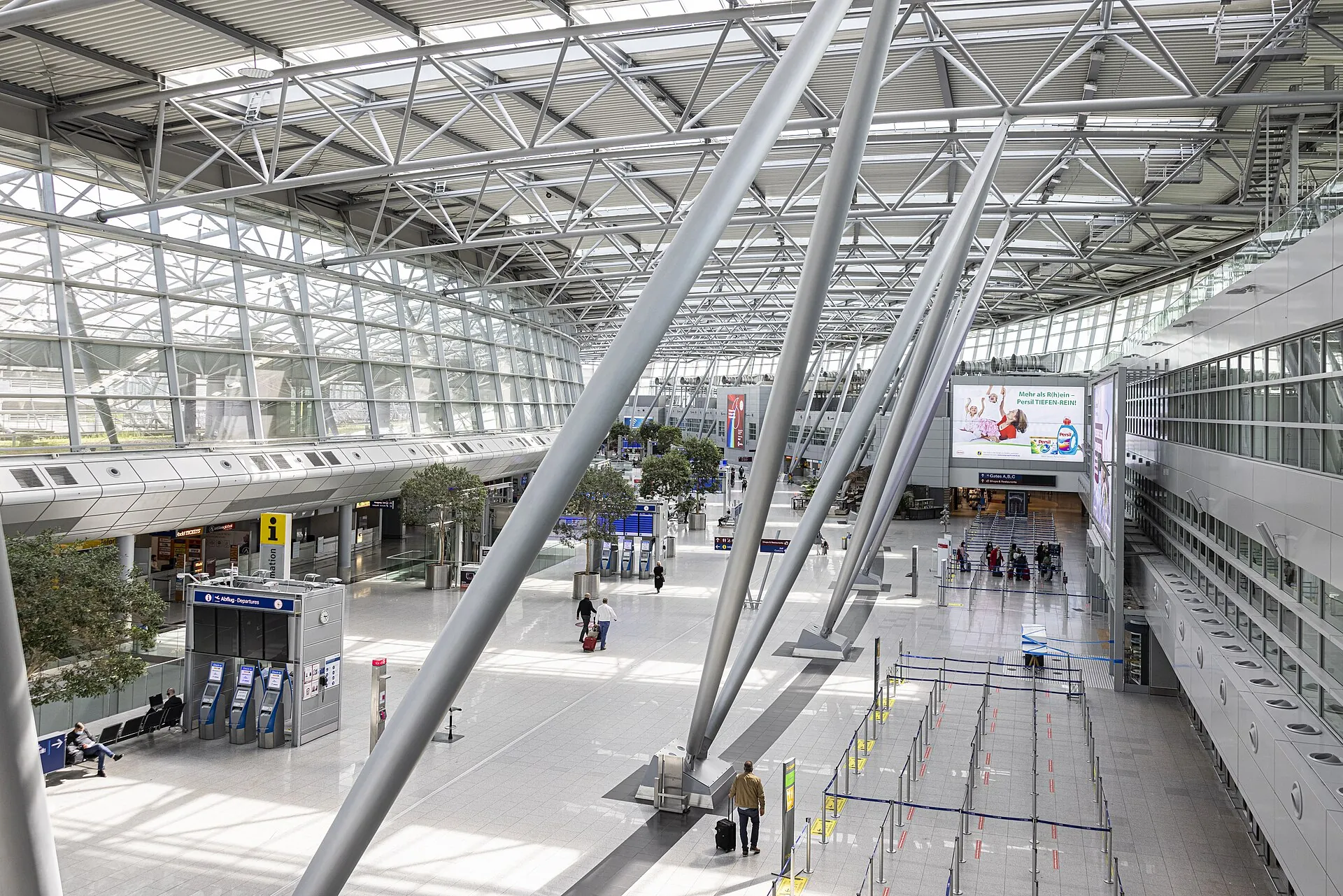
Terminal hall at Düsseldorf Airport. Photo by Arne Müseler, CC BY-SA 3.0 DE, via Wikimedia Commons.
Two parallel runways beside the Rhine, and a terminal that sits between them
Düsseldorf Airport occupies a compact site north of the city, close enough to the centre that the runway approach passes over the suburbs. It handles more passengers than any other airport in North Rhine-Westphalia and ranks fourth in Germany, behind Frankfurt, Munich and Berlin.
- Codes
- DUS for IATA and EDDL for ICAO
- Operator
- Flughafen Düsseldorf GmbH, half owned by the city and half by Airport Partners, with AviAlliance at 30 percent and Aer Rianta at 20 percent
- Location
- 7 kilometres north of Düsseldorf city centre, inside the Rhine and Ruhr urban belt
- Runway 05R/23L
- The main strip at 3,000 metres by 45 metres, carrying the long haul and most of the scheduled traffic
- Runway 05L/23R
- The second parallel strip at 2,700 metres by 45 metres, used for additional arrivals and departures
- Terminal capacity
- 22 million passengers a year across Terminals A, B and C
- Traffic in 2025
- 21,031,429 passengers and 159,984 aircraft movements, both up on 2024
- Air cargo in 2025
- 37,317 tonnes, carried mostly in the belly holds of passenger widebodies
- To Manila
- About 10,350 kilometres great circle, with no nonstop service
- SkyTrain
- 2.5 kilometres of automated people mover linking the terminals to the long distance rail station in about seven minutes
Why the site shape matters
Two parallel strips on a compact field mean short taxi times, but they also mean the airport cannot add a third runway on the current footprint. The terminal sits between the runways and the rail line, so a passenger can land, clear the building and be on a train to the city in under half an hour. That is the practical advantage of DUS over the larger German hubs: it is small enough to cross on foot.
What it means for a sourcing trip: a morning arrival from the Gulf can be in a Düsseldorf showroom before lunch, and a factory sample sent as belly cargo reaches the Air Cargo Center on the same field. The airport is a city gateway, not a freight mega hub, and the trade section below explains where the heavier apparel volume actually clears.
Three terminals under one roof, and a capacity figure the airport has almost reached
Terminals A, B and C are linked behind a single check in hall, so a transfer between them is a walk rather than a bus ride. The buildings were designed for 22 million passengers a year, and the 2025 total of 21.0 million puts the airport at about 96 percent of that figure.
| Terminal | Gates | Traffic it handles | What to know |
|---|---|---|---|
| Terminal AOpened 1977 | 16 gatesA01 to A16 | Lufthansa, Star Alliance carriers and a large share of the Schengen schedule | The largest of the three piers and the one most business travellers see. Security and passport control sit at the centre of the building, so allow the usual 90 minutes for a Schengen departure and two hours for a long haul one. |
| Terminal BShort haul and charter | 11 gatesB01 to B11 | Eurowings, Condor, oneworld and SkyTeam carriers, and most European leisure flying | The busiest pier for European leisure flying in summer. The far end handles flights to the United Kingdom, Ireland and other points outside the Schengen area, so follow the signs rather than the gate number alone. |
| Terminal COpened 1986 | 8 gatesC01 to C08 | Long haul and international flights outside Star Alliance, including the Gulf carriers | The smallest pier, reached by a covered walkway from the main hall. If you are flying to Istanbul, Doha, Dubai or Abu Dhabi, this is usually your building. Check the boarding pass, because airlines move between piers when the schedule changes. |
The three buildings share one landside hall, one shopping level and one set of rail and road links. That is unusual for an airport of this size, and it is why a self transfer at DUS is far less risky than a self transfer at a hub with separate terminal buildings. The trade off is that the airport has little room to grow: the 22 million design capacity is now the binding constraint, and the operator has been adding apron and security capacity rather than new piers.
The security record is genuinely good. In 2024 the airport reported that 97 percent of passengers cleared security in under ten minutes. That figure moves with the season and the hour, but it explains why DUS has a reputation as a calm airport compared with Frankfurt or Munich at peak.
Seven kilometres from the city, and two different rail systems under the terminal
DUS is close enough to Düsseldorf that the transfer is not a planning problem. The choice is between the S11 S-Bahn, which stops directly beneath the terminal, and the SkyTrain, which connects to the long distance station on the Cologne to Duisburg line.
S11 S-Bahn
The simplest route. The S11 runs from a station under the terminal to Düsseldorf Hauptbahnhof in about 12 minutes, then continues through the city. Trains run roughly every 30 minutes, and the fare is a normal local transport ticket.
- To Hauptbahnhof
- About 12 minutes
- Frequency
- Every 30 minutes
- Best for
- City centre hotels and the fashion showroom district
SkyTrain
An automated monorail on a 2.5 kilometre elevated line, opened in 2002. It links the terminal to the Düsseldorf Flughafen long distance station, where ICE, IC and regional trains stop. The ride takes about seven minutes and runs from 3:45 AM to 0:45 AM every five to seven minutes.
- Line length
- 2.5 kilometres
- Journey
- About 7 minutes
- Best for
- ICE and IC connections to Cologne, the Ruhr and Frankfurt
Road
The airport sits between the A44 and the A52, with signed access from both. A taxi to the city centre takes 15 to 20 minutes outside rush hour, and rather longer in the morning peak. Ride hailing is available but the taxi rank is usually faster at the terminal.
- To city centre
- About 7 kilometres
- Taxi time
- 15 to 20 minutes
- Best for
- Showrooms, the MedienHafen and luggage heavy arrivals
Other airports
DUS is not the only airport in the region, and the names can mislead. Cologne Bonn is about 50 kilometres south, Frankfurt is about 190 kilometres away, and Liège is roughly 120 kilometres west. Düsseldorf Weeze, used by Ryanair, is 80 kilometres northwest and is a different airport with the code NRN.
- Cologne Bonn
- About 50 km, 24 hour cargo
- Frankfurt
- About 190 km by rail or road
- Watch for
- Düsseldorf Weeze is not DUS
No nonstop, but one stop through the Gulf gets you there in about 15 hours
Düsseldorf has no scheduled nonstop to the Philippines. The practical route is a single connection through Istanbul, Doha, Dubai or Abu Dhabi, then a six to eight hour second leg into Manila. Total journey time runs from about 15 hours to 19 hours depending on the hub and the layover.
Turkish Airlines through Istanbul
One stop, the shortest total time from DUS
- First leg
- DUS to IST, about 3 hours 15 minutes
- Second leg
- IST to MNL, about 11 hours
- Total
- About 15 to 17 hours door to door
- Why it works
- Several daily frequencies into Istanbul, so a missed connection has a same day recovery
Qatar Airways through Doha
One stop, a longer layover and a strong long haul cabin
- First leg
- DUS to DOH, about 6 hours 15 minutes
- Second leg
- DOH to MNL, about 9 hours 30 minutes
- Total
- About 16 to 18 hours door to door
- Why it works
- Good connection windows and a straightforward transfer in one terminal
The hub comparison
Times are planning figures from DUS, including the layover. They move with the season and the day of the week, so check the schedule before you book.
| Hub | Carrier on the first leg | Typical total | When it makes sense |
|---|---|---|---|
| Istanbul | Turkish Airlines | 15 to 17 hours | The fastest and the deepest frequency, with a short first leg |
| Doha | Qatar Airways | 16 to 18 hours | Best cabin and connection experience if the fare is close |
| Dubai | Emirates | 17 to 19 hours | Widebody comfort and a long layover that is easy to use |
| Abu Dhabi | Etihad Airways | 17 to 19 hours | Often the best value in economy, with a quieter hub |
| Frankfurt or Munich | Lufthansa and a partner carrier | 17 to 20 hours | Useful if you are already in southern Germany, or if the rail leg replaces the first flight |
Where to land in the Philippines
Manila is the main international gateway, but it is not the only useful arrival point. Domestic connections are dense and cheap, and the right choice depends on whether the trip is a beach itinerary or a factory visit.
- MNL, Manila. The default arrival point and the start of most business trips. Intramuros is half an hour from the terminal in light traffic, and the rice terraces at Banaue are a night bus north.
- CEB, Cebu. The second gateway, with Bohol a fast ferry away and the diving at Moalboal and Malapascua within a day's drive. The best base for the central islands.
- CRK, Clark. The former United States air base north of Manila, now a passenger and cargo airport inside a freeport zone. Useful for factory visits in Pampanga and Central Luzon.
- DVO, Davao. The southern gateway and the closest airport to the apparel factories of the Davao Region and Northern Mindanao, which is why sourcing trips often finish here rather than in Manila.
Three rules that save the trip
Buy the whole journey on one ticket. A self transfer through Istanbul or Doha puts the risk on you. On one ticket the airline rebooks you when the first leg is late, which matters more in winter, when Düsseldorf can fog in and the connection window is tight.
Leave at least two hours in the hub. The Gulf carriers sell tight connections that work only when the first leg is on time. Two hours turns a missed connection into a wait rather than a lost day.
Register on eTravel before you fly. The free form at etravel.gov.ph opens 72 hours before arrival and is checked at check in as well as on landing. Doing it at the gate is the most common reason a passenger is pulled aside.
Thirty days without a visa, and an archipelago that fits inside them
A German passport holder can enter the Philippines without a visa for a stay of up to 30 days, which is enough for a two or three island itinerary or a combined factory and beach trip. The rules are simple, but the paperwork is checked at both ends.
Tourism or business, straight off the plane
A German passport holder may enter without a visa for a stay not exceeding 30 days. Carry a passport valid for at least six months beyond the stay, a confirmed return or onward ticket, proof of accommodation, and enough funds for the trip. The Philippine Embassy in Berlin publishes the same rule.
eTravel registration
Complete the eTravel form at etravel.gov.ph within 72 hours before arrival. It is free, it replaces the old arrival card, and it generates a QR code that is checked at check in and at immigration. One form per traveller, including children.
Extensions and the 9(a) visa
A 30 day visa free stay can be extended at a Bureau of Immigration office in the Philippines, subject to approval and a fee. Anything planned beyond that should start with a 9(a) temporary visitor visa through the Philippine Embassy in Berlin or the online portal at evisa.gov.ph.
When to go, quarter by quarter
The Philippine dry season runs from December to May, which is also the European winter. That makes January and February the strongest months for a trip that starts in Düsseldorf, but it also makes them the most expensive for domestic flights and island hotels.
January to March
Cool, dry and clear across most of the country. Peak season for Palawan, Boracay and Siargao, so book boats and internal flights early. The trade fair calendar is also busy, which matters if the trip mixes business with the beach.
April to May
The hottest months, and the best sea conditions for diving. Rates ease after the Easter peak. Good for Batangas, Anilao and the Visayas if you do not mind 35 degree afternoons.
June to October
Afternoon downpours, lower prices, and a real risk of typhoons between August and October. City breaks in Manila, Cebu and Davao work well; island hopping needs a flexible plan and travel insurance that covers disruption.
November to December
The rains taper, the light improves, and Filipino families travel for Christmas, which pushes domestic flights and hotels to their highest prices of the year. Book well ahead, especially for Boracay and Siargao.
Six places that reward the flight
- Palawan. The Underground River at Puerto Princesa and the limestone islands at El Nido. Fly Manila to Puerto Princesa in about 1 hour 20 minutes, then take the coastal road north.
- Boracay. A short flight to Caticlan or Kalibo, then a ferry. The white sand strip is four kilometres long and the sunsets are the reason people return.
- Siargao. Surf, lagoons and palm lined roads. Fly Manila to Sayak in about two hours, then a 45 minute drive to General Luna.
- Cebu and Bohol. Whale sharks at Oslob, the Chocolate Hills and the tarsier sanctuaries, with a fast ferry between the islands.
- Manila. Intramuros, the National Museum and the food scene in Poblacion. Worth two nights at the start or end of a trip.
- Banaue and Vigan. The rice terraces and the Spanish colonial street, both reachable by overnight bus or a short flight plus road transfer from Manila.
A 20 percent corporate rate and full foreign ownership in export manufacturing
The Philippines is not the cheapest place in Southeast Asia to build, but it is one of the few where a German manufacturer can own the whole operation outright in a priority sector, and the incentive regime has been rewritten in the investor's favour.
Under the CREATE MORE Act, Republic Act 12066, a registered export enterprise can claim a reduced corporate income tax rate, an income tax holiday, and then a special rate on gross income in place of national taxes. The terms below are the ones that matter for a manufacturing or distribution project.
The North Rhine-Westphalia angle. NRW is home to about 18 million people and produces roughly a fifth of German economic output, with exports above 223 billion euros a year and about 20,000 foreign companies established in the state. Düsseldorf is the capital and the administrative centre, while the Rhine and Ruhr belt supplies the machinery, chemicals, automotive, logistics and retail base that Philippine suppliers can plug into.
German industry is already present in the Philippines in aerospace maintenance, automotive parts, electronics and business services. Lufthansa Technik runs a heavy maintenance base in Manila, and the wider German footprint is concentrated in the same sectors that CREATE MORE was designed to attract. For a mid sized NRW company, the usual entry is a sales office or a contract manufacturing relationship before any greenfield plant.
The entry sequence that usually works
Take a serviced office or a PEZA locator unit before committing to land. Run the first production order through a local contract manufacturer to test labour, quality and logistics. Apply for registration only once you know your actual volumes, because registration carries reporting duties and an investment commitment that are easier to meet when the numbers are real.
What Düsseldorf and NRW buy, and what Philippine factories can make
NRW has a deep textile history of its own, so no buyer comes to the Philippines for plain commodity cotton. They come for the things the German and Turkish mills are slow at: small runs, heavy decoration, technical fabrics, fast sampling, and a factory that will take 50 pieces when the local supplier wants 5,000.
Düsseldorf order days and retail own brands
The city runs one of Germany's largest fashion wholesale clusters, with more than 800 showrooms around Kaiserswerther Strasse and the exhibition centre, plus the Düsseldorf Fashion Days each July. Private label buyers use Philippine factories for jersey, fleece, shirting and denim programs that need a fast second production base.
Staff kit, giveaways and exhibitor uniforms
Messe Düsseldorf hosts MEDICA, boot, ProWein, EuroShop, drupa, K and A+A. Exhibitors order polo shirts, softshell vests, lanyards, tote bags and embroidered jackets in short runs before each show, which is exactly the order band a Philippine contract factory handles well.
Uniforms, scrubs and workwear
Hospitals, clinics, hotel groups, logistics fleets and retail chains rebrand on a cycle. Pique polos, woven shirts, medical scrubs, high visibility jackets and office trousers with embroidered crests, packed by site or by department.
Contract apparel, priced for a German buyer
Indicative ex works prices for the order bands below, shown in the four currencies this site runs on. Embroidery, printing, labels and freight are quoted separately, and the euro figure moves with the exchange rate on the day of quotation.
Corporate polo shirts and office uniforms
Pique or jersey, embroidery, woven collar
Minimum 20 pieces, 12 to 18 working days after artwork approval.
Rash guards and athletic kit
Four way stretch, sublimation, flatlock seams
Minimum 20 pieces, 15 to 22 working days for a first run.
Heavy duty workwear and jackets
Twill or canvas, reinforced seams, reflective trim
Minimum 50 pieces, 20 to 30 working days depending on fabric.
Corporate jackets and blazers
Structured lining, embroidered crest, tailored fit
Minimum 50 pieces, 25 to 35 working days after fitting.
Pricing settles in the currency chosen in the header switcher. The converted figures are approximate, because the live engine converts from Philippine pesos at the rate on the day.
The fair calendar that drives the order book
Most NRW buyers work backwards from a show date. A stand at MEDICA in November needs staff kit in October, which means a production order in August. The months below are the ones that repeat every year.
One date already in the diary
MEDICA and COMPAMED run at Messe Düsseldorf from 16 to 19 November 2026. Exhibitors and visiting distributors who still need staff polo shirts, softshell vests or branded scrubs should be ordering now, because a contract run from the Philippines needs three to six weeks plus freight.
A 12 percent duty that disappears when the origin rule is met
Düsseldorf is a passenger airport with a modest cargo operation, not a freight mega hub. Its value to an apparel buyer is the belly capacity into a region of 18 million consumers, the Air Cargo Center on the field, and the short truck legs to the real cargo gateways at Cologne Bonn, Frankfurt, Liège and Duisburg.
For a garment entering Germany from the Philippines, the standard border charge is a 12 percent customs duty on the cost, insurance and freight value, plus 19 percent import VAT. The duty is a real cost. The VAT is recoverable for a VAT registered importer, so it behaves like a cash flow item rather than a permanent charge.
| Charge | Standard rate | With GSP+ and a valid REX statement |
|---|---|---|
| Customs duty on apparel, HS 61 and 62 | 12.00% | 0.00% |
| German import VAT | 19.00% | 19.00% |
| VAT treatment for a registered importer | Recoverable | Recoverable |
| Cash at the border on a 10,000 euro CIF shipment | 3,328 euro | 1,900 euro |
Read it as two numbers. On a 10,000 euro shipment at the standard rate, the duty is 1,200 euro and the import VAT is 2,128 euro, charged on the CIF value plus the duty. The total at the border is 3,328 euro. With GSP+ and a valid statement on origin, the duty falls to zero and the cash at the border falls to 1,900 euro, all of it recoverable.
The certificate that lowers it, and the rule behind it
The Philippines is a beneficiary of the European Union GSP+ scheme, which grants zero duty on 6,274 product lines, including apparel in Chapters 61 and 62. The current regulation has been extended to December 2027. The proof is a statement on origin issued by a registered exporter under the REX system, which replaced the old Form A. The statement is self certified by the Philippine exporter and checked by German customs under the ATLAS system.
The catch is the origin rule. For apparel, the product must be manufactured from yarn, which means the knitting or weaving has to happen in the Philippines before the garment is cut and sewn. A factory that imports finished fabric from China and only cuts and sews does not qualify, and no certificate can fix that. Bilateral cumulation can count inputs that originate in the European Union, so a Philippine factory using German or Italian fabric may still reach the threshold. The question to ask before the first order is whether the factory can show a costed origin calculation, not whether it has a REX number.
Freight on the lane
- Air: 4 to 6 days door to door through Istanbul, Doha, Dubai or a European hub, plus clearance. Belly capacity into DUS is useful for samples and urgent capsules, while heavier consignments usually land at Cologne Bonn, Frankfurt or Liège and move by truck.
- Sea: 30 to 38 days from Manila or Cebu to Rotterdam, Antwerp or Hamburg, then a Rhine barge or truck to Duisburg and Düsseldorf. Duisburg is the largest inland port in Europe and sits about 40 kilometres from the airport.
- Production: 3 to 6 weeks after sample, artwork and payment approval, on top of freight.
Customs and cargo at DUS
The airport customs post, Zollamt Flughafen Düsseldorf, sits in Terminal B and handles passenger and express declarations. Commercial air cargo clears through the Air Cargo Center on Frachtstrasse, where the cargo office works around the clock and the main handlers include FDCG and Swissport. Lufthansa Cargo also runs a station on the field. German customs uses ATLAS for electronic declarations, ICS2 for advance security filing, and requires an EORI number from the importer.
DUS handled 37,317 tonnes of air cargo in 2025. That is small compared with Frankfurt or Leipzig, so a buyer shipping more than a few pallets should price the lane through Cologne Bonn or Frankfurt and treat DUS as the passenger and sample gateway. The trade off is convenience: a sample that lands at DUS can be in a Düsseldorf showroom the same afternoon.
What travellers and buyers ask about Düsseldorf
What is the airport code and where is the airport?
The IATA code is DUS and the ICAO code is EDDL. The airport sits about 7 kilometres north of Düsseldorf city centre in North Rhine-Westphalia, on a compact site between the A44 and the A52. It has two parallel runways and three interconnected terminals.
Which terminal does my flight use?
Terminal A carries Lufthansa, Star Alliance and much of the Schengen schedule. Terminal B carries Eurowings, Condor, oneworld, SkyTeam and most European leisure flying. Terminal C carries long haul and international flights outside Star Alliance, including the Gulf carriers. All three share one check in hall, so a transfer is a walk. Check the terminal on your boarding pass, because airlines move between piers.
How do I get from the airport to Düsseldorf city centre?
Take the S11 S-Bahn from the station under the terminal. It reaches Düsseldorf Hauptbahnhof in about 12 minutes and runs roughly every 30 minutes. The SkyTrain connects the terminal to the Düsseldorf Flughafen long distance station in about seven minutes for ICE and IC services. A taxi takes 15 to 20 minutes outside rush hour.
Is there a nonstop flight from Düsseldorf to Manila?
No. There is no scheduled nonstop between DUS and Manila. The fastest routing is one stop through Istanbul with Turkish Airlines, at about 15 to 17 hours door to door, followed by Doha with Qatar Airways at about 16 to 18 hours. Dubai and Abu Dhabi are slightly longer. Book the whole journey on one ticket so the airline owns any misconnection.
Do German passport holders need a visa for the Philippines?
No, for stays of up to 30 days. A German passport holder may enter without a visa for tourism or business, with a passport valid at least six months beyond the stay, a confirmed return or onward ticket, proof of accommodation and enough funds. Complete the free eTravel form at etravel.gov.ph within 72 hours before arrival. Longer stays need an extension from the Bureau of Immigration or a 9(a) visa before departure.
When is the best time to visit the Philippines from Germany?
January to March is the strongest window: dry, clear and cool by Philippine standards. April and May are hotter but good for diving. June to October is the wet season, with the highest typhoon risk from August to October. November and December are dry again but crowded and expensive because Filipino families travel for Christmas.
What duty applies to Philippine garments entering Germany?
The standard duty on apparel in HS Chapters 61 and 62 is 12 percent of the CIF value, plus 19 percent German import VAT. Under the EU GSP+ scheme the duty falls to zero if the goods meet the origin rule and are covered by a REX statement on origin from a registered Philippine exporter. The VAT is recoverable for a VAT registered importer. GSP+ has been extended to December 2027.
Can a Düsseldorf buyer order a small run rather than a container?
Yes. Contract production starts at 20 pieces for polos and athletic kit and 50 pieces for workwear and jackets, which is the point of the lane for a buyer testing a design or supplying a single site. Blank stock minimums depend on brand, colour and size mix. Samples normally fly so the make can be inspected before the bulk order is released.
How long does air cargo take from Manila to Düsseldorf?
Four to six days door to door on the belly network, plus clearance. Much of the apparel volume lands at Cologne Bonn, Frankfurt or Liège and moves to Düsseldorf by truck, because DUS has limited freighter capacity. Production takes three to six weeks after sample, artwork and payment approval, on top of freight.
Is Düsseldorf Weeze the same airport as DUS?
No. Düsseldorf Weeze is a separate airport about 80 kilometres northwest of the city, with the code NRN, used mainly by Ryanair. Düsseldorf Airport is DUS and sits 7 kilometres from the city centre. Check the code on your booking before you arrange a transfer, because the two names are routinely confused.
Planning a trip or a production run from Düsseldorf?
Send your travel dates, flight routing or apparel specification and our team in Tagum City will reply. Business hours: Mon to Sat, 8:30 AM to 5:00 PM (PHT).
Traffic figures for 2025, terminal capacity, runway lengths, terminal gate counts and the SkyTrain line come from Flughafen Düsseldorf GmbH, the airport annual report and the airport location pages. Düsseldorf visitor and fashion district detail comes from Visit Düsseldorf and the Düsseldorf Fashion Days organisers. Trade fair months come from Messe Düsseldorf. Visa free entry for German passports, the 30 day limit and the eTravel requirement come from the Philippine Embassy in Berlin and the Bureau of Immigration. GSP+ product coverage, the 12 percent standard duty, the REX statement on origin, the manufacture from yarn rule and the extension to December 2027 come from the European Commission Access2Markets service and the EU GSP regulation. Investment terms come from Republic Act 12066, the CREATE MORE Act, and the Board of Investments. Airline routings and journey times are planning figures from published schedules and should be confirmed before booking.