
EZE / SAEZ · Buenos Aires, Argentina
Ezeiza International Airport, Buenos Aires
The main international gateway to Argentina, 23 kilometres southwest of the city, and the airport where a Philippine sourcing trip begins or ends. This page covers the terminals, the transfer to Aeroparque, the fastest routing to Manila, the 30 days Argentine passport holders can stay visa free, and the trade and manufacturing case that links the two countries.
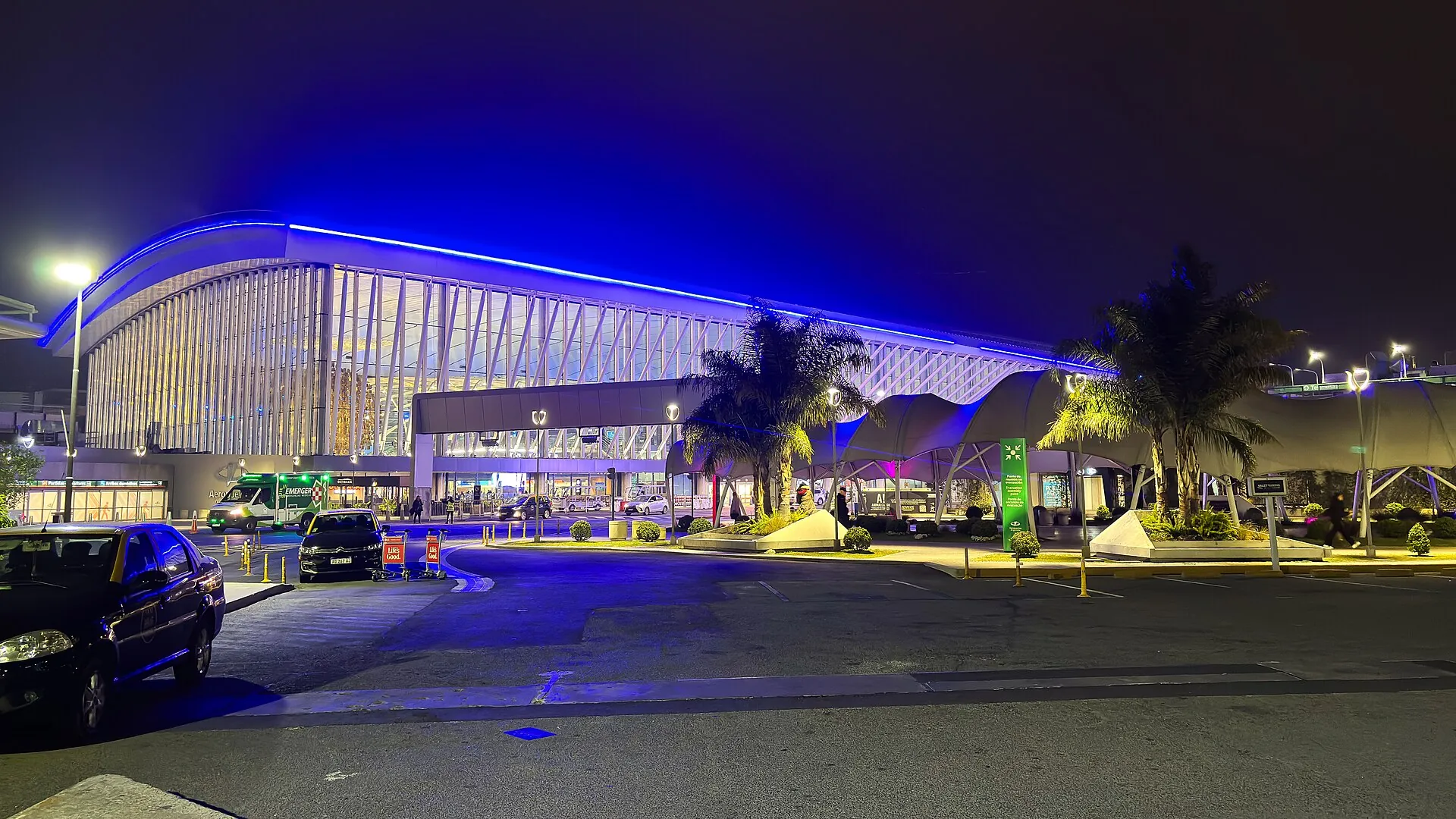
Departures terminal at night. Photo by Robert Motecinos Holda, CC BY-SA 4.0, via Wikimedia Commons.
A 1949 gateway rebuilt around a 2023 departures hall
Ministro Pistarini opened on 30 April 1949 and was the third largest airport in the world at the time. It covers 3,475 hectares and handles about 85 percent of Argentina's international air traffic, while Aeroparque Jorge Newbery handles most domestic and regional flying from inside the city. Aeropuertos Argentina 2000 has operated the airport since 1998, and the concession now runs to 2049, with a further seven years to 2056 if the committed investments are certified.
The airport was reorganised in April 2023, when a new Departures Terminal opened with 50,000 square metres over four floors and a projected capacity of 30 million passengers a year. The building cost about US$230 million and connects directly to Terminal B.
What remains is a three part configuration that rewards a little planning. International departures use the new hall. International arrivals use Terminal A, which holds immigration, baggage reclaim and customs. Domestic arrivals use Terminal C. The two are not the same building, and the walk between them is not obvious on a first visit.
Most domestic and regional flights do not leave from Ezeiza at all. They leave from Aeroparque Jorge Newbery, about 35 kilometres away on the riverfront. If your itinerary connects an international arrival at EZE to a domestic departure, you are changing airports, not terminals, and that transfer belongs in the plan from the start.
The change under construction. From 2027 to 2031 the current international arrivals building is replaced by a new 35,000 square metre terminal with a 3,000 square metre baggage hall and 14 carousels. The old Terminal A area then becomes a 10,000 square metre domestic terminal, which finally puts international arrivals and domestic connections inside one connected complex. Until then, treat EZE and AEP as two different airports.
EZE at a glance
- IATA and ICAO codeEZE / SAEZ
- Runway 11/293,300 m
- Runway 17/353,105 m
- Elevation20 m
- Site area3,475 ha
- OperatorAA2000 since 1998
- ConcessionTo 2049
- Air freight, 2024229,260 t
Which hall does what
31 airlines, 55 international destinations, and no nonstop to Southeast Asia
Ezeiza is the long haul airport for a country of 46 million people, so the network is broad rather than deep. Europe is served nonstop by five carriers, the Gulf by two, and North America by four. What the map does not have is a single nonstop flight to the Philippines, or to anywhere in Southeast Asia, which is why every Manila routing connects through a third hub.
Europe
- Madrid
- Iberia, Air Europa, Plus Ultra and Aerolíneas Argentinas
- Paris
- Air France
- Amsterdam
- KLM
- Frankfurt
- Lufthansa
- Rome
- ITA Airways and Aerolíneas Argentinas
- Istanbul
- Turkish Airlines
- London Heathrow
- British Airways
Middle East and Africa
- Dubai
- Emirates, with a stop in Rio de Janeiro
- Doha
- Qatar Airways
- Tel Aviv
- El Al, from 29 November 2026
- Addis Ababa
- Ethiopian Airlines, with a stop in São Paulo
North America
- Miami
- American Airlines and LATAM
- New York JFK
- American Airlines, with a seasonal Delta service
- Atlanta
- Delta Air Lines
- Houston
- United Airlines
- Toronto
- Air Canada
- Mexico City
- Aeroméxico
Latin America
- Panama City
- Copa Airlines
- Bogotá
- Avianca
- Lima
- LATAM, Sky Airline and JetSmart
- Santiago
- LATAM, Sky Airline, JetSmart and KLM
- São Paulo and Rio de Janeiro
- LATAM, Gol, JetSmart, Emirates and British Airways
- Domestic
- Aerolíneas Argentinas and Flybondi, though most domestic flying uses Aeroparque
Airline schedules move. A route that exists this season can be cut next season, and the Gulf carriers adjust capacity with demand. Confirm the operating carrier and the terminal on the day you book, not on the day you read this page.
Airport detail: Aeropuertos Argentina 2000 and the national airport regulator ORSNA.
Thirty five kilometres from the centre, and no train
Ezeiza sits outside the city boundary, so the transfer is a real journey rather than a short hop. There is no rail link to the terminal and no plan for one in the current works programme. Four road options cover almost every budget, and the choice mostly comes down to how much luggage you are carrying and how many people are travelling.
| Option | Fare | Time | Best for |
|---|---|---|---|
| Tienda León shuttleDepartures every hour from 4:00 AM to midnight, to Terminal Pellegrini near Retiro | ARS 16,500, about US$10 | 50 to 60 min | A solo traveller with light luggage who is heading for the Retiro and Microcentro area |
| Official taxiBook at the booth inside the arrivals hall, never from someone standing in the hall | About US$40 to US$45 | 45 to 60 min | Two or three travellers with bags who want a door to door ride |
| Ride appUber and Cabify collect from the marked curb outside arrivals | About US$25 to US$30 | 50 to 70 min | A traveller with a working data plan who does not mind a short walk to the pick up point |
| Line 8 colectivoThe city bus, which runs around the clock with fewer services overnight | Under US$1.50 | 2 hours or more | A backpacker with time to spare and no fixed check in |
| EZE to AEP transferTienda León runs a direct service between the two airports | ARS 17,000, about US$11 | 60 to 80 min | Anyone connecting to a domestic flight, which almost always leaves from Aeroparque |
Build the airport change into the ticket. An international arrival at EZE and a domestic departure from AEP are not a terminal change. Allow at least four hours between them, more in the evening peak, and remember that immigration, baggage and a new check in all sit inside that window. Fares quoted here were checked in 2026 and move with the exchange rate.
Ezeiza to Manila: one connection, and about 30 to 34 hours
There is no nonstop between Argentina and the Philippines, and no carrier flies the route with a single ticket that avoids a long wait. The practical choice is which hub to cross in. Doha, Dubai and Istanbul all work, and the difference between them is measured in an hour or two rather than in a whole day.
Through Doha
Qatar Airways, the shortest total journey of the three
- EZE to DOHQatar Airways, about 16 hours
- DOH to MNLQatar Airways, about 9 hours 15 minutes
Through Dubai
Emirates, with a stop in Rio before the Atlantic crossing
- EZE to DXBEmirates, about 16 hours 35 minutes
- DXB to MNLEmirates, about 8 hours 50 minutes
Through Istanbul
Turkish Airlines, the shortest first sector and the longest second one
- EZE to ISTTurkish Airlines, about 14 hours 30 minutes
- IST to MNLTurkish Airlines, about 11 hours 10 minutes
Before you fly
- Thirty days visa free. Argentine passport holders enter the Philippines without a visa for 30 days under Executive Order 408. The stay can be extended at the Bureau of Immigration. The passport must be valid six months beyond the stay and you need an onward or return ticket. Only Brazil and Israel get 59 days, under separate bilateral agreements.
- eTravel within 72 hours. Register free at etravel.gov.ph and keep the QR code offline. Airlines ask for it at the gate, and it replaces the paper arrival card.
- Doha and Dubai both mean a terminal walk. Hamad International and Dubai International are large, and a 90 minute connection is tight for a first time transfer. Two hours is comfortable and three is safe.
- Manila is not one terminal. International arrivals land at Terminal 1 or Terminal 3 depending on the carrier, and domestic departures leave from Terminal 2 or Terminal 4. Allow three hours between an international arrival and a domestic departure.
- The date changes twice. Manila runs 11 hours ahead of Buenos Aires. A Thursday evening departure from Ezeiza lands in Manila on Saturday afternoon, so book the first day lightly.
What the trip costs in time
Add the airport transfer at each end and the journey is closer to 34 to 38 hours. From a hotel in Palermo to a hotel in Makati, that is a full day and a half of travel, which is why most travellers break the trip in the Gulf rather than push straight through.
For business travel, the return leg is the one that hurts. A Friday evening departure from Manila lands in Buenos Aires on Saturday morning, which leaves a weekend to recover before a Monday meeting. Booking the Doha routing usually buys back two or three hours, and on a trip this long that is worth having.
Cargo is a separate calculation. Passenger routings are not cargo routings. Air freight from Manila reaches Ezeiza in 3 to 5 days airport to airport, and sea freight to the port of Buenos Aires takes 32 to 45 days. Contact the export team before you assume a passenger schedule applies to a shipment.
Official references: eTravel registration, Philippine visa policy and Philippine Airlines.
Argentines get 30 days, and the country is 7,000 islands wide
The Philippines recorded 6.48 million inbound arrivals in 2025, including 543,085 returning overseas Filipinos, and about ₱694 billion in visitor spending. Argentine arrivals are a small share of that total, which is exactly why the entry rules matter. Argentina sits on the 30 day visa free list under Executive Order 408, not the 59 day bilateral list that covers Brazil and Israel, and the stay can be extended at the Bureau of Immigration once you are there.
Manila and the Cordilleras
Intramuros, Fort Santiago and San Agustin Church sit inside a walled city built before Buenos Aires had its first coffee house. North of Manila, the rice terraces at Banaue and the mountain city of Baguio run 8 to 12 degrees cooler than the coast.
Manila is also the hinge for every domestic connection, so a night there at the start or the end is unavoidable and worth planning for.
Cebu, Bohol and Siargao
Cebu has a Spanish colonial core, the Moalboal sardine run and whale sharks at Oslob. Bohol pairs the Chocolate Hills with tarsiers and the Panglao beaches. Siargao, further east, is the surf island, with Cloud 9, Sugba Lagoon and the Magpupungko rock pools.
All three are a short domestic flight from Manila or Cebu, and all three are served by more than one carrier.
Davao and the south
Davao is the southern gateway: Samal Island, Mount Apo, and the beaches around Tagum City, where our own workshop sits. The region is also the country's fruit and cacao belt, so the food is a reason to come on its own.
Direct Manila to Davao flights take about 1 hour 50 minutes, and Tagum City is roughly two hours north by road.
When to come: December to May is dry and hot, June to November is wetter, and the surf season on Siargao runs August to November. Typhoon attention matters most from July to October. Domestic airlines cancel early rather than late, so build a buffer day before an international return.
Sourcing and travel context: shipping from the Philippines to Argentina and the Philippine investment case.
Argentina sells US$345 million to the Philippines, and most of it is feed and grain
Merchandise exports from Argentina to the Philippines reached about US$345 million in 2024, built on animal feed residues, cereals, wood and food preparations. Philippine exports to Argentina ran to about US$84 million, led by vehicle parts, machinery, electrical goods and coconut products. Each side reports its own exports, so the two numbers are not a single reconciled total, but the shape of the trade is clear: Argentine agriculture flows east, and Philippine manufactured goods flow west.
Feed residues, cereals, wood and food preparations. The buyers are feed millers, flour millers and food manufacturers, which means the commercial relationships already run on specification sheets and delivery windows.
Vehicle parts, machinery, electrical equipment and coconut products. The lane is smaller, which is the opportunity: a buyer already importing from Asia can add a garment programme to the same container plan.
Corporate income taxThe CREATE MORE Act, Republic Act 12066, set the corporate rate at 20 percent for domestic and foreign corporations and added enhanced deductions for power, training and infrastructure.
Foreign equity in most sectorsThe Public Service Act amendments under Republic Act 11659 opened most non utility sectors to full foreign ownership, and the amended Foreign Investments Act lowered barriers for smaller investors.
Units per style, minimumA pilot order does not need a container load. Twenty units per style lets an Argentine buyer test a Philippine line on its own specification before committing to a season.
Days by air freightManila to Ezeiza with one stop, airport to airport. Sensible for samples, a first order and replenishment that cannot wait for a ship.
Why an Argentine buyer looks east
Argentina is a food exporting country with a garment import habit. The meat packing plants, feed mills, flour mills, wineries, citrus packers and cold stores of the Pampas and the Littoral all buy workwear on a replacement cycle: white coats, aprons, sleeve covers, snoods, boots and high visibility vests.
The mining provinces add a second market. Lithium and copper operations in Salta, Jujuy, Catamarca and San Juan run remote camps that need durable uniforms, and the oil and gas fields in Neuquén run the same kind of programme. Both are specification driven, and both respond to a supplier that can quote a fabric weight and a wash cycle.
What the Philippines adds
English is the working language for contracts, quality manuals and audit reports, which removes the translation layer that slows approvals in other sourcing regions. Minimum order quantities start at 20 units per style. And the country sits inside ASEAN, with RCEP access and a trade position that is separate from China and Vietnam.
For a first move, the practical route is a sourcing contract rather than a plant: test a Philippine workshop on your own specification, measure the defect rate, then decide whether a joint venture or an economic zone locator makes sense.
Reference material: the Argentina import page, Argentina jerseys and team kit and investing in the Philippines.
A packing plant buys more workwear than an office tower
RB Advertising has manufactured technical apparel in the Philippines since the 1990s, with production in Tagum City and Cagayan de Oro and customers across North America, Europe and Australia. An Argentine buyer usually arrives with one of three needs: garments that survive a hygiene regime, high visibility for yard and port crews, or a branded uniform for a hotel, airline or retail network.
Food plant and agribusiness workwear
White coats, aprons, sleeve covers, snoods, beard covers and boots built for industrial laundering and for the colour coding that a hygiene audit expects. Fabric weight, closure type and seam construction are specified per plant.
We quote the laundry cycle with the garment, because a coat that fades after 30 washes is not a saving.
₱320.00 / about $5.10 / €4.45 / £3.85 Entry unit price, volume dependentHigh visibility workwear
Vests, polos, jackets and cargo trousers for ports, warehouses, mines and forklift crews, in the colour blocks and tape placement that an Argentine safety programme requires. Retroreflective tape grade is quoted separately so the comparison is honest.
The same programme can carry a company mark in embroidery or heat transfer, which is usually what turns a safety garment into a uniform.
₱420.00 / about $6.70 / €5.85 / £5.05 High visibility vest, volume dependentCorporate uniforms and technical apparel
Polos, button downs, aprons and hospitality sets, plus rash guards and compression wear for private label. Programmes start at 20 units per style, which suits a single site rollout or a pilot before a national contract.
Size sets, colour matching and carton labelling are quoted as part of the programme rather than as extras.
₱480.00 / about $7.65 / €6.65 / £5.75 Typical branded polo, volume dependentAir or sea into Argentina
- Air freight, 3 to 5 days. Manila to Ezeiza with one stop through Doha or Dubai. Best for samples, a first order and anything with a launch date attached.
- Sea freight, 32 to 45 days. Manila or Davao to the port of Buenos Aires, then road inland. Best for production volume, and the route is already busy in the other direction with Argentine feed and grain.
- Duty and classification. Most apparel lands under Chapter 61 or 62 of the tariff schedule, and the final line depends on fibre, knit or woven construction, gender and garment type. Ask an Argentine customs broker to model the landed cost before the order is placed.
Why EZE matters to a shipper
The Terminal de Cargas Argentina handles about 90 percent of the country's air foreign trade, and it is the facility that receives a Philippine sample parcel before a buyer ever sees it. Cold chambers, bonded warehouses and customs inspection bays sit inside the same perimeter, which is why a garment shipment can clear without leaving the airport.
The cargo side is being rebuilt as well. The 2027 to 2031 programme sets aside US$34 million for the cargo terminal, including a 15,000 square metre single courier terminal and a 3,000 square metre expansion of sheds and cold rooms for perishable exports.
Sourcing detail: manufacturing workwear, uniform programmes, sourcing from the Philippines, sea transport services and air transport services.
A US$760 million rebuild that finishes the terminal layout
Aeropuertos Argentina presented a US$1,500 million programme on 9 October 2026 covering its 35 airports through 2031. Ezeiza takes US$760 million of that, split between US$600 million for terminals and US$160 million for the runway system. The aim is to finish a configuration that started with the 2023 departures hall and has been half complete ever since.
- 1949 The airport opensInaugurated on 30 April, on a 3,475 hectare site, and the third largest airport in the world at the time.
- 1998 The concession beginsAeropuertos Argentina 2000 takes over operations and starts a modernisation programme that has since passed US$2,800 million across the network.
- 2011 Terminal C opensA new hall for Aerolíneas Argentinas, Air France and Alitalia, later repurposed for domestic arrivals.
- 2013 Terminal B opens28,795 square metres, built for Aerolíneas Argentinas and KLM, and now linked to the departures hall.
- 2023 The Departures Terminal opens50,000 square metres over four floors, about US$230 million, and a projected capacity of 30 million passengers a year.
- 2026 The concession is extendedAdministrative Decision 27/2026 extends the contract to 2049, with a further seven years to 2056 if the committed investments are certified.
- 2027 to 2031 The arrivals terminal and the runwayA new 35,000 square metre international arrivals hall, a 3,000 square metre baggage hall with 14 carousels, 15,000 square metres added to the international pier with six gates, a 10,000 square metre domestic terminal, and full renewal of pavements, signage and airfield lighting.
What changes on the ground
The most useful change for a traveller is the domestic terminal. Today an international arrival at EZE and a domestic departure from AEP require a 35 kilometre road transfer. After the rebuild, the old Terminal A area becomes a 10,000 square metre domestic terminal, and the three public halls connect to each other. The airport change becomes a walk.
The airside works are less visible but just as consequential. Runway 17/35 and taxiways Hotel and Alfa were repaved in 2026, Apron Golf adds aircraft parking stands, and the main runway repaving follows in 2027. In total the programme lays more than 200,000 square metres of asphalt and 60,000 square metres of concrete.
The number to watch
Twelve million passengers in 2025, up 5.1 percent on 2024, against a terminal built for 30 million. That gap is the whole investment case: the airport is not short of runway, it is short of space to process people and bags at the same time.
For a Philippine exporter, the cargo numbers matter more than the passenger ones. The cargo terminal gets US$34 million, the single courier terminal is already under construction at 15,000 square metres, and the perishable export cold rooms gain 3,000 square metres. Samples, parcel traffic and urgent replenishment all move through the same rebuild.
Project detail: Aviacionline on the 2027 to 2031 plan.
Five steps for a calm departure from Ezeiza
Check which airport you need
International flights leave from EZE. Most domestic flights leave from AEP. If your ticket mixes the two, you have a road transfer, not a terminal walk.
Leave three hours at the hub
Doha, Dubai and Istanbul all involve a long walk and a second security check. Ninety minutes is possible and unpleasant. Two hours is comfortable.
File eTravel first
Register within 72 hours of arrival in the Philippines and keep the QR code offline. The site is free and the airline can refuse boarding without it.
Check the passport clock
Six months validity beyond the stay, an onward or return ticket, and 30 days visa free for Argentine passport holders under Executive Order 408.
Book the transfer before you land
The official taxi booth, the Tienda León desk and the ride app curb are all inside or just outside arrivals. Deciding there, with bags, is where the overcharging happens.
What travellers and buyers ask about Ezeiza
What is the airport code for Ezeiza?
The IATA code is EZE and the ICAO code is SAEZ. The airport is officially Ministro Pistarini International Airport, opened on 30 April 1949, and sits about 23 kilometres southwest of Buenos Aires in the district of Ezeiza.
How far is Ezeiza from downtown Buenos Aires?
About 23 kilometres in a straight line and 32 to 35 kilometres by road, or 45 to 60 minutes by taxi in normal traffic. The Tienda León shuttle takes 50 to 60 minutes to Retiro, and there is no train to the terminal.
Is there a direct flight from Argentina to the Philippines?
No. There is no nonstop between Ezeiza and Manila, or between Argentina and anywhere in Southeast Asia. The practical routings connect through Doha, Dubai or Istanbul, and total journey time is about 30 to 34 hours including the wait on the ground.
Do Argentines need a visa for the Philippines?
No, for stays up to 30 days. Argentine passport holders enter visa free under Executive Order 408, with a passport valid six months beyond the stay and an onward or return ticket. The stay can be extended at the Bureau of Immigration. Only Brazil and Israel get 59 days, under separate bilateral agreements.
Which terminal do international flights use at EZE?
International departures use the Departures Terminal that opened in April 2023. International arrivals use Terminal A, which holds immigration, baggage reclaim and customs. Domestic arrivals use Terminal C. Most domestic departures use Aeroparque Jorge Newbery, a separate airport about 35 kilometres away.
Can apparel be shipped from the Philippines to Argentina?
Yes. Air freight from Manila reaches Ezeiza in 3 to 5 days airport to airport, and sea freight to the port of Buenos Aires takes 32 to 45 days. Most apparel is classified in Chapter 61 or 62, so an Argentine customs broker should model the landed cost before the order is confirmed.
Planning a trip or a production run from Argentina?
Send your travel dates, flight routing or apparel specification and our team in Tagum City will reply. Business hours: Mon to Sat, 8:30 AM to 5:00 PM (PHT).
Airport layout, runway, terminal and traffic figures come from Aeropuertos Argentina 2000, the national airport regulator ORSNA and the civil aviation authority ANAC. Terminal and investment detail is from the Aeropuertos Argentina programme presented on 9 October 2026 and reported by Aviacionline, together with Administrative Decision 27/2026 on the concession extension. Airline destinations come from the carriers named in the table. Ground transport fares were checked against Tienda León and Buenos Aires airport transfer listings in 2026. Trade figures are merchandise exports reported to UN Comtrade for 2024. Philippine tax and investment detail is from the CREATE MORE Act, Republic Act 12066, and the Public Service Act amendments under Republic Act 11659. Tourism figures are from the Philippine Department of Tourism, and the visa position is from the Philippine Department of Foreign Affairs and Executive Order 408. Schedules, fares, visa rules and project timelines change, so confirm with your airline, the airport authority and the Philippine consulate before you commit.