
FCO / LIRF / Rome, Lazio
Leonardo da Vinci International Airport and the Philippines
Rome's airport is the main air gateway between Italy and Southeast Asia, even though no airline flies the 10,424 kilometres to Manila nonstop. This page covers the field and its three runways, Terminal 1 and Terminal 3, the SkyBridge, the carriers that matter for a Philippine connection, the 30 days an Italian passport gets visa free, and the investment and manufacturing case that connects Rome to Philippine production.
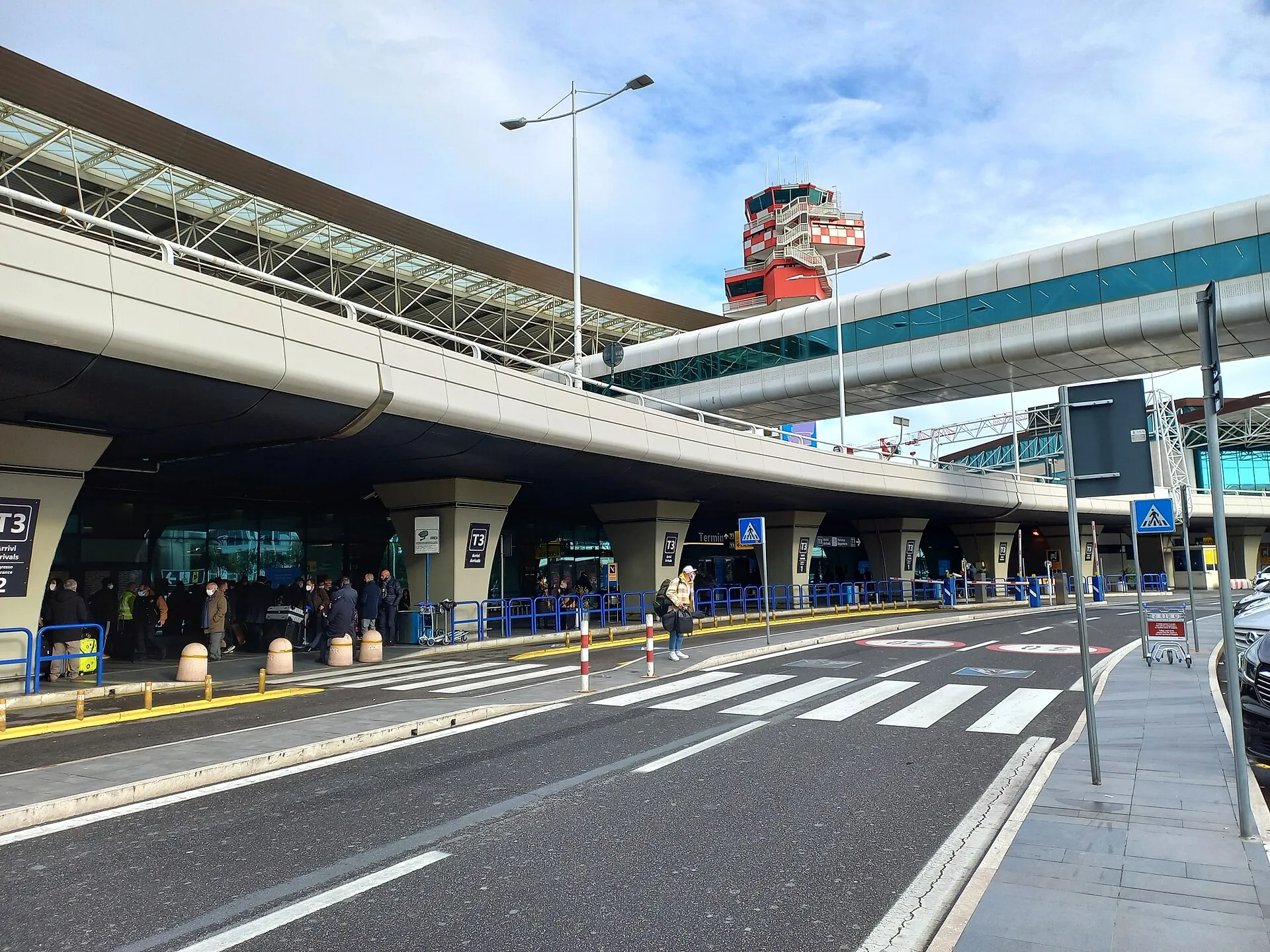
Terminal 3 kerbside with the SkyBridge and control tower above. Photo by CAPTAIN RAJU, CC BY-SA 4.0, via Wikimedia Commons.
Three runways on sixteen square kilometres beside the Tyrrhenian Sea
The airport sits at Fiumicino, where the Tiber meets the sea, 30 kilometres south of central Rome. It opened in 1961 to take pressure off Ciampino during the 1960 Summer Olympics, and it has grown into the busiest airport in Italy and the eighth busiest in Europe.
- Codes
- FCO for IATA and LIRF for ICAO
- Position
- 41°48'01"N 012°14'20"E, elevation 4.6 metres or 15 feet
- Owner and operator
- Owned by the Ministry of Infrastructure and Transport, operated by Aeroporti di Roma, part of Mundys
- Opened
- 15 January 1961, in use from 20 August 1960 for the Rome Olympics
- Site
- 16 square kilometres between the Tiber delta and the coast
- Low visibility
- Category III B instrument landing since 2005, and 30 movements an hour in thick fog
- Traffic in 2024
- 49,203,734 passengers, up 38.1 percent, across 315,597 movements
- Air cargo in 2024
- 271,580 tonnes, up 43 percent on the year before
- To central Rome
- About 30 kilometres south, and 35 kilometres by car to the historic centre
- To Manila
- 10,424 kilometres great circle, or 6,479 miles
Why the airport is already building its way out of a squeeze
Fiumicino has passed 50 million passengers in 2025 and its two passenger buildings carry the whole load. Terminal 2 closed permanently on 15 December 2017, and Terminal 5 was folded into Terminal 3 after a renovation, so there is no spare terminal to switch on. A new Terminal 4 is planned, along with runway and apron work and new car parks.
What this means for a traveller: Terminal 3 absorbs most international traffic, including every long haul departure to Asia. Security queues there are the ones that matter, and the walk to the E gates can take fifteen minutes before the SkyBridge ride even starts. Arrive three hours before a long haul departure rather than the two hours you might allow at a smaller European field.
Two terminals, one SkyBridge, and a train every fifteen minutes
Terminal 1 carries most of the Schengen and domestic schedule and Terminal 3 carries the non Schengen and long haul traffic, including the satellite where the Asian and American flights leave. The two buildings sit on the same campus, joined airside by an automated people mover and landside by a covered walkway.
Terminal 1
Schengen and domestic
The smaller and older of the two, reopened in August 2021 after a pandemic closure that was used to redesign the main hall. ITA Airways uses it as its home base, alongside the low cost and Schengen carriers.
If your ticket shows a short hop to a European city, this is the building you want. The walk from the train station is about five minutes.
Terminal 3
Non Schengen, long haul and some Schengen
The largest building on the field, and the one that carries every flight to Asia. It incorporates the former Terminal 5 and the satellite concourse for non Schengen departures, with a new central airside hall built into the middle section.
The E31 to E44 gates sit across the apron and are reached by the SkyBridge only. Allow extra time, because the train is the single route between the two halves of the building.
The SkyBridge opened in 1999 alongside the satellite concourse. It is an Innovia APM 100 people mover with two stations, one on the third floor of Terminal 3 and one on the second floor at gates E31 to E44. Departing passengers ride westbound only and arriving passengers ride eastbound only, and anyone who returns to the main building has to clear security again.
ITA Airways at the centre, the Gulf and Asia on the long haul
Fiumicino is a hub first. ITA Airways, the Italian flag carrier, works its European and intercontinental network out of Terminal 1 and Terminal 3, and Poste Air Cargo runs the mail and express freight hub. The carriers that matter for a Philippine trip are the Gulf three and the Asian flag carriers, not the European short haul operators.
The home carriersHub and operating base
Gulf and West AsiaThe practical connection to Manila
Asia and the PacificEvery one of these is a possible first leg
EuropeShort haul feeding the long haul banks
Americas and AfricaLong haul beyond the Philippine market
Carrier lists reflect the published schedule for late 2026. Airlines move between terminals and change frequencies without much notice, so confirm the operating carrier and terminal on your own booking.
10,424 kilometres, and not one nonstop
No airline flies from Rome to Manila without a stop. The distance is about 10,424 kilometres in a straight line, which is within the range of a widebody, but the traffic is not there yet. Every itinerary therefore runs through a hub, and the hub you pick decides both the total time and how the connection behaves if the first leg slips.
Philippine Airlines does not serve Rome at present, and no European carrier flies the route nonstop either. The realistic routings use a Gulf hub, Singapore, Seoul, Taipei or Delhi. The table below is a planning estimate for total journey time, door to door at the airport, including the connection. It is not a timetable: schedules change seasonally, so price the itinerary on the day you book.
Three rules that save this journey
Buy the whole trip on one ticket. A self transfer through a Gulf hub puts the risk on you when the Rome departure runs late, and a missed long haul is an expensive problem to solve at the counter. One ticket means the airline owns the connection.
Allow three hours at Ninoy Aquino. International arrivals and domestic departures are in different terminals at Manila, and the move between them takes longer than the map suggests. If the trip continues to Davao, Cebu or Iloilo, a three hour buffer is the minimum that works.
Watch the arrival time, not only the total. A 16 hour itinerary that lands at midnight is worse than an 18 hour one that lands at breakfast, because hotel check in and the first internal flight both depend on it.
Fifty nine days without a visa, and three archipelagos to spend them in
An Italian passport is one of the easiest to travel on in Southeast Asia. The Philippines admits Italian nationals visa free for up to 30 days, which is enough for a first trip, and the main paperwork left is the free electronic arrival form. The constraint is not permission. It is how much of the archipelago you can reach in the time.
When to go
The Philippine dry season runs from December to May and lines up neatly with the Italian winter. The wet months from June to November are warm and humid, with typhoon risk peaking from August to October. The chart shows relative travel comfort by month, not rainfall totals, because heat and humidity matter as much as rain to a visitor from a Mediterranean climate.
Luzon
Arrival islandManila is where the long haul lands. Intramuros holds the Spanish walled city, and the rice terraces at Banaue and Batad sit a night bus north.
- Anilao and Batangas, the closest serious diving to Manila
- Taal, a volcano inside a lake inside an island
- Bataan and the Zambales coast for a quiet first week
Visayas
Islands at the centreCebu is the second gateway, with Bohol's chocolate hills a fast ferry away. Siargao and Boracay are the two beach names that carry the archipelago internationally.
- Negros for the food cities and the diving at Apo Island
- Iloilo and Bacolod for a slower, less crowded week
- Cebu as the base for an island hopping loop
Mindanao
South and the factory floorDavao is the third gateway and the nearest international airport to the apparel manufacturing in the Davao Region and Northern Mindanao, where this company produces.
- Samal and Camiguin for water and volcanic scenery
- The Bukidnon highlands, cool and outside the usual circuit
- Davao as the base for a factory visit plus a coast week
Philippine Airlines and Cebu Pacific connect Manila onward to Cebu, Davao, Iloilo and Bacolod, so a 30 day trip can carry all three regions without repeating a flight. Two regions in two weeks is comfortable. Three regions in two weeks is mostly airports.
A twenty percent corporate rate and full foreign ownership in export manufacturing
The Philippines is not the cheapest place in Southeast Asia to build, but it is one of the few where an Italian manufacturer can own the whole export operation outright, in a priority sector, with a tax rate below the Italian headline. The two countries have been in treaty relations since 1947, and around 108,000 Filipinos live in Italy, one of the largest Filipino communities in Europe, with the biggest concentration in Rome.
The realistic entry sequence
Take a serviced office or a PEZA locator unit before committing to land, run the first production order through a local contract manufacturer to test labour and logistics, and only then apply for registration. Registration carries reporting duties and an investment commitment, and it is far easier to enter once you know your actual volumes.
What Rome buys, and what Philippine factories make
Italy has a deep textile and apparel base of its own, so no Italian buyer comes to the Philippines for basic cotton shirting. They come for specific things: small runs with heavy decoration, technical and performance fabrics, fast sampling, and a factory that will take 50 pieces when an Italian supplier wants 5,000.
Corporate uniforms and office wear
Steady demandBanks, hotel groups, retail chains and airline ground staff order by the thousand and rebrand on a cycle. Pique polos, woven shirts and office trousers with embroidered crests.
Performance and athletic kit
Where the edge isRunning, football, cycling and gym apparel in four way stretch, with sublimation that carries full colour across seams. This is the category where Philippine factories compete on decoration rather than on price.
Workwear and bags
Industrial buyersHi vis jackets, canvas work trousers, and printed bags for events and retail. Useful for construction, logistics and manufacturing clients buying alongside equipment.
Contract apparel, priced for an Italian buyer
Indicative ex works prices for the order bands below, in the four currencies this site runs on. Embroidery, printing, labels and freight are quoted separately, and the euro figure moves with the exchange rate on the day of quotation.
Zero duty with one certificate, then twenty two percent VAT
The European Union Generalized Scheme of Preferences Plus is the reason a Philippine garment can land in Italy cheaper than the headline tariff suggests. Knitwear and woven apparel in Chapters 61 and 62 carry a standard third country duty of 12 percent. Under GSP+, a shipment supported by a valid statement on origin enters at zero. The value added tax is a separate question, and it is recoverable.
Read it as two numbers, not one. The 22 percent IVA is a credit for an Italian business registered for VAT, so it is cash flow rather than cost, and the plafond IVA mechanism lets habitual exporters import without paying it up front. The part that does not come back is the duty, which is zero when the origin statement is valid and 12 percent when it is not. That single document is the most valuable piece of paper in the shipment.
The origin test a buyer should ask about first
GSP+ is not automatic. The exporter must be registered in the European Union REX system and issue a statement on origin with the REX number on the invoice, and the product must satisfy the product specific rules for its tariff line. A factory cutting and sewing fabric woven outside the Philippines may not meet the rule of origin for that garment.
The question to ask before the first order: can the factory show a costed origin calculation for this style, not just an assumption? A zero duty rate that collapses at the Italian border costs more than a slightly higher unit price.
Duty and tax lines change with the tariff schedule and the origin rules. Confirm the exact line with a licensed Italian customs broker before you build a landed cost model on it.
What travellers and buyers ask about Rome
What is the airport code and where is the airport?
The IATA code is FCO and the ICAO code is LIRF. The airport sits at Fiumicino in the Lazio region, 30 kilometres south of central Rome and 35 kilometres by car to the historic centre, at an elevation of 4.6 metres. It covers 16 square kilometres and has three runways.
Which terminal do I use?
Terminal 1 handles Schengen and domestic flights and Terminal 3 handles non Schengen, long haul and part of the Schengen schedule. The Asian carriers leave from Terminal 3, usually through the E gates. Check the terminal on your boarding pass, because airlines move between the two buildings.
Is there a nonstop flight from Rome to Manila?
No. No airline flies the route nonstop today, and Philippine Airlines does not serve Rome. The great circle distance is 10,424 kilometres. Practical connections run through Doha, Dubai, Istanbul, Abu Dhabi, Singapore, Seoul, Taipei or Delhi, with total journey times of about 16 to 22 hours depending on the hub and the layover.
Do Italian passport holders need a visa for the Philippines?
No, for a visit of up to 30 days. Italian nationals enter visa free for tourism or business under the Philippine visa exemption list, with a passport valid six months beyond arrival, confirmed accommodation, proof of funds, and a return or onward ticket. Longer stays need a waiver or extension from the Bureau of Immigration, applied for before the initial stay expires. Every traveller also completes the free eTravel form within 72 hours before arrival.
How long does air cargo take from Manila to Rome?
One to three days airport to airport on the belly network through a Gulf or Asian hub, plus Italian clearance. Sea freight runs 22 to 32 days port to port through the Suez Canal into Genoa, La Spezia or Trieste, then rail or road to Lazio. Production takes three to six weeks after sample approval, on top of either freight time.
What duty applies to Philippine garments entering Italy?
Knitwear and woven apparel in Chapters 61 and 62 normally carry a 12 percent third country duty. Under the EU GSP+ scheme, a shipment with a valid statement on origin from a REX registered exporter enters at zero. Import VAT is 22 percent of the customs value plus duty and related charges, and it is recoverable for a VAT registered Italian importer. Confirm the tariff line with a licensed broker.
How do I get from Fiumicino to Rome?
The Leonardo Express runs nonstop to Roma Termini in about 30 minutes, every 15 minutes. The FL1 regional line runs every 15 minutes and stops at Trastevere, Ostiense, Tuscolana and Tiburtina, with metro and tram connections. Taxis and the A91 motorway take about 35 kilometres to the historic centre, and Frecciarossa trains connect the airport station to Florence, Bologna, Venice and Naples.
Can an Italian company own a factory in the Philippines?
Yes, in export manufacturing. Under the CREATE MORE Act, Republic Act 12066, a registered export enterprise may be 100 percent foreign owned with no Filipino partner. Minimum paid in capital is 200,000 US dollars, or 100,000 US dollars for advanced technology projects or projects creating at least 50 direct jobs. Registration runs through the Board of Investments, PEZA, the Subic Bay Metropolitan Authority or the Clark Development Corporation.
Planning a trip or a production run from Rome?
Send your travel dates, flight routing or apparel specification and our team in Tagum City will reply. Business hours: Mon to Sat, 8:30 AM to 5:00 PM (PHT).
Airport facts, runway dimensions, terminal gate groups, the SkyBridge arrangement, ground transport and the 2024 traffic figures come from Aeroporti di Roma, the Italian Ministry of Infrastructure and Transport and the airport record maintained on Wikipedia, which cites the operator and the national statistics. The 2025 passenger figure of more than 50 million and the ranking as the busiest airport in Italy, eighth in Europe and fortieth in the world come from the operator and the European airport traffic tables. The absence of a Rome to Manila nonstop and the connecting hub list come from the published airline schedules for late 2026, including ITA Airways, Qatar Airways, Emirates, Etihad Airways, Turkish Airlines, Singapore Airlines, Korean Air, Asiana Airlines, China Airlines, Air India and Philippine Airlines. The 10,424 kilometre great circle distance is calculated from the airport coordinates. Philippine visa rules, the 30 day visa free stay for Italian passports and the extension options come from the Philippine Bureau of Immigration and the visa policy published by the Department of Foreign Affairs; confirm the current rule before travel. The EU GSP+ tariff treatment, the REX statement on origin and the 12 percent standard duty band for Chapters 61 and 62 come from the European Commission trade directorate and the Union Customs Code. Italian import VAT at 22 percent, the recoverable treatment and the plafond IVA mechanism come from the Italian revenue agency. CREATE MORE incentives, Republic Act 12066, and the minimum capital thresholds come from the Board of Investments and the Philippine Economic Zone Authority. The 1947 treaty date and the 2015 bilateral air services agreement come from the Philippine Embassy in Rome and the two governments, and the Filipino population figure of about 108,000 from Italian statistics as reported in the bilateral record. Prices are indicative ex works figures from this company and are not a quotation.