
MXP / LIMC Ferno, Varese, Lombardy
Milano Malpensa Airport and the Philippines: Travel, Investment and Manufacturing
Malpensa is Italy's second passenger airport and its first for air cargo, 49 kilometres northwest of Milan inside the Ticino park. This page covers the field and its two long runways, the terminals and the rail link, the one stop route to Manila, the 30 days an Italian passport gets visa free, and the production case that connects Lombardy to Philippine factories.
- Great circle
- 10,503 km
- Nonstop
- None
- Fastest one stop
- about 17 h 20 m
- Clock change
- Manila +7 h in winter
- Entry
- 30 days visa free
Milan sits on Central European Time, Manila on Philippine Standard Time. The gap narrows to six hours when Italy moves to summer time.
A two runway field in the Ticino park, 49 kilometres from the Duomo
Malpensa is the largest airport in northern Italy and the gateway for Lombardy, Piedmont, Liguria and the Swiss canton of Ticino. It opened to civil traffic in 1948 on an airfield that had been building aircraft since 1910, and it has been the country's cargo airport for more than two decades.
- Codes
- MXP / LIMC
- Operator
- SEA Aeroporti di Milano
- Location
- Ferno, province of Varese, Lombardy
- Distance
- 49 km northwest of central Milan
- Elevation
- 234 m above sea level
- Civil opening
- 21 November 1948
- Runways
- 17L/35R and 17R/35L, both 3,920 m
- Passenger terminals
- Terminal 1 and Terminal 2
- Traffic, 2025
- 31,234,229 passengers and 226,304 movements
- Cargo, 2025
- 764,171 tonnes flown
- Official name
- Aeroporto internazionale Milano Malpensa Silvio Berlusconi, since July 2024
The two runways are parallel and equal in length, which lets the field run independent departures and arrivals. Terminal 1 and Terminal 2 sit east of the strips, and Cargo City sits south of the passenger buildings.
Two terminals, three concourses, and a shuttle that runs all night
Terminal 1 carries almost every scheduled and charter flight, including the long haul departures to Asia. Terminal 2 belongs to easyJet alone. The two buildings are about five kilometres apart by road, so a traveller who books the wrong one loses more than a walk.
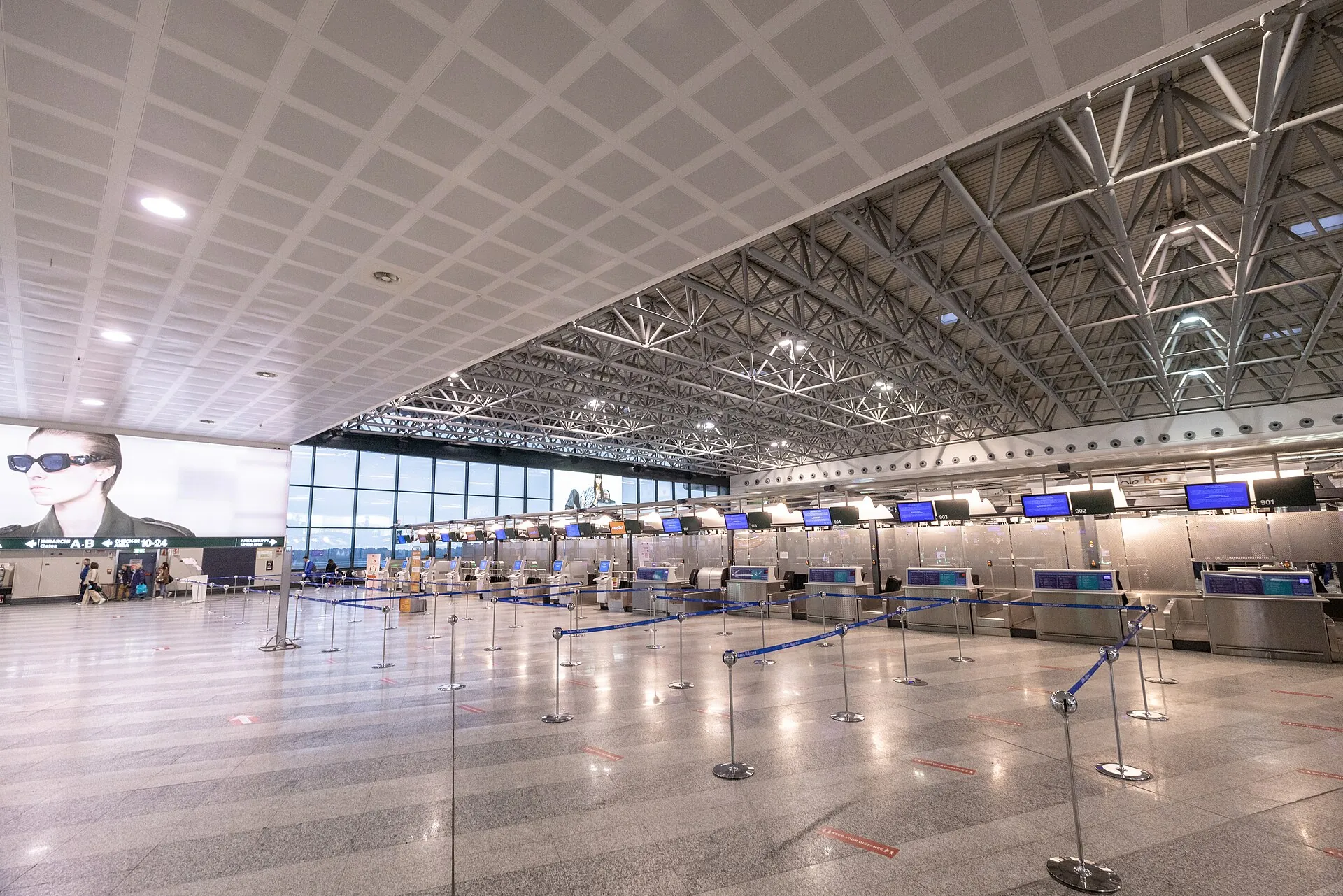
The main building, divided into three concourses by destination. Most airlines check in here, and every intercontinental departure leaves from the B and C piers.
- Concourse ADomestic and Schengen flights, including the Italian and European short haul network.
- Concourse BNon Schengen and intercontinental departures, with passport control at the pier entrance.
- Concourse COpened in January 2012 as B2. Handles intercontinental traffic and the security sensitive departures to the United States and Israel.
- TrainMalpensa Aeroporto Terminal 1 station sits under the terminal, linked by lifts and escalators.
The older terminal, closed during the pandemic and reopened on 31 May 2023 after renovation. easyJet is the sole tenant, with 21 gates and its own bag drop area.
- Who uses iteasyJet short haul flights only. No intercontinental carrier operates from Terminal 2.
- ShuttleA free bus links Terminal 1 and Terminal 2 around the clock, every seven minutes by day and every 30 minutes overnight, with a journey of 10 to 15 minutes.
- TrainMalpensa Aeroporto Terminal 2 station is about 200 m north of arrivals, reached by a covered walkway.
- Allow timeIf a connection switches terminals, treat the transfer as a 40 minute job with bags, not a five minute walk.
A 37 minute train to Cadorna, two motorways, and coaches that cost less
The airport is far enough from Milan that the train is not a convenience, it is the default. The Malpensa Express runs on a half hourly clock face from both terminals, and the buses compete on price rather than speed.
- Malpensa Express to Milano Cadorna About 37 minutes, every 30 minutes, first departure at 4:57 AM and last at 11:27 PM. Stops include Busto Arsizio Nord, Saronno and Milano Bovisa, which is the interchange for the Milan suburban lines. Best for the city centre
- Malpensa Express to Milano Centrale About 51 minutes on the same clock face, calling at Bovisa and Porta Garibaldi before Centrale. Use it for national rail connections and the airport buses that feed the station. Best for onward rail
- Free shuttle between the terminals Runs 24 hours, every seven minutes by day and every 30 minutes overnight, with a 10 to 15 minute journey. Both terminals also have their own railway station, and the train links the two stations in a few minutes, so a train passenger can usually avoid the bus entirely. Terminal 1 to Terminal 2
- Coach to Milano Centrale Flibco, Malpensa Shuttle and other operators run 60 to 70 minute services from both terminals. They stop at Busto Arsizio and the Milan fairgrounds on request, and they are the cheapest option after the train. 60 to 70 minutes
- Car, taxi and rideshare The A8 connects the airport to Milan and Switzerland, the A4 runs from Turin to Venice and Trieste, and the SS336 links Busto Arsizio and the local road network. A taxi to central Milan takes 45 to 60 minutes outside peak traffic. A8 and A4
The Malpensa Express fare is the same to Cadorna and to Centrale, so choose the station that suits your hotel rather than the one that sounds faster. Validate the ticket before boarding and keep it until the exit gates.
A 90 minute connection between a flight and a train is comfortable. A 45 minute connection is not, because passport control and baggage reclaim sit between the aircraft door and the station.
No nonstop to Manila, but the Gulf and Asia do the work in one stop
Milan and Manila are 10,503 kilometres apart and no airline flies the pair nonstop. Every itinerary connects once, usually through the Gulf or through a Southeast or East Asian hub, and the fastest runs about 17 hours 20 minutes gate to gate.
Manila arrivals are split across the four terminals of Ninoy Aquino International Airport, so confirm the arrival terminal before you book a domestic connection. Philippine Airlines, Cebu Pacific and AirAsia Philippines fly onward to Cebu, Davao, Iloilo, Bacolod and Puerto Princesa, and the domestic terminals are a short shuttle or taxi ride apart. For a first visit, build the domestic leg on a separate ticket and leave at least three hours between the international arrival and the domestic departure.
Thirty days visa free, three island groups, and a dry season that starts in December
An Italian passport is one of the easiest to travel on in Southeast Asia. The Philippines admits Italian nationals for 30 days without a visa, and the only form left is the free electronic arrival registration. The hard part is distance and geography, not permission.
Entry is granted under Executive Order 408 for tourism or business. Carry a passport valid for at least six months beyond arrival, a return or onward ticket, proof of accommodation and proof of funds.
Complete eTravel inside 72 hours before arrival. A first extension of 29 days is filed at a Bureau of Immigration office, and further monthly extensions run to 36 months.
Longer stays, work and study need the appropriate visa before departure. The visa free entry cannot be converted after arrival.
A first trip usually picks one island group and stays there. The country has 7,641 islands, and the domestic network is good but not seamless: a two hour flight can still eat half a day once you add the transfer to the airport and the transfer from the arrival airport to the coast.
Three weeks is enough for two groups. Two weeks is better spent in one group with two or three bases. The itineraries below assume a Manila arrival, a domestic flight on the same trip, and a return leg to Manila the day before the international departure.
December to May is the dry season. December to February is cooler and busier, March to May is hot and dry and the best beach window, and June to November brings the southwest monsoon and the typhoon season, with the highest risk from late August to October.
Rice terraces, colonial towns and volcanoes
Manila for the walled city and the museums, then Banaue and Batad for the terraces, Vigan for the Spanish colonial street, and Bicol for Mayon and the whale sharks of Donsol in season.
Road heavy. The terraces are an eight to ten hour drive or a short flight plus a mountain road, so give the north three nights.
7 to 10 daysReefs, chocolate hills and long white beaches
Cebu for the city and the sardine run, Bohol for the chocolate hills and the tarsier sanctuary, Dumaguete for Apo Island, and Boracay or Iloilo for the beach finish. Ferries and short flights link the group.
The most compact first trip for a beach focused visitor, with direct flights from Manila into Cebu, Bohol and Iloilo.
10 to 14 daysSurf, volcanoes and the highest peak
Davao for Samal Island and Mount Apo, Bukidnon for the pineapple plateau and the Kitanglad range, Camiguin for the volcanic springs, and Siargao for the surf and the lagoon.
Our own team is based in Tagum City, an hour north of Davao, so this is the region we know best. Check current travel advisories before booking remote areas.
10 to 14 daysCREATE MORE, a market the size of Lombardy, and the agencies that register the deal
Lombardy has about 10 million people and produces around a fifth of Italian output. It is also the country's textile and design belt, with the mills of Varese and Como and the fashion houses of Milan within an hour of the airport. The Philippine side of the case is cost, English speaking labour and preferred access to the European market.
- Corporate income tax
- 20 percent for a registered enterprise under CREATE MORE
- Income tax holiday
- Four to seven years, depending on the project tier
- Export rate
- 5 percent special corporate income tax on gross income in place of national taxes
- Foreign equity
- 100 percent in export manufacturing outside the Foreign Investment Negative List
- Minimum capital
- USD 200,000 paid in for a domestic market enterprise, or USD 100,000 with advanced technology or 50 or more employees
- Registration
- Board of Investments, PEZA, Subic Bay Metropolitan Authority or Clark Development Corporation
- Resident visas
- SIRV and SVEG for foreign investors and their families
- Repatriation
- Register the investment with the Bangko Sentral ng Pilipinas to preserve the right to repatriate capital and profits
- Philippine goods sold to Italy
- about USD 458 m
- Italian goods sold to the Philippines
- about USD 954 m
- Coconut oil, the single largest line
- about USD 117 m
- Philippine workers in Italy
- about 108,000
Italy is not one of the five largest Philippine investors, and this page does not pretend otherwise. The opening is sector specific: apparel and textiles, electronics assembly, food processing and design led manufacturing for a buyer base that already sources across Asia. Trade figures are UN Comtrade data compiled by OEC, and the diaspora figure comes from Italian statistics as reported in the bilateral record.
What a Philippine factory can make for an Italian label
Italian buyers do not need another low cost cut and sew line. They need a factory that can hold a fit, match a fabric hand, label in Italian and ship a replenishment in three weeks. That is the part of the market a Philippine supplier can serve.
The strongest categories are cotton jersey and interlock, fleece, technical knit tops, performance activewear, school and corporate uniforms, and bags. A factory can work from your fabric or source it, handle cut and sew, embroidery, screen print, sublimation and heat transfer, and pack to a retail or ecommerce standard.
Sampling comes first. A paid sample confirms the fit, the fabric, the stitch density and the label placement before bulk. Production then runs three to six weeks after approval, with a pre shipment inspection and a photo report before the cartons leave.
The commercial minimum is 50 pieces per design for custom work. Blank stock is more flexible. Buyers who need small runs across several colourways can combine them into one production block, which is how a Milan boutique competes with a chain on unit cost.
Italian sizing runs smaller than United States sizing and the shoulder and sleeve pitch differ. Send a graded spec sheet or a physical fit sample rather than a size label, and ask for a size set before bulk.
| Specification | What the factory can hold |
|---|---|
| Fabric | Cotton jersey, interlock, pique, fleece, polyester and recycled blends, with buyer supplied fabric accepted. |
| Weight | About 140 to 320 gsm, depending on the garment and the hand feel. |
| Labels | Italian language care and composition labels under EU Regulation 1007/2011, plus brand neck labels and hangtags. |
| Origin marking | Fabbricato nelle Filippine, permanently marked as required for the European market. |
| Packaging | Individual polybags with the CONAI material code, retail cartons and barcode labels. |
| Minimum | 50 pieces per design for custom production. Blank stock depends on colour and size mix. |
| Timing | Three to six weeks of production after sample approval, then one to three days by air or 22 to 32 days by sea. |
| Compliance | Ask for fibre composition records, restricted substance test reports and the social compliance audit that covers the line. |
Specifications are typical rather than universal. Confirm the exact construction, test standard and packaging code with the factory before the order is placed.
Zero duty under GSP+, 22 percent IVA, and a cargo city that handles 60 percent of Italy's air freight
The duty question has a good answer and a trap inside it. Qualifying apparel made in the Philippines enters the European Union at zero under GSP+, but the origin rule is strict and the duty is the part that sticks. Italian IVA is recovered through the VAT return by a registered importer.
The most favoured nation rate on most Chapters 61 and 62 apparel lines when no preference is claimed.
Preferential entry for qualifying goods, with a Registered Exporter statement on origin. The scheme runs to 31 December 2027 while the EU and the Philippines negotiate a free trade agreement.
Charged on the customs value plus freight and duty. Italian companies with regular exports can use the plafond IVA mechanism to postpone or recover it.
Cargo City covers about 500,000 square metres with seven warehouses that open directly onto the apron, 100,000 square metres of covered handling space and 4,000 square metres of temperature controlled storage. It handles about 60 percent of Italy's air cargo, ranks in the top ten in Europe for cargo tonnage and all cargo movements, and serves more than 80 destinations with over 20 regular freighter flights and three express couriers. Customs, health, veterinary and phytosanitary authorities sit on site, so a sample box or a rush capsule does not need a second clearance point.
What travellers and buyers ask first
01Is there a nonstop flight from Malpensa to Manila?
No. No airline operates a scheduled nonstop between Milan and any Philippine airport. Every itinerary connects at least once, most often through Doha, Dubai, Abu Dhabi, Istanbul, Singapore, Hong Kong, Bangkok, Seoul or Taipei. The fastest published total is about 17 hours 20 minutes, and a realistic planning window is 17 to 22 hours including the connection.
02Do Italian citizens need a visa for the Philippines?
No, for a stay of up to 30 days. Italian passports enter visa free under Executive Order 408, with a passport valid six months beyond the stay, a return or onward ticket, proof of accommodation and proof of funds. Register on eTravel inside 72 hours before arrival. A first extension of 29 days is filed at a Bureau of Immigration office, and further monthly extensions run to 36 months. Do not confuse Italy with Brazil or Israel, which have separate 59 day agreements.
03How do I get from Malpensa to Milan?
The Malpensa Express is the default. Trains run every 30 minutes to Milano Cadorna in about 37 minutes and to Milano Centrale in about 51 minutes, from 4:57 AM to 11:27 PM. Coaches take 60 to 70 minutes and cost less. A taxi is 45 to 60 minutes outside peak traffic. Both terminals have their own station, so a Terminal 2 arrival does not need the shuttle to reach the train.
04Which terminal does easyJet use, and how do I transfer?
easyJet uses Terminal 2 exclusively. A free shuttle links Terminal 1 and Terminal 2 24 hours a day, every seven minutes by day and every 30 minutes overnight, with a 10 to 15 minute journey. Both terminals have a Malpensa Express station. If you are connecting between terminals, allow 40 minutes with baggage and do not book a tight onward train.
05What duty will a Philippine garment shipment pay in Italy?
The standard rate is 12 percent on most apparel lines. With a valid Registered Exporter statement under GSP+, a qualifying Philippine garment enters at zero. Italian IVA is 22 percent on the customs value plus freight and duty, and it is handled separately from the duty. The origin rule is manufacture from yarn, so imported fabric that is only cut and sewn in the Philippines may not qualify. Confirm the line and the origin evidence with a customs broker before the order ships.
06What is the minimum order for custom production?
50 pieces per design for custom OEM and ODM work. Blank stock minimums depend on the brand, colour and size mix. A paid sample comes first, and production runs three to six weeks after approval. Small runs across several colourways can share one production block to keep the unit cost sensible.
07How long does shipping from the Philippines take?
Air freight is one to three days airport to airport from Manila to Malpensa Cargo City. Ocean freight is 22 to 32 days port to port into Genoa, La Spezia or Trieste. Express couriers deliver in three to five business days door to door. Add three to six weeks of production after sample approval, plus customs clearance at Malpensa or the seaport.
08When is the best time to visit the Philippines from Milan?
December to May. December to February is dry and cooler, March to May is hot and dry and the best beach window, and June to November brings the monsoon and the typhoon season, with the highest risk from late August to October. Milan adds a winter risk of its own: fog and snow can delay the first leg, so book a buffer day before the international departure.
Flying in, or sourcing from Manila?
Send your travel dates, your routing question or your apparel specification and our team in Tagum City will reply. Business hours: Mon to Sat, 8:30 AM to 5:00 PM (PHT).
Passenger, movement and cargo figures for 2025 come from Assaeroporti and SEA Aeroporti di Milano. Runway dimensions, terminal opening dates and the site location come from the airport operator and the Italian civil aviation authority. Cargo City area, warehouse and market share figures come from SEA and the Milano Malpensa Cargo service charter. Train times and frequencies come from Trenord and the Malpensa Express timetable; bus times come from the operators. Airline and destination detail comes from the published winter 2026 and summer 2027 schedules. The 10,503 kilometre great circle distance is calculated from the airport coordinates. Philippine visa rules come from Executive Order 408, the Department of Foreign Affairs visa policy page and the Bureau of Immigration. Investment terms come from Republic Act 12066, the CREATE MORE implementing rules and the Board of Investments. Trade values come from UN Comtrade data compiled by OEC, and the coconut oil line comes from World Bank WITS. The diaspora figure comes from Italian statistics as reported in the bilateral record. The EU GSP+ scheme, the REX statement and the 12 percent standard duty band come from the European Commission trade directorate and the Union Customs Code. Italian IVA at 22 percent and the plafond IVA mechanism come from the Italian revenue agency. Lombardy population and output come from the regional statistical record. The photograph is by Arne Müseler, CC BY-SA 3.0 DE, via Wikimedia Commons. Schedules, visa rules, tariff lines and terminal assignments change, so confirm with the airline, the airport operator, the customs broker and the Philippine Embassy before you commit.