
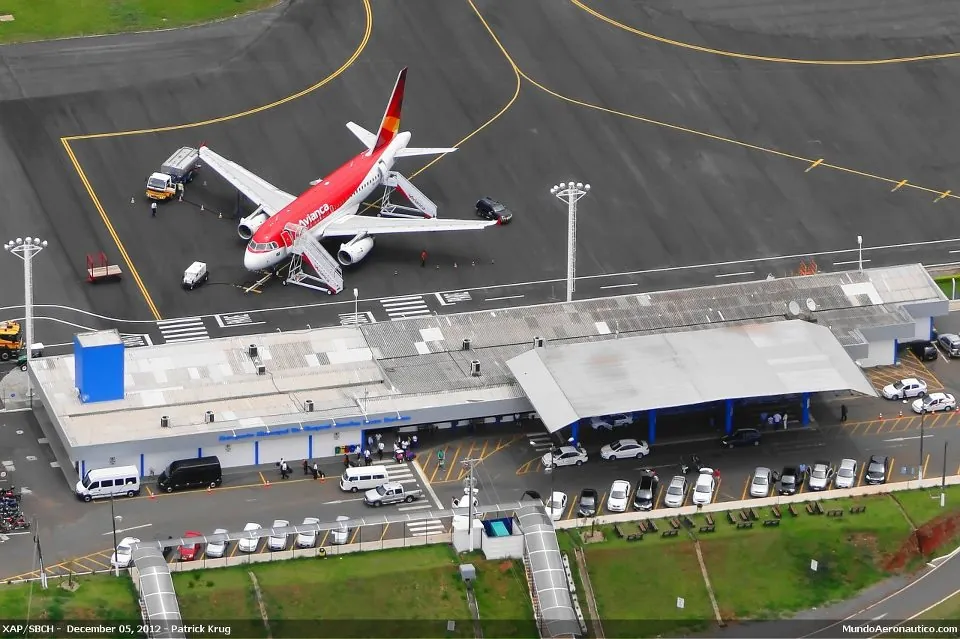
Serafim Enoss Bertaso Airport, Chapeco. Photo by Patrick Krug, CC BY-SA 3.0, via Wikimedia Commons.
Aeroporto de Chapecó: Serafim Enoss Bertaso
The airport for western Santa Catarina and the protein processing belt that supplies a large share of Brazil's pork and poultry exports. This page covers the terminal, the three airlines that fly here, the fastest way from Chapecó to Manila, the 59 days Brazilians can stay visa free, and the trade and manufacturing case that now connects Brazil's agro industry to Philippine production.
One terminal, one runway, and a concession that runs to 2050
The aerodrome opened on 18 March 1978, replacing a dirt strip at São Cristóvão that had served Douglas DC-3 aircraft since 1948. The municipality signed a 30 year concession in December 2020, and the concessionaire Voe XAP, controlled by the terminal operator Socicam, finished an expansion and modernisation programme in 2023. The result is small, calm, and quick to cross, which is what a regional airport in a farming belt should be.
Everything sits in one air conditioned building of about 2,400 square metres, with two baggage belts and four aircraft positions on the apron. You clear security, walk to the gate, and board without a train, a bus, or a second building. The control of the airfield is instrumented for the weather that western Santa Catarina actually gets: VOR/DME and NDB for approach, a PAPI glide slope indicator, night lighting, and an aerodrome beacon.
Traffic reached 647,900 passengers in 2025, up from 454,415 in 2019 and part of a record year for Santa Catarina, which handled 8.5 million passengers across its airports. Almost all of that growth is domestic. XAP has no scheduled international flight, so every trip to Asia begins with a short hop to São Paulo or Campinas.
For a first time visitor, the useful thing to know is that the airport behaves like a bus station with an aviation licence: fast in, fast out, no terminal geography to learn. The constraint is the schedule, not the building.
Weather reality: a 2021 to 2025 study prepared for the expansion project found that May and June carry the most hours with ceiling and visibility restrictions, about 4 percent of the annual total, and most of those hours fall between 5 AM and 11 AM. An early morning departure in late autumn is the one to watch.
XAP at a glance
- IATA and ICAO codeXAP / SBCH
- Runway 11/292,060 m by 45 m
- SurfaceAsphalt
- Terminal floor area2,400 m²
- Aircraft positions4
- Baggage belts2
- Car park150 spaces
- ConcessionVoe XAP to 2050
- Largest aircraft186 seats
Azul, Gol and LATAM, and 25 percent more seats to São Paulo
Three carriers share the apron and they overlap on almost nothing except the São Paulo market, which is the point. São Paulo is where the long haul begins, so the competition on that 90 minute sector decides how quickly a Chapecó traveller can reach Doha, Dubai or Istanbul and then Manila.
Seat capacity rose about 25 percent on the São Paulo corridor in August 2026. Azul added a second daily Viracopos rotation and LATAM added a Guarulhos frequency. For a traveller connecting to a Gulf carrier, that means more same day options and a shorter worst case wait on the ground.
Airline detail: Azul, Gol and LATAM Brasil. Airport concession: Socicam.
Nine kilometres from the centre, and no train
Chapecó is a compact city, and the airport sits on its southern edge rather than in a distant field. That short distance is the whole ground transport story: there is no rail link, no airport bus worth planning around, and no need for either.
Taxi and app rides
15 to 20 minutes to the centre in normal traffic, and the fare is a city fare rather than an airport surcharge. Ride app pick up is at the arrivals curb, and the same 15 minute ride returns you to the terminal.
Parking
About 150 spaces directly outside the terminal, which is the reason a 6 AM departure from Chapecó is less stressful than the same departure from a capital city airport. You park, you walk, you board.
By road
The airport is reached from the city on the southern access road, and the western Santa Catarina towns of Xanxerê, Concórdia, Erechim and São Miguel do Oeste all feed into Chapecó by highway. Regional passengers often drive in and park rather than connect by air.
Allow the right buffer. Domestic check in at XAP is quick, but the 90 minute São Paulo sector is where a tight connection gets expensive. If you are booking a separate long haul ticket, give the Guarulhos connection at least three hours, and four if you are changing terminals or rechecking bags.
Chapecó to Manila: two flights and about 30 hours
There is no nonstop between Brazil and the Philippines, and no carrier flies the route with a single connection that suits a regional Brazilian departure. The practical routing is one domestic hop to São Paulo or Campinas, then a Gulf or Turkish connection, then Manila. Total journey time lands between 30 and 36 hours depending on the wait in Guarulhos.
A typical routing, step by step
- Chapecó to São Paulo Guarulhos LATAM or Gol, about 1 hour 40 minutes 1 h 40
- Guarulhos to Doha Qatar Airways, about 14 hours 30 minutes 14 h 30
- Doha to Manila Qatar Airways, about 9 hours 15 minutes 9 h 15
- Manila to Cebu, Davao or Clark Philippine Airlines or Cebu Pacific, 1 hour 20 minutes to 1 hour 50 minutes 1 h 30
Two alternatives work almost as well. Emirates flies Guarulhos to Dubai in about 14 hours 20 minutes and Dubai to Manila in about 8 hours 50 minutes. Turkish Airlines flies Guarulhos to Istanbul in about 12 hours 55 minutes and Istanbul to Manila in about 11 hours 10 minutes, which is the shortest first sector and the longest second one.
Before you fly
- Fifty nine days visa free. Brazilian passport holders enter the Philippines without a visa for 59 days under a bilateral agreement, nearly double the 30 days given under the general visa free list. The passport must be valid six months beyond the stay and you need an onward or return ticket.
- eTravel within 72 hours. Register free at etravel.gov.ph and keep the QR code offline. Airlines ask for it at the gate, and it replaces the paper arrival card.
- Guarulhos is a terminal change. Domestic flights use Terminals 1 and 2 while the long haul carriers leave from Terminal 3. The airport bus is free and runs continuously, but budget 40 minutes for the transfer and recheck.
- Manila is not one terminal. International arrivals land at Terminal 1 or Terminal 3 depending on the carrier, and domestic departures leave from Terminal 2 or Terminal 4. Allow three hours between an international arrival and a domestic departure.
- The date changes twice. Manila runs 11 hours ahead of Brasília time. A Thursday night departure from Chapecó lands in Manila on Saturday afternoon, so book the first day lightly.
Official references: eTravel registration, Philippine visa policy and Philippine Airlines.
Brazilians get 59 days, and the country is 7,000 islands wide
The Philippines recorded 6.48 million inbound arrivals in 2025, including 543,085 returning overseas Filipinos, and about ₱694 billion in visitor spending. Brazilian arrivals are still a small share of that total, which is exactly why the visa agreement matters: 59 days is long enough to justify the flight and to see more than one island group.
Manila and the Cordilleras
Intramuros, Fort Santiago and San Agustin Church sit inside a walled city built before Brazil's gold boom. North of Manila, the rice terraces at Banaue and the mountain city of Baguio run 8 to 12 degrees cooler than the coast.
Manila is also the hinge for every domestic connection, so a night there at the start or the end is unavoidable and worth planning for.
Cebu, Bohol and Siargao
Cebu has a Spanish colonial core, the Moalboal sardine run and whale sharks at Oslob. Bohol pairs the Chocolate Hills with tarsiers and the Panglao beaches. Siargao, further east, is the surf island, with Cloud 9, Sugba Lagoon and the Magpupungko rock pools.
All three are a short domestic flight from Manila or Cebu and all three are served by more than one carrier.
Davao and the south
Davao is the southern gateway: Samal Island, Mount Apo, and the beaches around Tagum City, where our own workshop sits. The region is also the country's fruit and cacao belt, so the food is a reason to come on its own.
Direct Manila to Davao flights take about 1 hour 50 minutes, and Tagum City is roughly two hours north by road.
When to come: December to May is dry and hot, June to November is wetter, and the surf season on Siargao runs August to November. Typhoon attention matters most from July to October. Domestic airlines cancel early rather than late, so build a buffer day before an international return.
Sourcing and travel context: shipping from the Philippines to Brazil and the Philippine investment case.
Brazil sells US$2.3 billion to the Philippines, and most of it is protein
Merchandise exports from Brazil to the Philippines reached about US$2.34 billion in 2025 on UN Comtrade data, built on poultry, pork, beef, sugar and soy. Philippine exports to Brazil are a fraction of that number. The imbalance is the opportunity: a Brazilian agro industrial buyer already moves goods across the Pacific, and a Philippine supplier that can meet a spec sheet adds a second lane in the other direction.
Brazilian exports to the Philippines, 2025Merchandise only, on UN Comtrade figures. Protein dominates the mix, which means the buyer relationships are already in place on the Brazilian side.
Corporate income taxThe CREATE MORE Act, Republic Act 12066, set the corporate rate at 20 percent for domestic and foreign corporations and added enhanced deductions for power, training and infrastructure.
Foreign equity in most sectorsThe Public Service Act amendments under Republic Act 11659 opened most non utility sectors to full foreign ownership, and the amended Foreign Investments Act lowered barriers for smaller investors.
Units per style, minimumA pilot order does not need a container load. Twenty units per style lets a Brazilian buyer test a Philippine line on its own specification before committing to a season.
Days by air freightManila to São Paulo Guarulhos with one stop. Sensible for samples, a first order, and replenishment that cannot wait for a ship.
Days by sea freightManila or Davao to Santos, then road or rail inland. Sensible for production volume, where the per unit saving pays for the extra month.
Why a Chapecó buyer looks east
Western Santa Catarina runs on food processing. The region around Chapecó hosts slaughterhouses, further processing plants, cold stores and the packaging and logistics companies that serve them, and every one of those operations buys garments on a replacement cycle: white coats, aprons, sleeve covers, snoods, boots and high visibility vests.
Santa Catarina also carries one of Brazil's largest textile and apparel clusters, in Blumenau, Brusque, Joinville and Jaraguá do Sul. A buyer from that state already understands fabric weight, colour fastness and spec sheets, which shortens the conversation with a Philippine workshop considerably.
What the Philippines adds
English is the working language for contracts, quality manuals and audit reports, which removes the translation layer that slows approvals in other sourcing regions. Minimum order quantities start at 20 units per style. And the country sits inside ASEAN, with RCEP access and a trade position that is separate from China and Vietnam.
For a first move, the practical route is a sourcing contract rather than a plant: test a Philippine workshop on your own specification, measure the defect rate, then decide whether a joint venture or an economic zone locator makes sense.
Reference material: the Brazil import page, the Brazilian real against the Philippine peso and investing in the Philippines.
A meat plant buys more workwear than a factory floor
RB Advertising has manufactured technical apparel in the Philippines since the 1990s, with production in Tagum City and Cagayan de Oro and customers across North America, Europe and Australia. A Brazilian food processor usually arrives with one of three needs: garments that survive a hygiene regime, high visibility for yard and forklift crews, or a branded uniform for a retail and service network.
Food safety garments
White coats, aprons, sleeve covers, snoods, beard covers and boots built for industrial laundering and for the colour coding that a hygiene audit expects. Fabric weight, closure type and seam construction are specified per plant.
We quote the laundry cycle with the garment, because a coat that fades after 30 washes is not a saving.
₱320.00 / about $5.10 / €4.45 / £3.85 Entry unit price, volume dependentHigh visibility workwear
Vests, polos, jackets and cargo trousers for yards, cold stores and forklift crews, in the colour blocks and tape placement that a Brazilian safety programme requires. Retroreflective tape grade is quoted separately so the comparison is honest.
The same programme can carry a company mark in embroidery or heat transfer, which is usually what turns a safety garment into a uniform.
₱420.00 / about $6.70 / €5.85 / £5.05 High visibility vest, volume dependentCorporate uniforms and technical apparel
Polos, button downs, aprons and hospitality sets, plus rash guards and compression wear for private label. Programmes start at 20 units per style, which suits a single site rollout or a pilot before a national contract.
Size sets, colour matching and carton labelling are quoted as part of the programme rather than as extras.
₱480.00 / about $7.65 / €6.65 / £5.75 Typical branded polo, volume dependentAir or sea into Brazil
- Air freight, 6 to 9 days. Manila to São Paulo Guarulhos with one stop, then road to Santa Catarina. Best for samples, a first order and anything with a launch date attached.
- Sea freight, 30 to 45 days. Manila or Davao to Santos, then road or rail inland. Best for production volume, and the route is already busy in the other direction with Brazilian protein.
- Duty and classification. Most apparel lands under Chapter 61 or 62 of the tariff schedule, and the final line depends on fibre, knit or woven construction, gender and garment type. Ask a Brazilian customs broker to model the landed cost before the order is placed.
Why XAP matters to a shipper
Chapecó is a production city, not a tourist city, and its airport moves people rather than freight. Air cargo for export leaves through Guarulhos or Viracopos, which is why the domestic sector matters commercially as well as for travel: it is the first leg of every sample that arrives for approval.
The runway extension now under study, from 2,060 to 2,200 metres, would let the airport take the Airbus A321. That does not create a freighter gateway, but it does widen the range of aircraft that can serve the region as the cargo and processing base grows.
Sourcing detail: manufacturing workwear, uniform programmes, sourcing from the Philippines, sea transport services and air transport services.
A longer runway, a new terminal, and a 2045 forecast of 933,000 passengers
The modernisation project, developed by the federal Secretariat of Ports and Airports with LabTrans at the Federal University of Santa Catarina, is designed for demand in 2045 rather than for today's traffic. It is still in the planning stage: the environmental licence, the topographic survey and the geotechnical investigation come before the basic design and the construction calendar.
- 1948: the first field A dirt strip at São Cristóvão, one hangar, and Douglas DC-3 services flown by Varig, Cruzeiro do Sul and Sadia.
- 1978: the current aerodrome Opened on 18 March, south of the city, with a paved runway able to take regular scheduled aircraft.
- 2020: the concession A 30 year contract with the municipality, held by Voe XAP under Socicam, with a commitment to double the terminal.
- 2023: expansion completed Refurbished terminal, apron and access, delivered by the concessionaire.
- September 2026: the project shrinks its footprint A revised layout cut the expropriation area from 775,000 to 505,000 square metres and saved about R$55 million without removing the core works.
- Next: licence, design, construction Runway to 2,200 metres, a new 8,000 square metre terminal, a 754 space garage, a 97 space terminal car park, and an 8,000 square metre hangar condominium with 86 general aviation spaces.
What changes on the ground
A 2,200 metre runway is the difference between a 186 seat narrowbody and a full A321, and that is the whole commercial argument. More seats per rotation on the São Paulo corridor, and a wider choice of aircraft for any carrier that wants to serve the west of the state.
The terrain is the constraint. The airspace authority required the takeoff gradient at runway 12 to rise from 5 percent to 5.5 percent and the approach angle at runway 30 to widen from 3.2 to 4 degrees, because of obstacles and the slope of the ground. Those are engineering facts that shape the design, not marketing points.
The number to watch
647,900 passengers in 2025 against a 2045 forecast of 933,000. That is about 44 percent growth over 20 years, which is a modest projection for a region that already exports protein at scale, and the reason the project is sized around a terminal rather than a second runway.
Project detail: Chapecó city hall on the revised airport project.
Five steps for a calm departure from Chapecó
Pick the São Paulo airport
LATAM and Gol use Guarulhos, Gol also uses Congonhas, and Azul uses Viracopos. Your long haul connection decides which one you need.
Leave three hours at Guarulhos
Domestic flights use Terminals 1 and 2, while long haul departures leave from Terminal 3. The free bus runs continuously but the transfer and recheck take time.
File eTravel first
Register within 72 hours of arrival and keep the QR code offline. The site is free and the airline can refuse boarding without it.
Check the passport clock
Six months validity beyond the stay, an onward or return ticket, and 59 days visa free for Brazilian passport holders under the bilateral agreement.
Buffer the domestic leg
Manila international arrivals and domestic departures sit in different terminals. Three hours is the safe gap, and a later flight is cheaper than a missed one.
What travellers and buyers ask about Chapecó
What is the airport code for Chapecó?
The IATA code is XAP and the ICAO code is SBCH. The airport is named Serafim Enoss Bertaso, opened on 18 March 1978, and sits about 9 kilometres south of the city centre in western Santa Catarina.
How far is the airport from downtown Chapecó?
About 9 kilometres, or 15 to 20 minutes by taxi or ride app in normal traffic. There is no rail link and no airport bus worth planning around, but there are roughly 150 parking spaces directly outside the terminal.
Is there a direct flight from Chapecó to the Philippines?
No. Every routing starts with a 90 minute flight to São Paulo Guarulhos, Congonhas or Viracopos, then a connection through Doha, Dubai or Istanbul, then Manila. Total journey time is about 30 to 36 hours including the wait on the ground.
Do Brazilians need a visa for the Philippines?
No, for stays up to 59 days. Brazilian passport holders enter visa free under a bilateral agreement, with a passport valid six months beyond the stay and an onward or return ticket. That is nearly double the 30 days granted to most visa free nationals.
Which airlines fly to Chapecó?
Azul flies to Viracopos and Florianópolis, Gol flies to São Paulo Congonhas, São Paulo Guarulhos and Florianópolis, and LATAM flies to São Paulo Guarulhos. Seat capacity on the São Paulo corridor rose about 25 percent in August 2026.
Can apparel be shipped from the Philippines to Brazil?
Yes. Air freight from Manila reaches São Paulo Guarulhos in 6 to 9 days with one stop, and sea freight to Santos takes 30 to 45 days. Most apparel is classified in Chapter 61 or 62, so a Brazilian customs broker should model the landed cost before the order is confirmed.
Planning a trip or a production run from Santa Catarina?
Send your travel dates, flight routing or apparel specification and our team in Tagum City will reply. Business hours: Mon to Sat, 8:30 AM to 5:00 PM (PHT).
Airport layout, runway, terminal and traffic figures come from the Brazilian National Civil Aviation Agency, the Department of Airspace Control, the Chapecó city government project update of 23 September 2026 and the concessionaire Voe XAP. Airline destinations and frequencies come from Azul, Gol and LATAM and from Aeroin reporting in August 2026. Trade figures are merchandise exports from UN Comtrade. Philippine tax and investment detail is from the CREATE MORE Act, Republic Act 12066, and the Public Service Act amendments under Republic Act 11659. Tourism figures are from the Philippine Department of Tourism, and the visa position is from the Philippine Department of Foreign Affairs. Schedules, fares, visa rules and project timelines change, so confirm with your airline, the airport authority and the Philippine consulate before you commit.