
BOM / VABB / Mumbai, Maharashtra
Chhatrapati Shivaji Maharaj International Airport and the Philippines
India's second busiest airport, built inside the city that outgrew it, and holder of the record for the world's busiest single runway operation. This page covers the crossing runways, the two terminals, the carriers by region, the first nonstop to Manila, the visa an Indian passport needs, and the trade and manufacturing case that connects Mumbai to Philippine production.
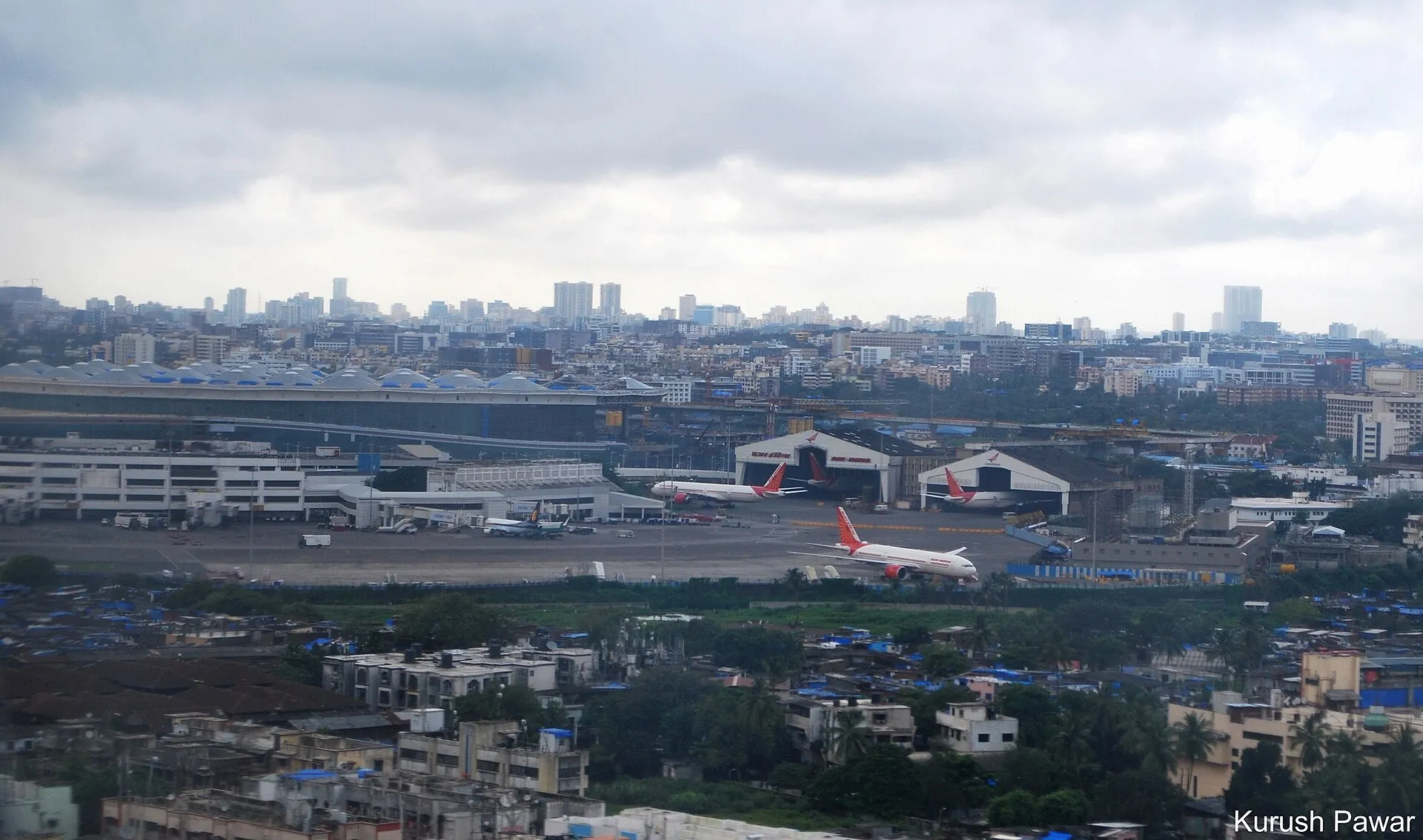
An Air India widebody on the apron, with the Terminal 2 canopy and hangars behind. Photo by Kurush Pawar, CC BY-SA 2.0, via Wikimedia Commons.
Philippine Airlines opens the first Mumbai to Manila nonstop in December 2026, four times a week, subject to final regulatory clearance. Until then every Mumbai departure connects through a hub, and the routing choice changes the trip by several hours. The detail is in the route section below.
Two runways that cross, on a site with no room to grow
The airport occupies about 1,900 acres at Sahar and Santacruz, inside the Mumbai city limits and roughly seven kilometres north of the business district. That footprint, and the way the two runways intersect, decides almost everything about how the airport performs.
- Codes
- BOM for IATA and VABB for ICAO
- Position
- 19°05'N 072°52'E, elevation 12 metres or 39 feet
- Operator
- Mumbai International Airport Limited, held 74 percent by Adani Airport Holdings and 26 percent by the Airports Authority of India
- Runway 09/27
- The primary strip, 3,448 metres by 60 metres, with 3,188 metres declared on account of a displaced threshold. Category II instrument landing on 27 and Category I on 09.
- Runway 14/32
- The crosswind strip, 2,871 metres by 45 metres. Category I on 14 and no instrument landing on 32.
- Declared capacity
- 44 aircraft movements an hour on the runway system, and 55 million passengers a year across both terminals
- Stands
- 131 Code C equivalent aircraft stands, of which 43 are contact gates at Terminal 2 and 8 at Terminal 1
- Traffic in 2025
- 55.5 million passengers, split 39.2 million domestic and 16.3 million international, across 331,011 movements
- Air cargo
- 927,499 tonnes in the financial year to March 2026, up 4.2 percent on the year before
- To South Mumbai
- About 30 kilometres by road, an hour outside peak traffic and considerably longer inside it
- To Manila
- 5,136 kilometres great circle, the shortest air link between India and the Philippines
Why one runway carries the airport
The two strips intersect near the centre of the field, so an aircraft on one has to be clear of the other before the next can move. Simultaneous use of the crossing runways was dropped in the middle of 2013 after the operator found that concentrating movements on the main runway produced more of them per hour. Runway 14/32 now works as a backup, used when 09/27 is closed for maintenance or when monsoon crosswinds make the main runway unusable.
The result is that roughly 90 percent of movements run on a single strip, at intervals that fall to about 65 seconds at peak. In March 2017 the field overtook Gatwick to become the busiest airport in the world operating one runway at a time, and it now clears more than 1,000 movements on its busiest days. Every arrival on 09/27 has to cross the other runway on the way to Terminal 2, which is one reason a slot here is harder to obtain than at almost any airport in Asia.
What this means for a traveller: build slack into a connection made on separate tickets, expect departures to bunch in the evening peak, and expect runway work to move the whole operation onto the shorter strip. Both runways close together for scheduled maintenance, most recently a six hour block in November 2026.
One airport in two halves, about four kilometres apart
Terminal 1 at Santacruz handles domestic traffic and Terminal 2 at Sahar handles international traffic plus part of the domestic schedule. They are separate buildings on opposite sides of the field, connected by road and by a shuttle, so the terminal on your boarding pass is the first thing to check.
Terminal 1, Santacruz
Domestic
The older of the two buildings, in the south of the field, handling the low cost domestic carriers. It runs 8 contact gates and has been under refurbishment as the airport shifts more domestic capacity to Terminal 2.
A single storey kerbside drop, a compact security hall, and short walks to the gates. If a domestic leg is on your ticket, check whether it leaves from here or from Terminal 2 before you book a car.
Terminal 2, Sahar
International and some domestic
Opened on 11 January 2014 on the site of the old international terminal, which was demolished in phases while the airport stayed open. Skidmore, Owings and Merrill drew it as a four level building on an X plan, 450,000 square metres of floor area under a coffered roof carried on 30 columns and coloured like a peacock's tail.
The X shape keeps walking distances short from the central headhouse to four concourses, and the post security areas can swing between domestic and international use as demand shifts. A multi level car park takes about 5,200 cars.
Together the terminals are rated for 55 million passengers a year and the airport carried 55.5 million in calendar 2025, so the design ceiling has already been passed. That gap is precisely the reason for the second airport across the harbour, and it is why the operator keeps squeezing movements out of a single runway rather than waiting for new concrete.
The Gulf carries half the international traffic
Mumbai is a domestic trunk hub first and a long haul gateway second. The international mix is unusually concentrated in the Middle East, which matters when you are shopping for a connection to Southeast Asia: the useful carriers for Manila are the Asia Pacific ones, not the Gulf three.
| Region | Share of international | Carriers and nonstop points |
|---|---|---|
| Middle East | 48.8% | Emirates, Etihad, Qatar Airways, flydubai, Air Arabia, Oman Air, Saudia, Kuwait Airways, Gulf Air and Air India Express. Dubai alone takes 15 percent of all international traffic, with Abu Dhabi at 7.5 percent. |
| Asia Pacific | 28.2% | Singapore Airlines, Scoot, Cathay Pacific, Thai Airways, Malaysia Airlines, Batik Air, VietJet and AirAsia. Denpasar, Krabi, Almaty and Tbilisi were added during 2025. |
| Europe | 14.5% | Air India, British Airways, Virgin Atlantic, Lufthansa, KLM, Air France, SWISS and Turkish Airways. London Heathrow takes 7.5 percent. Copenhagen and Manchester joined the map in 2025. |
| Africa, the Americas and other | Remainder | Kenya Airways, Ethiopian Airlines, RwandAir and Air India on the long haul network, with Amman and Fujairah added during 2025. |
| Domestic | 39.2 million | IndiGo, Air India, Akasa Air and SpiceJet. Delhi takes 17 percent of domestic traffic, Bengaluru 10 percent and Goa 6 percent. |
Carrier and route lists reflect the schedule published in late 2026. Airlines move between terminals and add or drop frequencies without much notice, so confirm the operating carrier and the terminal on your own booking.
5,136 kilometres, and the first nonstop arrives in December 2026
There is no nonstop between Mumbai and Manila today. Delhi is the only Indian city with an active nonstop to the Philippines, so a Mumbai departure either connects through an Asian hub or routes over Delhi on a single ticket. That is about to change.
Philippine Airlines has announced a nonstop Mumbai to Manila service from December 2026, operating four times a week on Tuesday, Thursday, Saturday and Sunday with a 168 seat Airbus A321neo carrying 12 business and 156 economy seats. It would be the airline's return to India after 13 years and the first nonstop between the two cities. Final regulatory clearance is still outstanding, so treat the date as announced rather than confirmed and check the schedule before you book around it.
Two practical rules for this route
Buy the whole journey on one ticket. A self transfer through Bangkok or Kuala Lumpur puts the risk on you if the first leg runs late, and Mumbai's evening peak is not a place to be improvising. One ticket means the airline owns the connection.
Watch the visa clock. The 14 day visa free entry for Indian passports starts on arrival and cannot be extended, so a long layover does not cost you a day of it, but a two week trip leaves no room for a delayed return. If the itinerary needs longer, arrange the visa before you fly rather than at the airport.
Fourteen days without a visa, and three archipelagos to spend them in
The Philippines opened visa free entry to Indian passport holders on 8 June 2025, and Indian arrivals responded faster than any other market. The constraint is no longer paperwork. It is the 14 day ceiling and the fact that internal flights eat into it.
When to go
Indian arrivals grew 17 percent in 2025 even as total Philippine arrivals fell, which tells you the demand is not weather led. But the calendar still matters, and it lines up badly with Mumbai's own seasons: the Philippine wet months are the Indian monsoon months, so the two climates are wet at the same time.
Luzon
NorthManila is the arrival point and the reason most business trips start here. Intramuros holds the Spanish walled city, and the rice terraces at Banaue and Batad sit a night bus north.
South of the capital, Batangas and Anilao are the closest serious diving to the airport, and Taal is a volcano inside a lake inside an island.
Visayas
CentreCebu is the second gateway, with Bohol's chocolate hills a fast ferry away. Siargao and Boracay are the two beach names that carry the archipelago internationally.
Iloilo and Bacolod are the food cities, and Negros has the sugar estates and the diving at Apo Island.
Mindanao
SouthDavao is the third gateway and the nearest international airport to the country's apparel manufacturing in the Davao Region and Northern Mindanao.
Camiguin, Samal and the Bukidnon highlands sit outside the usual tourist circuit, which is exactly the appeal.
Philippine Airlines connects Manila onward to Cebu, Davao, Iloilo and Bacolod, so a 14 day trip can carry two regions without a wasteful backtrack. Three regions in 14 days is possible but it is mostly airports.
A 20 percent corporate rate and full foreign equity in export manufacturing
The Philippines is not the cheapest place in Southeast Asia to build, but it is one of the few where a foreign manufacturer can own the whole operation outright in a priority sector, and it has just made itself a much easier sell to Indian capital.
Under the CREATE MORE Act, Republic Act 12066, a registered export enterprise can claim a 20 percent corporate income tax, an income tax holiday of four to seven years, and then a 5 percent special corporate income tax on gross income in place of all national taxes. Export enterprises also get VAT zero rating on local purchases and duty exemption on imported capital equipment. One hundred percent foreign equity is allowed in export manufacturing, with no Filipino partner required.
The incentive is administered through the Board of Investments, the Philippine Economic Zone Authority, the Subic Bay Metropolitan Authority and the Clark Development Corporation. Minimum paid in capital is 200,000 US dollars, or 100,000 US dollars for advanced technology projects or those creating at least 50 direct jobs.
Why this matters from Mumbai specifically: Indian investment already in the Philippines is estimated at about 5 billion US dollars, concentrated in IT and business process services, pharmaceuticals, textiles, chemicals, automotive parts and fast moving consumer goods. India is the largest supplier of pharmaceuticals to the Philippines, at about 460 million US dollars in the 2024 to 2025 financial year. The two governments declared a strategic partnership in August 2025 with a Plan of Action running to 2029, and both sides are negotiating a bilateral preferential trade agreement alongside the review of the ASEAN India goods agreement.
The realistic entry sequence
Take a serviced office or a PEZA locator unit before committing to land, run the first production order through a local contract manufacturer to test labour and logistics, and only then apply for registration. Registration carries reporting duties and an investment commitment, and it is far easier to enter once you know your actual volumes.
What Mumbai buys, and what Philippine factories can make
India has a deep textile base of its own, so no Indian buyer comes to the Philippines for basic cotton. They come for specific things: small runs with heavy decoration, technical and performance fabrics, fast sampling, and a factory that will take 50 pieces when Tiruppur wants 5,000.
Corporate uniforms and office wear
Steady demandBanks, business process outsourcing floors, hotel groups and retail chains order by the thousand and rebrand on a cycle. Pique polos, woven shirts and office trousers with embroidered crests.
Performance and athletic kit
Where the edge isRunning, cricket, football and gym apparel in four way stretch, with sublimation that carries full colour across seams. This is the category where Philippine factories compete on decoration rather than on price.
Workwear and bags
Industrial buyersHi vis jackets, canvas work trousers, and printed bags for events and retail. Useful for construction, logistics and manufacturing clients buying alongside equipment.
Contract apparel, priced for an Indian buyer
Indicative ex works prices for the order bands below, in the four currencies this site runs on. Embroidery, printing, labels and freight are quoted separately, and the rupee figure moves with the exchange rate on the day of quotation.
Corporate polo shirts and office uniforms
Pique or jersey, embroidery, woven collar
Minimum 20 pieces, 12 to 18 working days after artwork approval.
Rash guards and athletic kit
Four way stretch, sublimation, flatlock seams
Minimum 20 pieces, 15 to 22 working days for a first run.
Heavy duty workwear and jackets
Twill or canvas, reinforced seams, reflective trim
Minimum 50 pieces, 20 to 30 working days depending on fabric.
Corporate jackets and blazers
Structured lining, embroidered crest, tailored fit
Minimum 50 pieces, 25 to 35 working days after fitting.
3.9 billion dollars of trade, a 20 percent duty band, and one certificate that lowers it
Bilateral trade reached 3.9 billion US dollars in the 2025 to 2026 financial year, up from 3.34 billion the year before. India sells engineering goods, pharmaceuticals, vehicles and rice. The Philippines sells semiconductors, electrical machinery, copper, ores and precious stones. Apparel runs the other way, and that is where the arithmetic gets interesting.
The headline number for a garment entering India looks punitive until you separate what is recoverable from what is not. Duty is charged on the assessable value, which is the cost, insurance and freight figure, so freight quality affects the tax base as well as the cost.
Read it as two numbers, not one. The integrated tax is a credit, not a cost, for a buyer registered under goods and services tax. The part that does not come back is the basic duty, the cess and the surcharge, which together are 26.4 percent of the CIF value at the 20 percent band. That is the number to build into a landed cost model, and it is the number a trade agreement can move.
The ASEAN India certificate
The Philippines has been a party to the ASEAN India Trade in Goods Agreement since 17 March 2016, and a shipment backed by a Form AI certificate of origin can claim the preferential basic duty rate instead of the standard band. Indian importers claim it under Customs Notification 46 of 2011, as amended, and must follow the origin rules notified under CAROTAR 2020.
The test that decides it is 35 percent AIFTA content by free on board value, with the final manufacturing process performed inside a party. A Philippine factory cutting and sewing fabric woven outside ASEAN may not reach that threshold, and a certificate cannot fix it. This is the single most useful question an Indian buyer can ask before placing a first order: can the factory show a costed origin calculation, not just an assumption?
One operational warning for 2026 and 2027
The operator has suspended dedicated freighter operations at CSMIA from August 2026 to May 2027 to recarpet the main runway, build a parallel taxiway to remove crossings at runway 14, and rebuild the ageing apron G. Passenger flights and belly cargo continue, but an all cargo routing into Mumbai needs a different plan during that window, usually Delhi, Bengaluru or Chennai with a domestic road leg. Confirm capacity with the forwarder before quoting a delivery date.
Freight times on the lane
- Air: 3 to 5 days airport to airport on the belly network, plus clearance. Samples usually fly so the buyer can inspect the make before committing a container.
- Sea: 7 to 18 days on the planning estimate, into Nhava Sheva or Mundra on the west coast or Chennai on the east, then rail or road on the dedicated freight corridors.
- Production: 3 to 6 weeks after sample, artwork and payment approval, on top of freight.
What travellers and buyers ask about Mumbai
What is the airport code and where is the airport?
The IATA code is BOM and the ICAO code is VABB. The airport sits inside the Mumbai city limits at Sahar and Santacruz in Maharashtra, about 30 kilometres by road from South Mumbai, at an elevation of 12 metres. It covers roughly 1,900 acres and has two intersecting runways.
Which terminal do I use?
Terminal 2 at Sahar handles international flights and part of the domestic schedule. Terminal 1 at Santacruz handles the rest of the domestic traffic, mainly the low cost carriers. The two buildings are about four kilometres apart with a shuttle between them. Check the terminal on your boarding pass, not on your itinerary email, because airlines do move.
Is there a nonstop flight from Mumbai to Manila?
Not yet. Philippine Airlines has announced a nonstop service from December 2026, four times a week on Tuesday, Thursday, Saturday and Sunday, with a 168 seat A321neo, subject to final clearance. Until it starts, the fastest connection is about 9 hours 10 minutes through Bangkok. Singapore, Kuala Lumpur, Hong Kong and a Delhi routing also work. The great circle distance is 5,136 kilometres.
Do Indian passport holders need a visa for the Philippines?
No, for short trips. Since 8 June 2025 Indian nationals may enter without a visa for 14 days for tourism or business, non extendible and non convertible, on a passport valid six months beyond the stay, confirmed accommodation, proof of financial capacity, and a return or onward ticket. A valid US, Japanese, Australian, Canadian, Schengen, Singapore or UK visa or residence permit raises it to 30 days. Anything longer needs a 9(a) visa, applied for at the embassy in New Delhi or through evisa.gov.ph.
How long does air cargo take from Manila to Mumbai?
Three to five days airport to airport on the belly network, plus clearance. Sea freight to Nhava Sheva, Mundra or Chennai runs 7 to 18 days on the planning estimate, then rail or road inland. Note that dedicated freighter operations at Mumbai are suspended from August 2026 to May 2027 for runway and apron work, so an all cargo consignment may need to clear at Delhi, Bengaluru or Chennai and move by road.
What duty applies to Philippine garments entering India?
Knitwear and woven apparel in Chapters 61 and 62 typically carry a 20 percent basic customs duty, plus a 4 percent agriculture cess charged on the duty, plus a social welfare surcharge of 10 percent on duty and cess, plus integrated goods and services tax at 5 or 18 percent depending on the per piece value. At the 18 percent slab the headline figure is about 49.15 percent of the CIF value. The irrecoverable part, once the integrated tax is credited, is about 26.4 percent of CIF. Confirm the exact line with a licensed broker.
Does a trade agreement reduce that duty?
It can. The Philippines has been in the ASEAN India Trade in Goods Agreement since 17 March 2016, and a Form AI certificate of origin claims the preferential rate. The binding test is 35 percent AIFTA content by free on board value with the final process inside a party, which a factory working with imported fabric may fail. A bilateral Philippines India preferential trade agreement is still under negotiation, so it does not apply yet.
Is Mumbai a practical base for a Philippine sourcing office?
Yes, for the commercial side. Mumbai has the capital markets, the trading houses and the family offices, English is the working language, and the time difference gives a Mumbai morning that overlaps a Manila afternoon. The harder parts are the cost of office space, road congestion and the airport's single runway, which makes same day returns to the north of India unreliable. Most buyers keep the commercial team in Mumbai and place quality staff near the factory.
Planning a trip or a production run from Mumbai?
Send your travel dates, flight routing or apparel specification and our team in Tagum City will reply. Business hours: Mon to Sat, 8:30 AM to 5:00 PM (PHT).
Runway dimensions, declared runway capacity, stand counts, terminal capacities and the operating constraints come from the Mumbai International Airport Limited submission to the Airports Economic Regulatory Authority for the fourth control period. Traffic for calendar 2025, the 331,011 movements and the regional traffic shares come from the MIAL release of 8 January 2026, and the financial year figure for 2025 to 2026 from the operator. Terminal 1 and Terminal 2 capacities, the 55 million passenger design figure and the intersection constraint come from the Airports Authority of India concession order for Navi Mumbai, Order 07 of 2026 to 2027. Terminal 2 design facts, the 450,000 square metre area, 30 columns, 29 design gates and the 40 million design capacity come from the Skidmore, Owings and Merrill project record and the terminal opening of 11 January 2014. Navi Mumbai dates, the 20 million passenger first phase and the two 3,700 metre runways come from the Prime Minister's Office and the operator. The announced Mumbai to Manila nonstop, the four weekly frequencies and the 168 seat A321neo come from Philippine Airlines as reported in September 2026; confirm clearance before booking. The freighter suspension from August 2026 to May 2027 comes from the MIAL letter to cargo partners. Indian duty bands come from the Central Board of Indirect Taxes and Customs tariff and the integrated tax treatment from the goods and services tax schedules effective 22 September 2025. Trade agreement detail comes from the ASEAN India Trade in Goods Agreement and Customs Notification 46 of 2011 as amended, read with CAROTAR 2020. Bilateral trade values come from the India Philippines Joint Working Group release of 5 June 2026 and the Ministry of External Affairs brief, with commodity detail from UN Comtrade as reported by Trading Economics. Visa rules come from Foreign Service Circulars 2025-019 and 2025-020 and the policy page at evisa.gov.ph. Indian arrival figures come from the Philippine Department of Tourism. Investment detail comes from the CREATE MORE Act, Republic Act 12066. The hero photograph is by Kurush Pawar, CC BY-SA 2.0, via Wikimedia Commons. Schedules, fares, visa rules, tariff lines and construction dates change, so confirm with the airline, the airport operator, the customs broker and the Philippine Embassy before you commit.