
DEL / VIDP / Palam, New Delhi
Indira Gandhi International Airport and the Philippines
India's busiest airport, built on a wartime airfield at the edge of the capital and now one of the few in the world with four parallel runways. This page covers the runway system, the terminals, the winter fog that decides your schedule, the nonstop to Manila, the visa an Indian passport needs, and the trade and manufacturing case that runs from Delhi to Philippine factories.
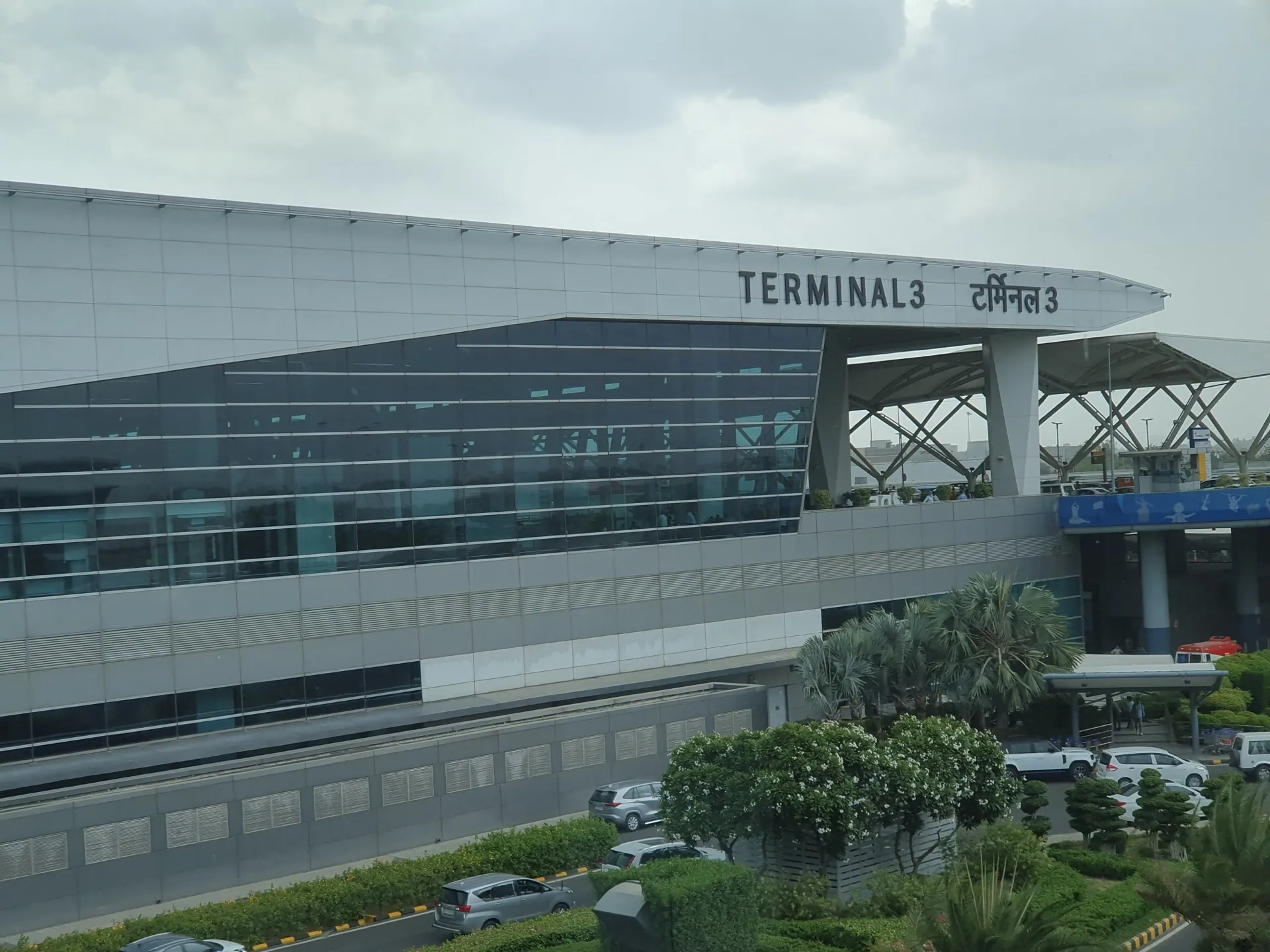
Terminal 3 at Palam. Photo by Ravi Dwivedi, CC BY-SA 4.0, via Wikimedia Commons.
Four parallel runways on 5,106 acres, and a taxiway that flies over the roads
The airport sits at Palam, 16 kilometres southwest of the city centre, on land that began as a Second World War air force station. Its modern shape was set in 2023, when the fourth runway and a pair of elevated cross taxiways opened in the same month.
- Codes
- DEL for IATA and VIDP for ICAO
- Operator
- Delhi International Airport Limited, the GMR led concession with the Airports Authority of India, Fraport and Eraman Malaysia as partners
- Site
- 5,106 acres, or 2,066 hectares, inside the National Capital Region
- Runway 11R/29L
- The longest strip at 4,430 metres by 60 metres, with Category III instrument landing on both ends
- Runway 11L/29R
- The fourth runway, 4,400 metres by 45 metres, opened in July 2023 and Category III on both ends
- Runway 10/28
- 3,813 metres by 45 metres, Category III on 28 and Category I on 10
- Runway 09/27
- The original wartime strip, 2,816 metres by 45 metres, Category I on both ends
- Eastern Cross Taxiway
- 2.1 kilometres of elevated dual taxiway, 202 metres across the full structure, carrying aircraft over the approach roads instead of around them
- Traffic in FY 2024 to 2025
- 79.2 million passengers, the highest in the airport's history
- Air cargo
- About 1.0 million tonnes a year, the largest cargo throughput of any airport in India
- To Manila
- 4,773 kilometres great circle, about 6 hours 35 minutes eastbound
Scroll the chart sideways to read the runway labels on a small screen.
Why four runways changed the arithmetic
Until 2023 the field worked two runways hard and two lightly, because the southern pair sat too close to the northern pair to be used independently. The fourth runway and the elevated taxiways broke that constraint. Aircraft no longer have to vacate a runway and loop around the approach roads to reach the other side of the field, which is what the taxiway is for, and it takes roughly 2,000 vehicle movements and 55,000 tonnes of carbon a year off the airport's road network.
What it means for a traveller: more slots at peak, shorter taxi times after landing, and a field that can keep accepting arrivals when visibility drops. The last point matters more here than at almost any other airport in Asia, and it has a section of its own below.
Three terminals rated at 100 million passengers, and a fourth generation already planned
Terminal 3 carries the international schedule and part of the domestic one. Terminal 1 was rebuilt around a single integrated hall and reopened through 2024 and 2025. Terminal 2 was refurbished and reopened in October 2025. All three now sit inside one combined capacity figure.
| Terminal | Annual capacity | Traffic it handles | What to know |
|---|---|---|---|
| Terminal 1Integrated domestic | 40 million206,950 square metres | IndiGo and SpiceJet domestic departures and arrivals | Rebuilt at roughly three times the floor area of the old building and opened in stages, reaching full operations in April 2025. A separate building from Terminal 3, so check the terminal on your boarding pass. |
| Terminal 2Refurbished domestic | 15 millionReopened October 2025 | Domestic low cost traffic alongside Terminal 1 | The oldest building in service, opened in 1986, closed for modernisation and reopened on 26 October 2025 with self service bag drop and new boarding bridges. Small and quick compared with Terminal 3. |
| Terminal 3International and domestic | 45 million5.8 million square feet | Air India, all international carriers, and a share of domestic flying | Built for the 2010 Commonwealth Games in 37 months. Nine levels, two piers of 1.2 kilometres each, 78 boarding bridges, and a 100 room transit hotel inside the building. |
Together the three buildings are rated at about 100 million passengers a year, which puts Delhi in a group of only a handful of airports worldwide at that scale. The master plan goes further: Terminals 4, 5 and 6 are designed but not yet triggered, and when they arrive the international schedule is expected to move across to them, leaving Terminal 3 as a domestic building.
The practical rule for a Delhi connection: Terminal 1 and Terminal 2 sit on the southern side of the field and Terminal 3 on the northern side, several kilometres apart by road. A self transfer between them needs two hours of slack, not forty minutes.
Fog, not rain, is the thing that moves your flight
Between the middle of December and the end of January, dense radiation fog forms over the northern plains before dawn and can sit on the field until late morning. Delhi is one of the few airports in the region built to keep landing through it, which is exactly why the schedule compresses so hard when it happens.
Three of the four runways carry Category III instrument landing systems, which allow an aircraft to approach with a runway visual range as low as 50 metres. The old 09/27 strip does not, so as visibility falls the field loses the use of one runway and starts sequencing everything onto the other three under low visibility procedures. Arrivals land, but the gaps between them grow, departures queue, and by mid morning the whole day is running late.
Bar length is the minimum visibility each runway needs before it can accept an arrival, so a longer bar means a less capable approach.
Booking around the fog season
Choose an afternoon arrival where you can. Fog usually forms in the small hours and clears by mid morning. A flight landing at 3 AM is the most exposed; one landing at 2 PM is close to certain to get in.
Do not book a tight same day connection through Delhi in December or January. If you are connecting to Manila, allow a full day, or route through Bangkok or Singapore on one ticket so the airline owns the misconnection rather than you.
Watch for diversions. When the field drops below minima, arrivals divert to Jaipur, Lucknow or Ahmedabad and recover by road or on a later slot. It is inconvenient, not unusual, and travel insurance that covers a missed connection is worth reading before you buy it.
4,773 kilometres, and the only nonstop between India and the Philippines
Delhi is the one Indian city with a direct scheduled service to the Philippines. Air India has flown it since 1 October 2025, and Philippine Airlines is due to add a second operator from December 2026. Every other Indian departure connects through a hub.
Air India, Delhi to Manila
Nonstop, five days a week, Airbus A321neo
- Days
- Monday, Wednesday, Thursday, Saturday, Sunday
- Distance
- 4,773 km
- Block time
- About 6 hours 35 minutes eastbound
- Terminal
- Terminal 3 at Delhi
Philippine Airlines, Delhi to Manila
Three days a week, subject to final regulatory clearance
- Manila to Delhi
- PR642, Monday, Wednesday and Friday, 10:40 PM to 3:00 AM
- Delhi to Manila
- PR643, Tuesday, Thursday and Saturday, 8:15 AM to 5:00 PM
- Connections
- Onward through Manila to Cebu, Davao, Iloilo and Bacolod
Treat the December 2026 date as announced rather than confirmed. Philippine Airlines has not yet published fares, and clearance from both sides is still outstanding. The Air India service is operating and bookable today.
If you have to connect, these are the useful hubs
Total journey times are door to door planning figures from Delhi, including the layover. They move with the schedule and the season, so check the day you fly.
| Hub | Carriers on the leg | Typical total | When it makes sense |
|---|---|---|---|
| Bangkok | Thai Airways, IndiGo, Thai VietJet | 10 to 12 hours | Deepest frequency, usually the cheapest fare, and a short second leg |
| Singapore | Singapore Airlines, Scoot | 11 to 13 hours | The best option if the trip may slip by a day, since there are several departures |
| Kuala Lumpur | Malaysia Airlines, Batik Air | 11 to 13 hours | Good value and a straightforward transfer |
| Hong Kong | Cathay Pacific | 11 to 14 hours | Widebody comfort, longer layovers, useful for cargo in the belly |
Two rules that save the trip
Buy the whole journey on one ticket. A self transfer through Bangkok during the December peak puts the risk on you. On one ticket the airline rebooks you, and Delhi's winter delays make that worth a small premium.
Count the visa days from arrival, not from departure. The 14 day visa free entry starts when you land and cannot be extended. A two week itinerary that ends with a delayed return flight has no spare day in it.
Fourteen days without a visa, and an archipelago that fits inside them
The Philippines opened visa free entry to Indian passport holders on 8 June 2025, and the market responded faster than any other. India sent 51,116 visitors between January and July 2025, and it was one of the few source markets to grow while total arrivals softened.
Tourism or business, straight off the plane
Under Foreign Service Circular 2025-019, an Indian passport holder may enter for 14 days without a visa. The stay cannot be extended or converted. Carry a passport valid six months beyond your stay, confirmed accommodation, proof of funds, and a return or onward ticket.
Add a valid visa from a partner country
Under Circular 2025-020, a valid visa or residence permit from the United States, Japan, Australia, Canada, Schengen, Singapore or the United Kingdom lifts the stay to 30 days. This is also non extendible, so it is a ceiling rather than a starting point.
The 9(a) temporary visitor visa
Anything longer needs the 9(a) visa, applied for through the Philippine Embassy in New Delhi, which is the nearest mission for most of northern India, or through the online portal at evisa.gov.ph. Start early if the trip runs past two weeks.
One last step for every traveller: complete the free eTravel form within 72 hours before arrival at etravel.gov.ph. It is checked at check in as well as on landing, so do it before you leave for the airport rather than in the queue.
When to go, quarter by quarter
The Philippine calendar runs opposite to Delhi's comfort in one important way: the wet months in Manila are the same months as the Indian monsoon, so the two climates are wet at the same time. The dry window is December to May.
January to March
Cool, dry and clear across most of the country. This is peak season for Palawan, Boracay and Siargao, so book boats and internal flights early. Note that Delhi fog can still bite in the first half of January.
April to May
The hottest months, and the best sea conditions for diving. Rates ease after the Easter peak. Good for Batangas, Anilao and the Visayas if you do not mind 35 degree afternoons.
June to October
Afternoon downpours, lower prices, and a real risk of typhoons between August and October. City breaks in Manila, Cebu and Davao work well; island hopping needs a flexible plan.
November to December
The rains taper, the light improves, and Filipino families travel for Christmas, which pushes domestic flights and hotels to their highest prices of the year. Book well ahead.
Three gateways, one ticket
AirAsia, Cebu Pacific and Philippine Airlines all run dense domestic networks out of Manila, so a two week trip can carry two regions without wasteful backtracking. The three useful arrival points are:
- MNL, Manila. The international arrival point and the start of most business trips. Intramuros, the old walled city, is half an hour from the terminal, and the rice terraces at Banaue are a night bus north.
- CEB, Cebu. The second gateway, with Bohol a fast ferry away and the diving at Malapascua and Moalboal within a day's drive. Best base for the central islands.
- DVO, Davao. The southern gateway and the closest airport to the apparel factories of the Davao Region and Northern Mindanao, which is why sourcing trips usually finish here rather than in Manila.
A 20 percent corporate rate and full foreign ownership in export manufacturing
The Philippines is not the cheapest place in Southeast Asia to build, but it is one of the few where a foreign manufacturer can own the whole operation outright in a priority sector, and the incentive regime has just been rewritten in the investor's favour.
Under the CREATE MORE Act, Republic Act 12066, a registered export enterprise can claim a reduced corporate income tax rate, an income tax holiday, and then a special rate on gross income in place of national taxes. The terms below are the ones that matter for a manufacturing or distribution project.
The Indian angle. Indian investment in the Philippines is estimated at about 5 billion US dollars, concentrated in information technology and business process services, pharmaceuticals, textiles, chemicals, automotive parts and fast moving consumer goods. India is the largest supplier of pharmaceuticals to the Philippines at about 460 million US dollars a year. The two governments declared a strategic partnership in August 2025 with a plan of action running to 2029, and both sides are negotiating a bilateral preferential trade agreement alongside the review of the ASEAN India goods agreement.
The entry sequence that usually works
Take a serviced office or a PEZA locator unit before committing to land. Run the first production order through a local contract manufacturer to test labour, quality and logistics. Apply for registration only once you know your actual volumes, because registration carries reporting duties and an investment commitment that are easier to meet when the numbers are real.
What Delhi and the NCR buy, and what Philippine factories can make
India has a deep textile base of its own, so no buyer comes to the Philippines for plain cotton. They come for the things Tiruppur and Ludhiana are slow at: small runs, heavy decoration, technical fabrics, fast sampling, and a factory that will take 50 pieces when the local mill wants 5,000.
Corporate uniforms and office wear
Banks, business process outsourcing floors, hotel groups and retail chains across Gurugram and Noida order by the thousand and rebrand on a cycle. Pique polos, woven shirts and office trousers with embroidered crests, packed by site or by floor.
Performance and athletic kit
Cricket, football, running and gym apparel in four way stretch, with sublimation that carries full colour across seams. This is the category where Philippine factories compete on decoration and turnaround rather than on price per piece.
Workwear and bags
High visibility jackets, canvas work trousers, and printed bags for events and retail. A natural fit for construction, logistics and manufacturing clients buying alongside equipment and safety gear.
Contract apparel, priced for an Indian buyer
Indicative ex works prices for the order bands below, shown in the four currencies this site runs on. Embroidery, printing, labels and freight are quoted separately, and the rupee figure moves with the exchange rate on the day of quotation.
Corporate polo shirts and office uniforms
Pique or jersey, embroidery, woven collar
Minimum 20 pieces, 12 to 18 working days after artwork approval.
Rash guards and athletic kit
Four way stretch, sublimation, flatlock seams
Minimum 20 pieces, 15 to 22 working days for a first run.
Heavy duty workwear and jackets
Twill or canvas, reinforced seams, reflective trim
Minimum 50 pieces, 20 to 30 working days depending on fabric.
Corporate jackets and blazers
Structured lining, embroidered crest, tailored fit
Minimum 50 pieces, 25 to 35 working days after fitting.
Pricing settles in the currency chosen in the header switcher. The converted figures are approximate, because the live engine converts from Philippine pesos at the rate on the day.
A duty stack that looks punitive until you separate what comes back
Delhi is India's largest air cargo airport at about 1.0 million tonnes a year, with more than 70 international cargo destinations and the country's largest on airport temperature controlled facility. Apparel from Manila arrives here by belly hold, or by sea through a west coast port and rail to an inland depot near Delhi.
The headline number for a garment entering India is built from four charges. Duty is charged on the assessable value, which is the cost, insurance and freight figure, so freight quality affects the tax base as well as the freight cost.
| Charge | Rate | On the CIF value |
|---|---|---|
| Basic customs duty | 20.00% | 20.000% |
| Agriculture infrastructure and development cess | 4.00% | 0.800% |
| Social welfare surcharge | 10.00% | 2.400% |
| Integrated goods and services tax, at the 18 percent slab | 18.00% | 22.752% |
| Total at the 18 percent slab | 49.15% | of the CIF value |
Read it as two numbers. The integrated tax is recoverable as input credit for a buyer registered under goods and services tax, so it is a cash flow item rather than a cost. The part that does not come back is the basic duty, the cess and the surcharge, which together are 26.4 percent of the CIF value at this band. That is the number to build into a landed cost model, and the number a trade agreement can move.
The certificate that lowers it
The Philippines has been a party to the ASEAN India Trade in Goods Agreement since 17 March 2016, and a shipment backed by a Form AI certificate of origin can claim the preferential basic duty rate instead of the standard band. Indian importers claim it under Customs Notification 46 of 2011, as amended, and must follow the origin rules notified under CAROTAR 2020.
The test that decides it is 35 percent AIFTA content by free on board value, with the final manufacturing process performed inside a party. A Philippine factory cutting and sewing fabric woven outside ASEAN may not reach that threshold, and no certificate can fix it. This is the single most useful question a Delhi buyer can ask before placing a first order: can the factory show a costed origin calculation, not just an assumption?
Freight on the lane
- Air: 3 to 5 days airport to airport on the belly network into Delhi, plus clearance. Samples usually fly so the buyer can inspect the make before committing a container.
- Sea: 7 to 18 days on the planning estimate into Jawaharlal Nehru Port or Mundra, then rail on the Western Dedicated Freight Corridor to ICD Dadri, or road to ICD Tughlakabad, where the container clears customs inland.
- Production: 3 to 6 weeks after sample, artwork and payment approval, on top of freight.
One operational note for 2026 and 2027
Dedicated freighter operations at Mumbai are suspended from August 2026 to May 2027 for runway and apron work. Some of that all cargo volume is rerouting to Delhi, so book freighter capacity early in that window and confirm the cutoff with your forwarder rather than assuming a next day handover.
What travellers and buyers ask about Delhi
What is the airport code and where is the airport?
The IATA code is DEL and the ICAO code is VIDP. The airport sits at Palam in the National Capital Region, 16 kilometres southwest of the city centre, on 5,106 acres. It has four parallel runways and three passenger terminals.
Which terminal does my flight use?
Terminal 3 handles all international flights and part of the domestic schedule. Terminal 1 and Terminal 2 handle domestic low cost traffic and sit on the southern side of the field, several kilometres from Terminal 3 by road. Check the terminal on your boarding pass rather than your itinerary email, because airlines move between buildings.
Is there a nonstop flight from Delhi to Manila?
Yes. Air India has operated a nonstop five days a week since 1 October 2025, on Monday, Wednesday, Thursday, Saturday and Sunday, with an Airbus A321neo. Block time is about 6 hours 35 minutes and the great circle distance is 4,773 kilometres. Philippine Airlines has announced a second service from December 2026, three days a week, subject to final clearance.
Do Indian passport holders need a visa for the Philippines?
No, for short trips. Since 8 June 2025 Indian nationals may enter without a visa for 14 days for tourism or business, non extendible and non convertible, on a passport valid six months beyond the stay, with confirmed accommodation, proof of financial capacity and a return or onward ticket. A valid United States, Japanese, Australian, Canadian, Schengen, Singapore or United Kingdom visa or residence permit raises it to 30 days. Anything longer needs a 9(a) visa, applied for at the Philippine Embassy in New Delhi or through evisa.gov.ph.
Why do flights get delayed at Delhi in winter?
Dense radiation fog forms over the northern plains between mid December and late January, usually before dawn and often until mid morning. Three runways carry Category III instrument landing, which allows approaches down to 50 metres of runway visual range, so arrivals continue, but the gaps between them widen and departures queue. Choose an afternoon arrival where you can, and do not book a tight same day connection through Delhi in that window.
How long does air cargo take from Manila to Delhi?
Three to five days airport to airport on the belly network, plus clearance. Sea freight runs 7 to 18 days into Jawaharlal Nehru Port or Mundra, then rail on the Western Dedicated Freight Corridor to ICD Dadri or road to ICD Tughlakabad. Production takes 3 to 6 weeks after sample, artwork and payment approval, on top of freight.
What duty applies to Philippine garments entering India?
Knitwear and woven apparel in Chapters 61 and 62 typically carry a 20 percent basic customs duty, plus a 4 percent agriculture cess charged on the duty, plus a social welfare surcharge of 10 percent on duty and cess, plus integrated goods and services tax at 5 or 18 percent depending on the per piece value. At the 18 percent slab the headline figure is about 49.15 percent of the CIF value. The irrecoverable part, once the integrated tax is credited, is about 26.4 percent of CIF. Confirm the exact line with a licensed broker.
Can a Delhi buyer order a small run rather than a container?
Yes. Contract production starts at 20 pieces for polos and athletic kit and 50 pieces for workwear and jackets, which is the point of the lane for a buyer testing a design or supplying a single site. Blank stock minimums depend on brand, colour and size mix. Samples normally fly so the make can be inspected before the bulk order is released.
Planning a trip or a production run from Delhi?
Send your travel dates, flight routing or apparel specification and our team in Tagum City will reply. Business hours: Mon to Sat, 8:30 AM to 5:00 PM (PHT).
Runway lengths, declared distances, instrument landing categories, the 2.1 kilometre elevated Eastern Cross Taxiway and the 5,106 acre site come from the Delhi International Airport Limited fact sheet and the Airports Authority of India aeronautical publications. Terminal capacities of 40 million for Terminal 1, 15 million for Terminal 2 and 45 million for Terminal 3 come from GMR Group releases of March 2025 and the terminal reopening of 26 October 2025; Terminal 3 design facts, the 5.8 million square feet, the 78 boarding bridges and the nine levels come from the operator's own terminal record. The 79.2 million passengers for the 2024 to 2025 financial year comes from the operator's traffic release. Cargo throughput of about 1.0 million tonnes and the 70 plus international cargo destinations come from the Delhi Airport cargo division. The Air India nonstop of 1 October 2025, its five weekly frequencies, the A321neo equipment and the 6 hour 35 minute block time come from the Air India press release and booking engine. The Philippine Airlines Delhi and Mumbai services announced on 25 September 2026, the three weekly Delhi frequencies and the PR642 and PR643 timings come from Philippine Airlines as reported; confirm clearance before booking. The fourth runway and taxiway opening of July 2023, and the removal of 2,000 vehicle movements and 55,000 tonnes of carbon a year, come from the Ministry of Civil Aviation and the operator. Indian duty bands come from the Central Board of Indirect Taxes and Customs tariff and the integrated tax treatment from the goods and services tax schedules effective 22 September 2025. Trade agreement detail comes from the ASEAN India Trade in Goods Agreement, Customs Notification 46 of 2011 as amended, and CAROTAR 2020. Indian investment, pharmaceutical supply and bilateral trade values come from the India Philippines Joint Working Group and Ministry of External Affairs material. Visa rules come from Foreign Service Circulars 2025-019 and 2025-020 and the policy page at evisa.gov.ph. Indian arrival figures come from the Department of Tourism release covering January to July 2025. Freight transit times are planning estimates from Philippine forwarders and change with carrier schedules and clearance.