
Rio de Janeiro Galeão Airport and the Philippines
The international gateway for Rio de Janeiro, the state of Rio and the oil, steel and creative economy around Guanabara Bay. This page covers the two runways, the working terminal, the airlines that fly here, the fastest way from Rio to Manila, the 59 days Brazilians can stay visa free, and the trade and manufacturing case that connects Brazil's second largest economy to Philippine production.
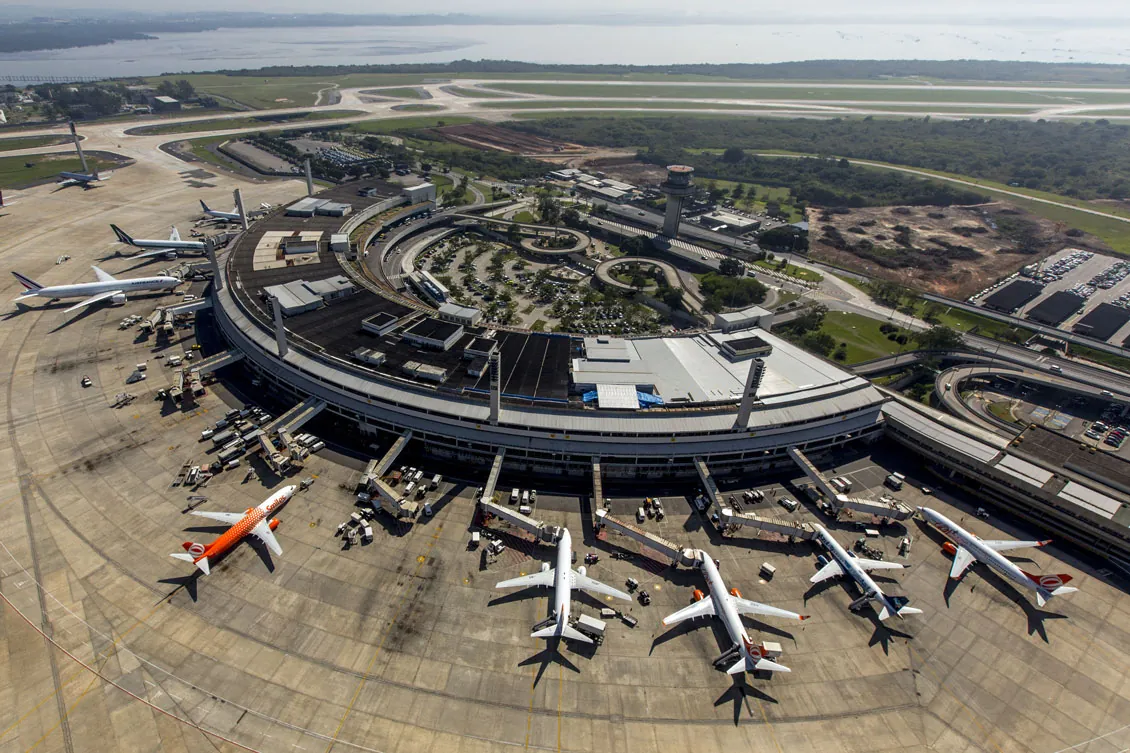
Galeão terminal and apron, with Guanabara Bay beyond. Photo by Daniel Basil, Portal Brasil 2016, CC BY 3.0 BR, via Wikimedia Commons.
Two runways, one working terminal, and 1,788 hectares on the bay
Galeão opened its first passenger terminal in February 1952 and took the name Antonio Carlos Jobim in 1999, a tribute to the composer who put the airport into Samba do Avião. Terminal 1 opened in January 1977, Terminal 2 in July 1999, and the site on Ilha do Governador is the largest airport property in Brazil at 1,788 hectares. It is 20 kilometres north of Centro, across the water from the city it serves.
Only one terminal is in passenger use. Check in and baggage claim at Terminal 1 closed in November 2016, and every passenger now enters and leaves through Terminal 2, including passengers whose gates sit in the older building. The arrangement is efficient but it is not obvious to a first time visitor, so the practical instruction is simple: go to Terminal 2 and ignore any older signage that points elsewhere.
Traffic reached 17,906,990 passengers in 2025, up 24 percent on the year before, with 129,363 aircraft movements, up 18 percent. The airport is expected to close 2026 near 19 million passengers against a designed capacity of 37 million. That gap is the whole commercial story of the next decade: the concrete is already there, and the task is to fill it.
Gol uses Galeão as a hub and LATAM treats it as a focus city, so the domestic network is broad for a airport that sits outside the city centre. The long haul side is thinner than Guarulhos but broader than most Brazilian airports outside São Paulo, with daily service to Dubai and nonstop flights to seven European cities.
Terminal 1 is not open. Aena has said it will study reopening the building only if demand from new flights justifies it. Until then, do not plan a meeting, a pickup or a check in at Terminal 1. Terminal 2 is the only passenger entrance.
Runway and field data
Runway 10/28 carries the long haul departures. The field sits 9 metres above sea level, operates around the clock, and holds rescue and fire fighting category 10.
- IATA and ICAO codeGIG / SBGL
- Passenger terminalTerminal 2 only
- Terminal 1 check inClosed since 2016
- Site area1,788 hectares
- Elevation9 m
- Operational hours24 hours
- Fire fighting categoryCAT 10
Aena took over on 6 October 2026, with a contract to 2039
The Spanish operator Aena won the re concession auction in March 2026 with a bid of R$2.9 billion and took over the terminal on 6 October 2026, replacing the RIOgaleão consortium that had run it since 2014. Aena already operates 18 Brazilian airports and more than 63 million passengers a year across them, so Galeão joins a network rather than standing alone.
The immediate plan is connectivity rather than construction. Aena announced more than 50 additional weekly frequencies to nine international destinations by January 2027: Paris, Miami, Frankfurt, Lisbon, Porto, Santiago, Córdoba, Atlanta and Panama. It also named nine cities for new or resumed service in the same window: New York, Dallas, Toronto, Montreal, Asunción, Salta, Mendoza, Rosario and Lima.
On the ground, about R$1 billion of partner investment is planned over three years. The list includes an Accor hotel of at least 232 rooms in the building between the two terminals, a vehicle testing centre for BYD, a maintenance hangar for Gol, and logistics and cargo facilities. The cargo area is set to double from 20,000 to 40,000 square metres under a R$54 million project.
Terminal 1 stays closed for now. Aena has been explicit that reopening it depends on demand, and that the first priority is to use the capacity already available in Terminal 2.
Concession detail: the Ministry of Ports and Airports briefing of 13 October 2026 and the airport operator.
Daily to Dubai, nonstop to seven European cities, and a domestic hub for Gol
Galeão's long haul map is built around Europe and the Gulf, with the Americas close behind. The single most useful fact for a traveller heading to Asia is that Emirates flies nonstop to Dubai every day, which makes Dubai the cleanest one stop between Rio and Manila. There is no nonstop from Rio to any Philippine airport.
Europe
Gulf and Asia
Americas
Brazil
Do not sell Doha or Istanbul as a one stop from Rio. Qatar Airways and Turkish Airlines do not serve Galeão nonstop. A routing through either hub needs a domestic or regional first leg, usually through São Paulo, which makes it a two stop journey. Emirates through Dubai and Air France through Paris are the two genuine one stop options.
Airline detail: Emirates, Air France, Gol and LATAM Brasil.
Twenty kilometres from Centro, and still no train
Galeão sits on an island in Guanabara Bay, connected to the city by two road corridors. The distance to Centro is about 20 kilometres, to Copacabana and Ipanema about 25 to 30, and to Barra da Tijuca about 35. Traffic decides the journey time far more than distance does, so a 30 minute ride at 6 AM can become 75 minutes at 6 PM.
| Mode | Fare | Journey time | Where to catch it |
|---|---|---|---|
| BRT Expresso Gentileza | R$15 | 50 to 60 minutes | Terminal 2 to Terminal Gentileza, beside the Novo Rio bus station |
| Bus 1760D to Charitas | R$18 | 60 to 80 minutes | Terminal 1, operated by Auto Viação 1001 |
| Coach to Búzios or Macaé | Operator fare | 2 to 3 hours | Terminal 2, same operator |
| Taxi or app car | R$100 to R$160 | 30 to 50 minutes | Arrivals curb, both terminals |
| Car rental | From R$110 a day | Collect on site | Five agencies in the airport complex |
Allow 90 minutes in peak traffic. The BRT is the cheapest reliable option and it connects to the long distance bus station, but it is not a rail service and it does not reach the beach districts directly. For Copacabana, Ipanema or Leblon, a taxi or app car is the sane choice with luggage.
Ground transport detail: the airport passenger page and Mobi Rio.
Rio to Manila: 18,120 kilometres, one stop, about 26 to 30 hours
There is no nonstop between Brazil and the Philippines, and none is on the horizon. The good news is that Galeão has a genuine one stop option in each direction of the world: Emirates through Dubai, or Air France through Paris, where the second leg is a nonstop to Manila. Both keep the journey under about 30 hours including the connection.
Emirates, daily
Galeão to Dubai in about 14 hours on a Boeing 777, then Dubai to Manila in about 8 hours 15 minutes. One stop, one ticket, and the shortest total journey of the practical options. The first leg is 11,884 kilometres.
Air France, three weekly
Galeão to Paris Charles de Gaulle in about 11 hours, then the nonstop Paris to Manila service in about 13 hours 21 minutes. The second leg runs three times a week, so the connection day matters when you book.
Via São Paulo and a Gulf hub
Fly or connect through São Paulo Guarulhos, then Doha on Qatar Airways or Istanbul on Turkish Airlines, then Manila. More choice and sometimes a lower fare, but two connections, two bag transfers and more exposure to a delay.
Before you fly
- Fifty nine days visa free. Brazilian passport holders enter the Philippines without a visa for 59 days under a bilateral agreement. The passport needs six months of validity beyond the stay and an onward or return ticket.
- eTravel within 72 hours. Register free at etravel.gov.ph and keep the QR code offline. Airlines ask for it at the gate.
- Manila has four terminals. International arrivals use Terminal 1 or Terminal 3 depending on the carrier, and domestic departures use Terminal 2 or Terminal 4. Allow three hours between an international arrival and a domestic flight.
- The clock moves 11 hours. Manila runs 11 hours ahead of Rio. A Wednesday night departure lands in Manila on Friday morning, so the first day should stay light.
- One ticket is safer. If the long haul and the domestic connection are separate tickets, you carry the risk of a missed bag transfer and a missed flight.
- Extend at the Bureau of Immigration. A 59 day stay can be extended in Manila before it expires. Do not wait for the last week.
Why the visa agreement matters
Most visa free nationals receive 30 days in the Philippines. Brazil is one of the few countries with a bilateral agreement that doubles that to 59 days, which is the difference between a beach week and a proper multi island trip. It also makes the Philippines competitive with Southeast Asian neighbours that require an e visa or a visa on arrival for Brazilian passports.
For a business visitor, 59 days is enough to inspect a supplier, visit an economic zone, open a bank account and meet the investment promotion agencies without racing a 30 day clock.
Official references: eTravel registration, Philippine visa policy and the Bureau of Immigration.
Fifty nine days is enough for three island groups
The Philippines recorded 6.48 million inbound arrivals in 2025, including 543,085 returning overseas Filipinos, and about ₱694 billion in visitor spending. Brazilian arrivals are still a small share of that total, which is exactly why the visa agreement is worth knowing about: it is long enough to justify the flight and to see more than one region.
When to come: December to May is dry and hot, June to November is wetter, and typhoon attention matters most from July to October. Domestic airlines cancel early rather than late, so build a buffer day before an international return.
Travel context: shipping from the Philippines to Brazil and the Philippine investment case.
A 20 percent corporate rate and full foreign equity in most sectors
The Philippines has rewritten the rules that used to keep foreign capital out of domestic businesses. The CREATE MORE Act, Republic Act 12066, cut the corporate income tax to 20 percent and widened deductions. The Public Service Act amendments under Republic Act 11659 opened most non utility sectors to full foreign ownership, and the amended Foreign Investments Act lowered the capital threshold for smaller investors.
Corporate income taxThe CREATE MORE Act set the rate at 20 percent for domestic and foreign corporations and added enhanced deductions for power, training and infrastructure.
Foreign equity in most sectorsRepublic Act 11659 removed the 40 percent ceiling in most non utility industries, including many that were previously reserved for Philippine nationals.
Years of income tax holidayRegistered projects can qualify for an income tax holiday, followed by enhanced deductions or a special rate depending on the incentive package.
Minimum paid in capitalThe general threshold for a domestic market enterprise, halved to US$100,000 where the venture brings advanced technology or hires at least 50 Filipinos directly.
VAT on local purchasesRegistered export enterprises can qualify for VAT zero rating on local purchases and VAT exemption on imports of capital equipment and raw materials.
Investment promotion agenciesPEZA, the Board of Investments, SBMA and CDC each administer their own ecozones and incentive packages, with different locational and export conditions.
Why a Rio company looks east
Rio de Janeiro state is not a garment province. It is an oil and gas province with a shipbuilding and offshore services cluster around Guanabara Bay and Açu, a steel base at Volta Redonda, a pharmaceutical and health research base around Fiocruz, and a creative and audiovisual economy that punches above its size. Each of those sectors buys technical apparel and each of them is used to dealing with suppliers in another time zone.
The Philippines offers something Brazil cannot easily replicate for the ASEAN market: English language contracts and audits, a young workforce, and a position inside ASEAN with RCEP access. For a Brazilian company already exporting to Asia, a Philippine production or sourcing base is a second leg on a route it already flies.
Where to start
The practical first step is not a factory. It is a sourcing contract: test a Philippine workshop on your own specification, measure the defect rate, the lead time and the landed cost, then decide whether a joint venture, a locator agreement or a wholly owned entity makes sense.
Visas follow the investment. The Special Investor's Resident Visa and the Special Visa for Employment Generation both allow a foreign investor to live in the Philippines while the business is built. The Bangko Sentral registration of inward capital is the step that protects repatriation later, and it is routinely missed by first time investors.
Reference material: investing in the Philippines, the SIRV visa and the SVEG visa.
Workwear for offshore, marine, hospitality and aviation programmes
RB Advertising has manufactured technical apparel in the Philippines since the 1990s, with production in Tagum City and Cagayan de Oro and customers across North America, Europe and Australia. A Rio buyer usually arrives with one of three needs: garments that survive an offshore rotation, high visibility for a yard or port crew, or a branded uniform for a hotel, an airline or a retail network.
Offshore and marine coveralls
Coveralls, work trousers and jackets built for industrial laundering, salt air and the colour coding that an offshore safety programme expects. Fabric weight, closure type and seam construction are specified per site, and flame resistant programmes are quoted to the applicable standard rather than described loosely.
High visibility vests and jackets
Vests, polos, jackets and cargo trousers for ports, yards, cold stores and forklift crews. Retroreflective tape grade is quoted separately so the comparison is honest, and the same programme can carry a company mark in embroidery or heat transfer.
Hospitality and aviation uniforms
Polos, button downs, aprons, housekeeping sets and front desk uniforms for hotels, restaurants and ground handling teams. Size sets, colour matching and carton labelling are quoted as part of the programme rather than as extras.
Air or sea into Rio
- Air freight, 6 to 9 days. Manila to Rio with one stop, usually through Dubai or Paris. Best for samples, a first order and anything with a launch date attached.
- Sea freight, 30 to 45 days. Manila or Davao to Rio, Itaguaí or Santos, then road to the state interior. Best for production volume, and the lane is already busy in the other direction with Brazilian exports.
- Duty and classification. Brazil has no free trade agreement with the Philippines, so apparel enters under MFN rates, with many Chapter 61 and 62 lines at 35 percent, plus state ICMS and federal contributions. Ask a Brazilian customs broker to model the landed cost before the order is placed.
Why Galeão matters to a shipper
Galeão moves people more than freight. Dedicated freighters use Guarulhos and Viracopos, and Galeão's cargo terminal handles belly hold and express volume, with a planned expansion from 20,000 to 40,000 square metres. For a Rio importer, that means samples can arrive at GIG while production volume lands at the port.
The minimum order is 20 units per style, which suits a single hotel, a single offshore platform or a pilot before a national rollout. We quote in four currencies so the comparison with a local supplier is immediate.
Sourcing detail: manufacturing workwear, uniform programmes, sourcing from the Philippines, sea transport services and air transport services.
Brazil sells US$2.3 billion to the Philippines, and the return lane is wide open
Merchandise exports from Brazil to the Philippines reached about US$2.34 billion in 2025 on UN Comtrade data, built on poultry, pork, beef, sugar, soy and iron and steel. Philippine exports to Brazil were about US$219 million in the same year, led by electronics, coconut products, machinery and garments. Each side reports its own flow, so the two numbers are not one reconciled total, but the shape of the lane is clear.
The sea gateways
Rio de Janeiro state is served by the Port of Rio de Janeiro at Guanabara Bay, the deep water terminal at Itaguaí, and the steel and bulk terminals around Sepetiba Bay. Santos, in neighbouring São Paulo state, carries the largest container volume in Latin America and remains the default for a first shipment. Navegantes and Paranaguá cover the south.
For an importer in the state capital, Itaguaí is usually the closest container option and Santos is usually the cheapest. A customs broker will compare the two with the inland leg included, which is the only comparison that matters.
The air gateways
Galeão handles belly cargo on passenger flights, with daily Emirates capacity to Dubai and European carriers to Lisbon, Paris, Amsterdam, Frankfurt, Madrid, Rome and London. Dedicated freighters and the largest express integrators use Guarulhos and Viracopos, both in São Paulo state.
For samples and replenishment, the practical routing is Manila to Dubai to Rio, or Manila to Paris to Rio. For a pallet scale shipment, compare the all in cost against a sea freight quote before assuming air is faster overall.
Trade reference: the Brazil import page, the Brazilian real against the Philippine peso and sourcing from the Philippines.
What travellers and buyers ask about Galeão
What is the airport code for Rio de Janeiro Galeão?
The IATA code is GIG and the ICAO code is SBGL. The airport is named Antonio Carlos Jobim, sits on Ilha do Governador about 20 kilometres north of Centro, and covers 1,788 hectares.
How far is Galeão from Copacabana and Ipanema?
About 25 to 30 kilometres, or 30 to 50 minutes by taxi or app car outside peak traffic. Allow 75 to 90 minutes in the evening rush. There is no rail link, and the BRT connects to the long distance bus station rather than the beaches.
Is there a direct flight from Rio to Manila?
No. The cleanest one stop is Emirates through Dubai, about 14 hours to Dubai and 8 hours 15 minutes to Manila. Air France through Paris is the second one stop, with the Paris to Manila nonstop running three times a week. Total journey time is about 26 to 30 hours.
Do Brazilians need a visa for the Philippines?
No, for stays up to 59 days. Brazilian passport holders enter visa free under a bilateral agreement, with a passport valid six months beyond the stay and an onward or return ticket. The stay can be extended at the Bureau of Immigration.
Which terminal does Galeão use?
Terminal 2. Check in and baggage claim at Terminal 1 closed in November 2016, and every passenger now enters and leaves through Terminal 2, including passengers whose gates are in the older building. Terminal 1 will only reopen if traffic justifies it.
Can apparel be shipped from the Philippines to Rio?
Yes. Air freight reaches Rio in 6 to 9 days with one stop, and sea freight to Rio, Itaguaí or Santos takes 30 to 45 days. Brazil has no free trade agreement with the Philippines, so a customs broker should model the MFN duty, state ICMS and federal contributions before the order is confirmed.
Planning a trip or a production run from Rio?
Send your travel dates, flight routing or apparel specification and our team in Tagum City will reply. Business hours: Mon to Sat, 8:30 AM to 5:00 PM (PHT).
Airport layout, runway data, terminal status and traffic figures come from the Brazilian National Civil Aviation Agency, the Department of Airspace Control, the airport operator RIOgaleão and the Aena operational capacity statement for the 2026 season. Concession, investment and route announcements come from the Ministry of Ports and Airports briefing of 13 October 2026, Aena and Valor International. Airline destinations and frequencies come from the carriers and from OAG schedule data. Trade figures are merchandise flows reported by each country to UN Comtrade for 2025. Philippine tax and investment detail is from the CREATE MORE Act, Republic Act 12066, the Public Service Act amendments under Republic Act 11659 and the amended Foreign Investments Act. Tourism figures are from the Philippine Department of Tourism, and the visa position is from the Philippine Department of Foreign Affairs. Schedules, fares, visa rules and concession plans change, so confirm with your airline, the airport operator and the Philippine consulate before you commit.