
GRU / SBGR Guarulhos, Greater São Paulo, Brazil
Guarulhos Governador André Franco Montoro International Airport and the Philippines: Travel, Investment and Manufacturing
São Paulo's international gateway sits 25 km north east of the city centre, carried 47.19 million passengers in 2025, and handles 57 percent of Brazil's international air cargo. This page sets out the two close set runways, the three terminals and their gate ranges, the free people mover that now reaches all of them, the one stop crossings to Manila, the 59 days a Brazilian passport receives without a visa, and the production case for Brazilian brands.
Airport docket
- Passengers, 2025
- 47,188,223
- International
- 16,809,000
- Air cargo, 2025
- 342,300 t
- Runways
- 2, 375 m apart
- Distance to Manila
- 18,369 km
No scheduled nonstop between São Paulo and any Philippine airport. Every itinerary connects at least once.
Two parallel runways 375 metres apart, and a ceiling of 60 movements an hour
Guarulhos opened on 20 January 1985 on 1,400 hectares at Cumbica, and it has been the country's front door ever since. The layout is the constraint: the two strips are so close that they cannot run fully independent approaches, so the field clears about 60 movements an hour in good weather and fewer when the approach is degraded. That single number explains the terminal works, the new pier and the pressure that moved some domestic flying to Viracopos and Congonhas.
- Operator
- Concessionária do Aeroporto Internacional de Guarulhos S.A., trading as GRU Airport, a consortium of Invepar and ACSA
- Concession
- Began in 2012, extended to November 2033 under the eleventh contract amendment
- Location
- Guarulhos, Greater São Paulo, about 25 km north east of the city centre
- Site and elevation
- 1,400 hectares, 750 m above sea level
- Runways
- 09R/27L at 3,000 m, used mainly for landings. 09L/27R at 3,700 m, used mainly for takeoffs and widened in 2015 for the A380
- Approach
- Category II ILS on the 09 thresholds, Category I on the 27 thresholds
- Traffic, 2025
- 47,188,223 passengers, of them 16,809,000 international, and 342,300 tonnes of cargo at TECA
- Capacity
- About 50 million passengers a year today, targeted at 70 million by 2029
- Investment
- R$2.5 billion from the concessionaire to 2029, plus about R$1.8 billion of private investment mobilised by the Investe+ Airports programme, more than 25 interventions in total
Runway lengths and the 375 m separation are drawn to scale along the strips. The upper strip carries landings and the lower strip carries takeoffs. Runway width is exaggerated so it stays visible at phone size.
Three terminals, four colours, and gate numbers that tell you where you are
GRU Airport colours each building so a passenger can read the airport at a glance: Terminal 1 is blue, Terminal 2 is orange, Terminal 3 is magenta, and the cargo terminal is green. Gate numbers follow the same logic, so a gate beginning with 1 is in Terminal 1, a gate beginning with 2 is in Terminal 2, and a gate beginning with 3 is in Terminal 3. Terminals 2 and 3 are joined by a walkway. Terminal 1 is not, which is why the people mover below matters.
Azul domestic, and nothing else
Terminal 1 handles Azul's domestic network only, with check in row A and no international operation. It is the smallest and simplest of the three buildings, and it sits apart from the other two.
- 101 to 109
- Check in A
The domestic workhorse, with the South American neighbours
Terminal 2 carries GOL's domestic hub, LATAM's domestic flying and VOEPASS, plus most of the regional international services. Aerolíneas Argentinas, Air Europa, Arajet, Avianca, Boliviana de Aviación, Ethiopian, Flybondi, JetSMART, Royal Air Maroc, SKY Airline and TAAG are listed here.
- 201 to 229, west
- 250 to 268, east
- Check in B to E
The long haul building, opened for the 2014 World Cup
Terminal 3 is international only, with check in rows F, G and H. LATAM's long haul flying, the Star Alliance carriers, the oneworld carriers, Emirates, Qatar Airways, Turkish Airlines, KLM, Air France, Lufthansa, SWISS, TAP, Iberia, ITA Airways, United, Delta, American, Air Canada, Air China and British Airways are listed here. Every Manila connection on this page departs from this building.
- 301 to 332
- Check in F to H
Terminal assignments are set daily and move with capacity works, so confirm the building on the boarding pass or the airline app. The gate ranges above come from the airport operator's own terminal page.
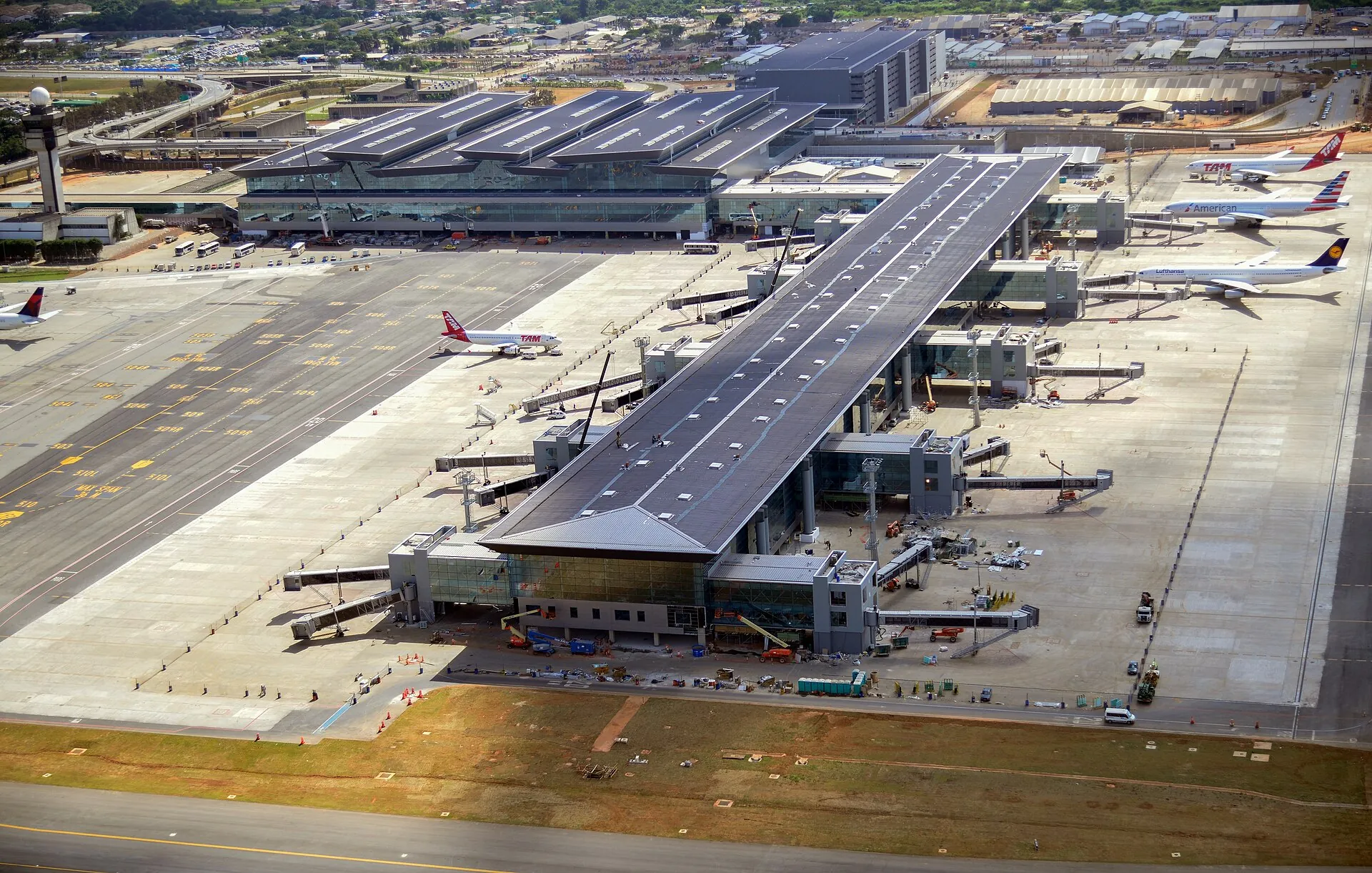
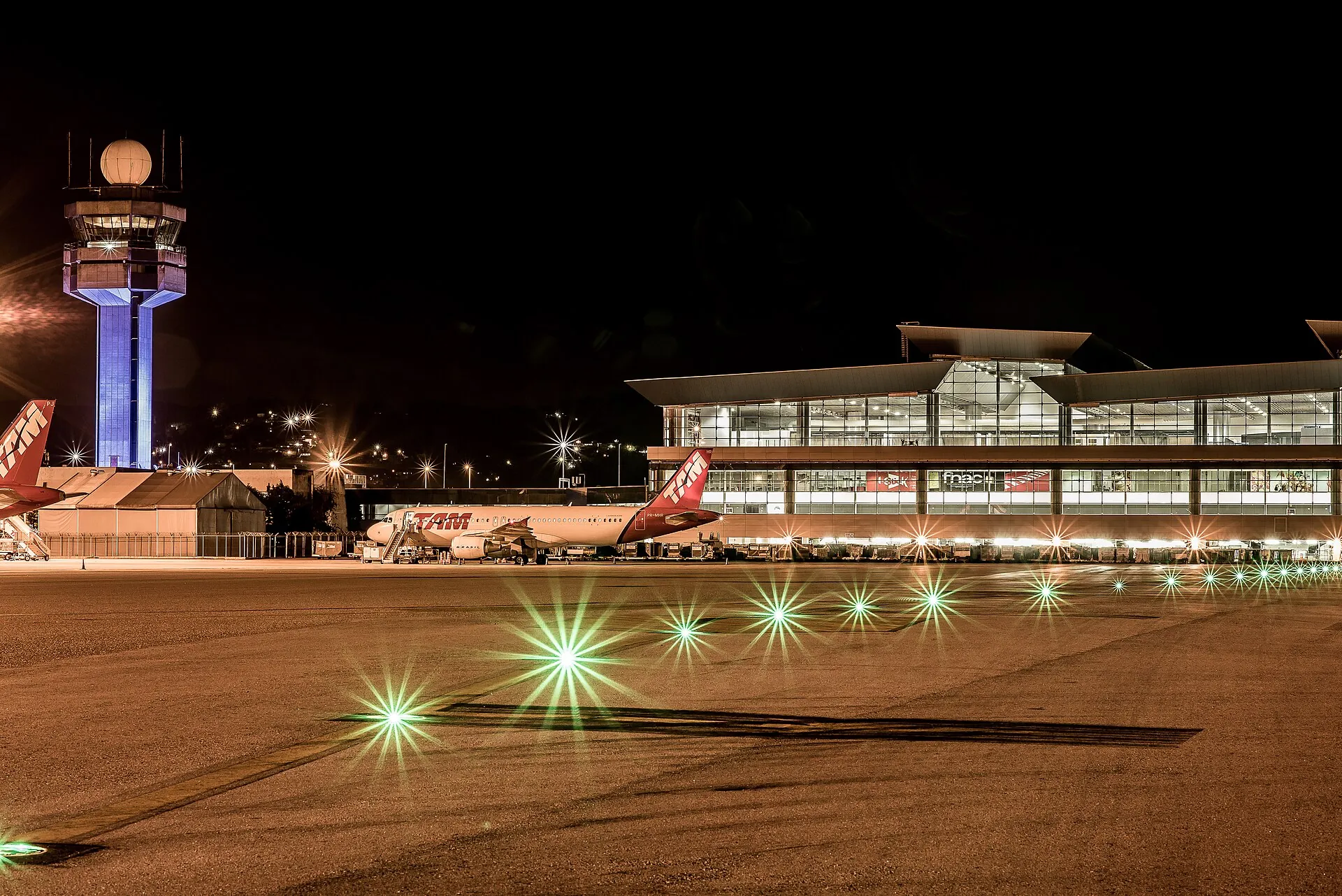
The apron at Guarulhos after dark. The tower and the Terminal 2 frontage sit behind a LATAM Brasil widebody. Photograph by Caiomelow, CC BY-SA 4.0, via Wikimedia Commons.
A free people mover, a R$5.40 train, and three road options into a city of 22 million
For twenty years the rail line stopped short of the terminals, and the last two kilometres were a bus. That gap closed in 2026. The AeroGRU people mover now runs from the CPTM station to all three terminals, free, on the same hours as the trains, which makes Guarulhos one of the few major South American airports with a rail connection that actually reaches the gate.
- CPTM stationLine 13 Jade, Aeroporto Guarulhos
- Terminal 1Azul domestic
- Terminal 2GOL and the regionals
- Terminal 3International long haul
People mover and train
The AeroGRU system opened on 20 February 2026: 2.7 km of elevated track, four stations, two trains in service of 200 passengers each, and about 2,000 passengers an hour. It is free, certified to SIL4, and runs from 04:00 to midnight since 27 September 2026.
Free with a train ticketCPTM Line 13 Jade
Trains run from the airport station to Engenheiro Goulart, where Line 12 Safira continues to Tatuapé, Brás and Luz. The Airport Express leaves Barra Funda once an hour and takes about 40 minutes to the airport station.
R$5.40 a journeyBus, taxi and app cars
The airport bus reaches Avenida Paulista, Congonhas and Tietê bus terminal in 60 to 90 minutes for R$40 to R$47. A taxi is R$130 to R$200 and an app car R$80 to R$140, both at the mercy of the Marginal Tietê in the morning peak.
25 km to the centreThe people mover is still in assisted operation, so the bus fleet keeps running in parallel. If a train is cancelled late at night, the free terminal shuttle still covers the three buildings.
There is no nonstop, so the hub you pick is the trip
Guarulhos and Manila sit 18,369 km apart, and the great circle runs south of Africa and across the Indian Ocean. No airline flies it nonstop, and the range of a loaded widebody out of a 750 m high field makes a nonstop unlikely. Every itinerary changes once, and the choice of hub decides whether the journey takes 26 hours or 31.
| Hub | Carriers | Typical total | Why choose it |
|---|---|---|---|
| Doha | Qatar AirwaysDaily from Guarulhos, three daily Doha to Manila | 27 to 30 h | Best frequency into Manila, and the longest single leg, so the connection is short. |
| Dubai | EmiratesDaily from Guarulhos, A380 on the Dubai to Manila leg | 27 to 31 h | The most comfortable second leg, with the A380 cabin and a late evening arrival. |
| Istanbul | Turkish AirlinesDaily on both legs | 26 to 29 h | Usually the shortest elapsed time, and a strong food and lounge product. |
| Amsterdam | KLMDaily on both legs | 26 to 29 h | A European stopover on the way, and the shortest of the European options. |
| New York | LATAM, American or Delta, then Philippine AirlinesSeveral daily on the first leg, nonstop on the second | 27 to 30 h | The only routing where the second leg is a nonstop into Manila, and the easiest for a US visa holder. |
Manila is 11 hours ahead of Brasília, so a late evening departure from Guarulhos lands in Manila in the evening two days later. Add a buffer day before any domestic connection, because a single missed long haul costs a full day.
Air cargo follows the same hubs. TECA handles 21 freighter operators alongside belly capacity on the passenger services, and a Guarulhos to Manila air booking usually runs 3 to 5 days door to door through Doha, Dubai, Istanbul or Amsterdam. See air transport services for the booking side.
Fifty nine days without a visa, and a dry window that runs from December to May
Brazil holds a tier almost nobody else gets. Under the Philippine visa exemption list, Brazilian passports receive 59 days on arrival, the same figure granted to Israel and 29 days longer than the 30 days most European and American passports receive. That is enough for Manila, Palawan, the Visayas and a dive trip without filing anything at an embassy.
Passport valid six months beyond the stay, a return or onward ticket, and eTravel completed inside 72 hours of arrival. The Department of Foreign Affairs does not publish an extension rule for this tier, so treat 59 days as the planning limit and confirm with the Bureau of Immigration before booking a longer stay.
Carry a yellow fever certificate. Brazil is a yellow fever risk country, and the Philippines asks for proof of vaccination from travellers arriving from a risk area.
The year, month by month
Brazilian school holidays fall in December to February and in July. The first window is the best of the year. The July window lands in the middle of the wet season, so plan it around diving in Palawan and Cebu rather than a beach week in Siargao.
Where to go on a first trip
- Palawan. El Nido for the limestone lagoons, Coron for wreck diving, and Tubbataha for liveaboard diving from March to June.
- Cebu and Bohol. Moalboal for the sardine run, Malapascua for thresher sharks, and the Chocolate Hills and tarsier sanctuaries on Bohol.
- Siargao. Surf from August to November, and a laid back base the rest of the year.
- Manila and the north. Intramuros, then the rice terraces at Banaue and the cobblestone streets of Vigan.
Domestic connections leave from Manila Terminal 2 and Terminal 3 with Philippine Airlines, Cebu Pacific and AirAsia Philippines, and ferries link the Visayan islands. A two week trip usually covers two island groups, not four. See the tourist visa page for the full entry list.
A 20 percent corporate rate, and full foreign equity in export manufacturing
The Philippines is not the first market a São Paulo investor thinks of, which is exactly why the terms are worth reading. The country sits inside ASEAN, sells to 114 million people, works in English, and has written a tax regime that is more generous to an export manufacturer than anything in Mercosur.
- Corporate income tax at 20 percentUnder Republic Act 12066, the CREATE MORE Act, a registered enterprise pays 20 percent on taxable income rather than the previous 25 percent.
- An income tax holiday of four to seven yearsFour years for most registered projects, six for those in an industry identified as strategic, and seven where the project locates outside the National Capital Region or suffers infrastructure gaps.
- A 5 percent special rate afterwardsExport enterprises can take 5 percent on gross income in place of national taxes after the holiday, with VAT zero rating on local purchases and duty exemption on capital equipment.
- Full foreign equity in export manufacturingExport activity is open to 100 percent foreign ownership, with a minimum paid in capital of 200,000 dollars, halved to 100,000 dollars with advanced technology or 50 or more direct employees.
- Registration and residenceThe Board of Investments or PEZA registers the project, and the SIRV and SVEG visas cover resident status for the investor and family.
Why a Brazilian firm looks here
- ASEAN access. Rules of origin under the ASEAN Trade in Goods Agreement let a Philippine factory serve a regional market, not just the domestic one.
- English at every level. Technical specifications, quality reports and factory audits run in English, which removes a translation layer from a Brazilian buying office.
- Apparel depth. The country has cut and sew capacity in Manila, Cebu, Clark and the PEZA zones, with a long record in swimwear, activewear and uniforms.
- Time zone. Manila is 11 hours ahead of Brasília, so a Philippine factory closes as Brazil opens, and a question asked in the morning is answered before the end of the day.
- A single market entry point. The Board of Investments approved ₱1.56 trillion of projects in 2025, and 422 PEZA zones are already operating.
Brazilian direct investment in the Philippines is still small. That is an opening, not a warning: the buyers who set up first in a thin market tend to keep the shelf space.
Jiu jitsu is Brazilian, and the rash guard can be Philippine
Brazil gave the world jiu jitsu, and jiu jitsu gave the world a wardrobe: rash guards, spats, board shorts, no gi sets and kimonos. Those are cut and sew products with short runs, frequent design changes and a heavy dependence on print quality, which is exactly the work a Philippine factory does well. The same floor makes uniform programmes for Brazilian companies and hospitality groups.
| Category | Minimum | Production | Decoration |
|---|---|---|---|
| Rash guards and spats | 50 per design | 3 to 6 weeks | Sublimation, flatlock seams |
| Gis and no gi sets | 50 per design | 4 to 7 weeks | Embroidery, woven patches |
| Board shorts and swim | 50 per design | 3 to 6 weeks | Sublimation, heat transfer |
| Uniform shirts and workwear | 20 per design | 3 to 5 weeks | Embroidery, screen print |
- A paid sample first, with the exact fabric, the exact print and the Brazilian size run, so grading is settled before bulk.
- Pantone matching within Delta E 2.0 on sublimation, with a strike off approved before the run.
- Fabric test reports from a DOLE accredited laboratory on request, plus a pre shipment inspection and a photo report before the carton is sealed.
- Official invoicing and serialised cartons for a multi site delivery, which matters for a franchise or a retail rollout.
Per uniform shirt at the entry specification, ex works. The header currency switcher converts live and settles the cart in the selected currency, so the three converted figures are indicative rather than a fixed quote.
A Brazilian brand usually starts with one category, one size run and one print. From there the factory can hold a size curve, replenish a best seller in three weeks, and add a second category without a new supplier.
Manufacturing workwear covers the uniform programme, the manufacturing FAQ answers the commercial questions, and uniforms shows the finished range.
The lane runs one way, and the return leg is the opening
Brazil sells the Philippines about 2.2 billion dollars a year, mostly food and fuel. The Philippines sells Brazil about 327 million dollars, mostly electronics, printers and measuring instruments. A one way lane is a standing invitation, and apparel is the category a Philippine supplier can enter fastest.
What TECA handles
The cargo terminal covers more than 200,000 square metres of storage, 33,000 cubic metres of cold chambers and 440 positions for refrigerated containers. It runs 24 hours a day with 21 freighter operators alongside the belly hold on passenger flights.
342,300 tonnes in 2025, up 1.3 percent on 2024 and a record for the terminal. That is 57 percent of all Brazilian international air cargo: 55 percent of imports and 59 percent of exports.
What moves each way
- Brazil to the Philippines. Poultry meat, frozen beef, ethanol and alcohol, sugar, soy products, coffee and tobacco. Poultry alone was about 261 million dollars in 2025.
- Philippines to Brazil. Industrial printers, video displays, revolution counters, integrated circuits, coconut products, tuna and a small but growing apparel line.
The duty stack into Brazil
There is no free trade agreement between the Philippines and Mercosur, so a Philippine garment pays the common external tariff and the cascade behind it. The headline rate is not the landed cost.
Common external tariff on most apparel lines in HS 61 and 62.
Federal social contributions on import, 2.1 percent plus 9.65 percent.
São Paulo state rate, charged on the customs value plus duty and freight.
Merchant marine levy on ocean freight, so air avoids it and sea does not.
IPI applies to some lines on top of this, and the ICMS base includes the duty, so the layers compound rather than add. Air freight avoids the AFRMM but costs more per kilo, which is why a first order often flies and the repeat order sails. Santos and Paranaguá to Manila run 30 to 45 days port to port.
This is not advice on a specific entry. Classification, the state rate and any ex tariff treatment are decided at the port, so take a written landed cost from a licensed Brazilian broker before you price a shelf.
For the sea side, see sea transport services, and for the whole country lane see import from the Philippines to Brazil.
What travellers and buyers ask about Guarulhos
01Is there a nonstop flight from Guarulhos to Manila?
No. No airline operates a scheduled nonstop between São Paulo and any Philippine airport. Every itinerary connects at least once, through Doha, Dubai, Istanbul, Amsterdam or New York. The great circle distance is 18,369 km, and the route runs south of Africa and across the Indian Ocean rather than over Europe.
02How long does the trip take from São Paulo?
Plan on 26 to 31 hours of elapsed time, including the connection. Istanbul and Amsterdam are usually the shortest at about 26 to 29 hours, Doha and Dubai run 27 to 31, and New York sits in the same band. Manila is 11 hours ahead of Brasília, so an evening departure lands in Manila in the evening two days later. Add a buffer day before a domestic connection.
03Do Brazilian citizens need a visa for the Philippines?
No, for a stay of up to 59 days. Brazil and Israel are the only two nationalities on the 59 day tier of the Philippine visa exemption list, which is 29 days longer than the 30 days most European and American passports receive. Carry a passport valid six months beyond the stay, a return or onward ticket, and an eTravel registration completed inside 72 hours. Carry a yellow fever certificate as well, because Brazil is a risk country and the Philippines asks for proof from arrivals from a risk area.
04Which terminal at Guarulhos do I use?
Terminal 3 for every Manila connection, because it is the international long haul building with check in rows F, G and H and gates 301 to 332. Terminal 1 is Azul domestic only, gates 101 to 109. Terminal 2 is the domestic and regional workhorse, gates 201 to 229 and 250 to 268, and it carries GOL, LATAM domestic, VOEPASS and most South American neighbours. Assignments move with capacity works, so confirm on the boarding pass.
05How do I get from Guarulhos into São Paulo?
Take the free AeroGRU people mover from any terminal to the CPTM station, then Line 13 Jade to Engenheiro Goulart and Line 12 Safira onward to Tatuapé, Brás and Luz. The fare is R$5.40 and the journey is 60 to 90 minutes depending on the connection. The Airport Express from Barra Funda leaves once an hour. The airport bus is R$40 to R$47, a taxi R$130 to R$200, and an app car R$80 to R$140, with 40 to 90 minutes on the road depending on the Marginal Tietê.
06How much cargo goes through Guarulhos to the Philippines?
TECA handled 342,300 tonnes in 2025, 167,000 in imports and 175,000 in exports, which is 57 percent of all Brazilian international air cargo. Twenty one freighter operators use the terminal alongside belly capacity on passenger flights. A Guarulhos to Manila air booking usually runs 3 to 5 days door to door through Doha, Dubai, Istanbul or Amsterdam, and a sea booking through Santos or Paranaguá runs 30 to 45 days port to port.
07Can a Philippine factory make jiu jitsu and swim gear for a Brazilian brand?
Yes. Rash guards, spats, board shorts, no gi sets and gis are standard cut and sew work, from 50 pieces per design, with sublimation, flatlock seams, embroidery and woven patches. A paid sample settles the fabric, the print and the Brazilian size run before bulk, production runs 3 to 7 weeks after approval, and the factory handles the labelling pack and a pre shipment inspection report. Uniform programmes start at 20 pieces per design.
08When is the best time to visit the Philippines from Brazil?
December to May. December to February is dry and cooler, March to May is hot and dry and the best beach and diving window, and June to November brings the southwest monsoon, with the highest typhoon risk from August to October. Brazilian school holidays in December to February land in the best window. The July holidays do not, so plan that trip around diving in Palawan and Cebu and expect rain elsewhere.
Flying in, or sourcing from São Paulo?
Send your travel dates, your routing question or your apparel specification and our team in Tagum City will reply. Business hours: Mon to Sat, 8:30 AM to 5:00 PM (PHT).
Passenger, cargo, airline and destination figures for 2025 come from the GRU Airport annual report and the operator's traffic releases. Runway dimensions, elevations and approach categories come from the Brazilian aeronautical publication and the airport operator. Terminal colours, gate ranges and check in rows come from the GRU Airport terminal page. The AeroGRU people mover detail comes from the operator, the CPTM Line 13 Jade timetable and the federal audit court record. Ground transport fares come from the operator and the São Paulo metropolitan rail company. Trade values come from the Observatory of Economic Complexity using Brazilian and Philippine customs data for 2025. Brazilian duty and contribution rates come from the Mercosur common external tariff, the federal revenue service and the São Paulo state finance secretariat. Investment terms come from Republic Act 12066 and the CREATE MORE implementing rules. Visa and entry rules come from the Department of Foreign Affairs visa policy page, the Bureau of Immigration and the Philippine yellow fever requirements. Photographs by Caiomelow, CC BY-SA 4.0, and by Portal da Copa, Government of Brazil, CC BY 3.0 br, both via Wikimedia Commons. Schedules, terminal assignments and tariff treatment change, so confirm with the airline, the airport operator, the customs broker and the Philippine Embassy before you commit.